Tunisian Brik
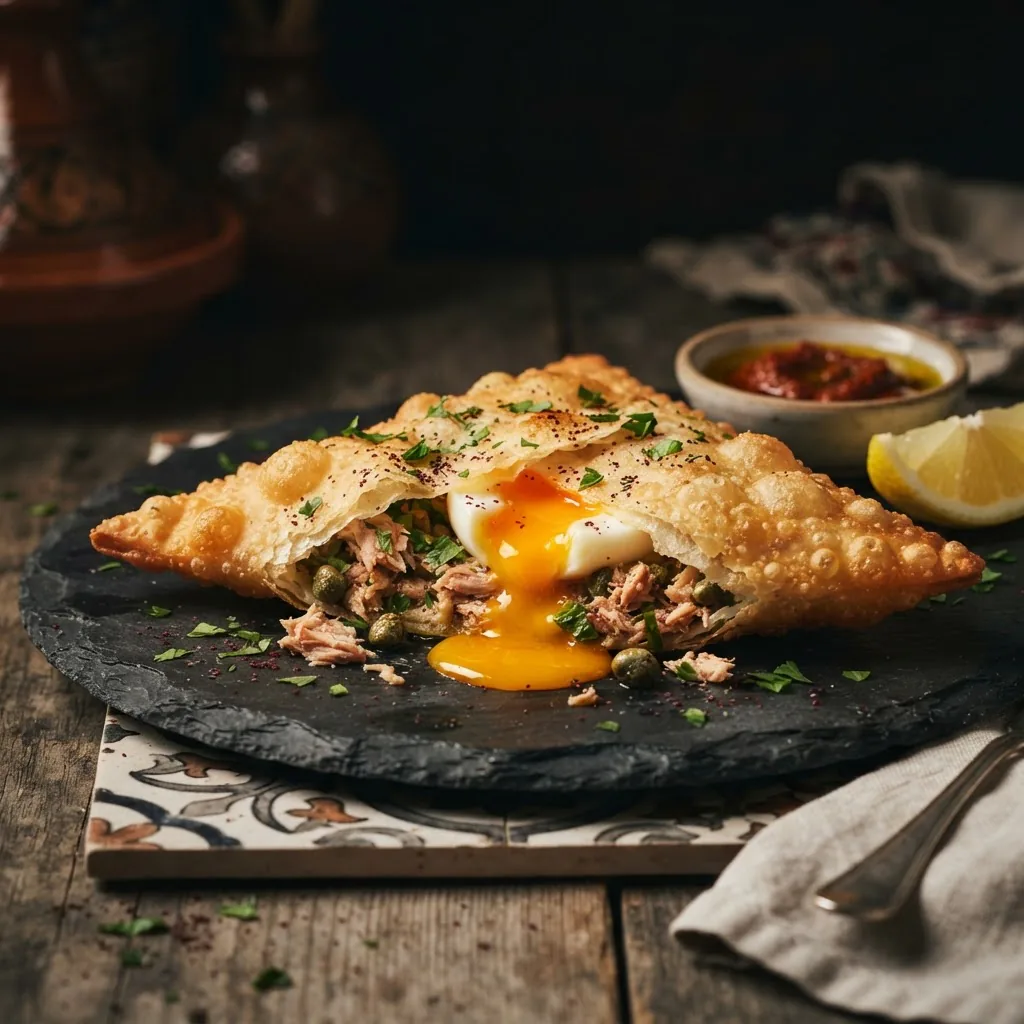
Quantities live in the recipe card.
The filling (per brik)
- a small one; the fold must not fire before the fry)
The pastry and fry
- sold frozen in Tunisian and Middle Eastern groceries; bridge below)
Doneness & Quality Checkpoints
- The fold: sealed, flat, the yolk nested with clearance.
- The fry: blistered gold in 60–90 seconds, spooned oil on the top face.
- The yolk: liquid at the bite — the lean is the proof.
Tunisian Brik
Prep: 30 minutes · Cook: 15 minutes · Total: About 50 minutes · Makes 6 briks
Ingredients
The filling (per brik)
- 2 tbsp mashed potato (about 40 g), seasoned with salt (about 1 g) and cumin
- 1 tbsp canned tuna in oil (about 15 g), flaked
- 1 tsp capers, rinsed; 1 tbsp chopped parsley (about 4 g)
- A pinch of harissa (#91 — a small one; the fold must not fire before the fry)
- 1 whole egg, the freshest you have, at room temperature
The pastry and fry
- 6 sheets malsouka (brik pastry, about 60 g — sold frozen in Tunisian and Middle Eastern groceries; bridge below)
- Neutral oil (about 500 ml), 2 cm deep, at 190 °C
- A squeeze of lemon (about 15 ml), more harissa (about 15 g) to serve
Instructions
- **Fill one at a time, fold immediately (90 seconds per brik).** Lay one sheet on a flat plate. On one half — the half you will fold over — make a shallow nest: the potato spread thin as a bed, the tuna, capers, parsley, and harissa over it, and the egg cracked into a small well pressed in the center. Fold the empty half over into a half-moon, pressing the edges sealed with fingertips — the pastry's own starch seals it, no water needed. Checkpoint — the yolk must sit in its nest with room around it: if the potato bed is thin at the edges, the egg runs to the fold and the seal fails in the oil. The sealed half-moon should feel like a flat envelope, air pressed out, edges crimped firm. Fill the next brik only when this one is in the oil — the assembly line is one brik deep.
- **Fry hot and brief (60–90 seconds).** Slide the brik into the 190 °C oil — away from you — and immediately tilt the pan, spooning hot oil over the top sheet so both faces blister at once. When the pastry is golden and pocked with bubbles across its whole face, lift it out, drain for a moment held vertical, and onto the plate. Checkpoint — the color is the clock: deep gold with darker blisters, never brown. The yolk's state is read at the fold — the pastry there should be set and just faintly translucent where steam has cooked the white. Sixty seconds is typical; ninety is the ceiling before the yolk hardens. The first brik of the batch is the cook's test — break it over a plate, check the yolk's run, adjust the heat.
- **Serve the moment it leaves the oil — with the lean.** Lemon and harissa at the table; the eater takes the brik in both hands, tilts the head and the brik forward together, and bites the blistered corner so the yolk runs into the mouth, not the lap. Checkpoint — eating test: the crackle of the blistered sheet — loud, shattering, gone in a second — then the soft potato-tuna interior, the caper's salt-sour cut, parsley's green, and the harissa's late warmth, with the liquid yolk binding all of it into richness. The yolk must run. A set yolk is a failed brik, and every Tunisian at the table will know it and say so, kindly but accurately.
Finish & Plate
One brik per plate, folded edge toward the eater, lemon wedge and a small dish of harissa beside. Six briks serve three people honestly or two greedily, and the second batch assembles while the first is eaten — the meal is meant to run in rounds, the pan never cold.
Troubleshooting
| Symptom | Cause | Fix |
|---|---|---|
| Fold burst in the oil | Egg under the seal, or air left in | Nest the egg deep; press the air out before crimping |
| Yolk set solid | Oil under-temperature or over-stayed | 190 °C, flick-test first; 60–90 seconds only |
| Pastry tore at the fold | Dried pastry or over-handled | Keep the stack covered; fold once, decisively |
Storage, Make-Ahead & Variations
- Brik is eaten the minute it leaves the oil; there is no storage answer, only the next round's assembly. The potato filling keeps 2 days refrigerated; the pastry keeps frozen for months and a week thawed. - Variations: brik à la viande (the raw-beef version — a brighter risk), shrimp and cheese, the tripe brik of the old city. The #86 ojja and the #18 lablabi are brik's fellow Tunisians on this site — harissa's cuisine in three formats.