Fricassé Sandwich
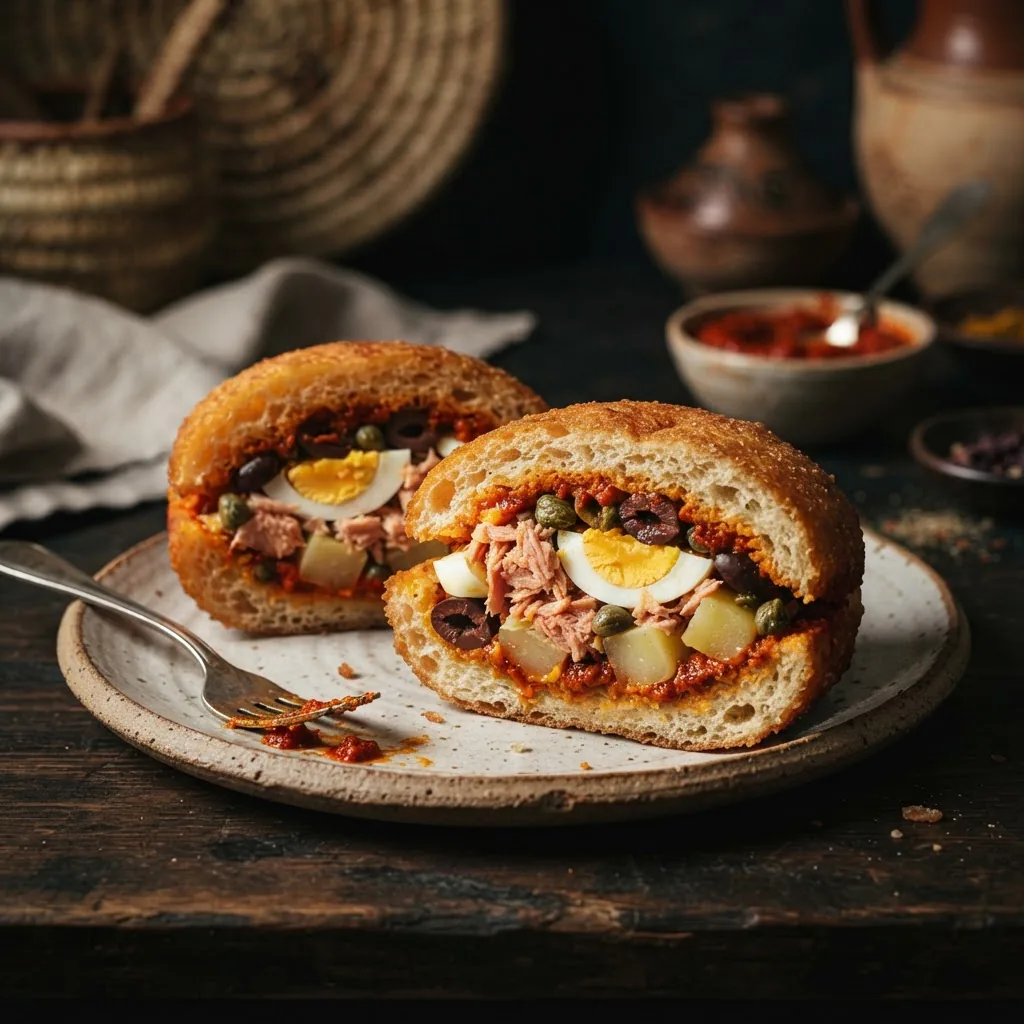
The Tunisian fricassé is the fried-sandwich art's pinnacle: a small oval of enriched dough, fried golden like a doughnut's serious cousin, then split and stuffed while still warm — tuna, harissa potato, olives, capers, a sliver of egg — so the bread's interior steams soft against the filling and the crust stays crisp. It is brik's sibling in the Tunisian street canon: same pantry, same harissa, one fried on the outside instead of folded around the egg.
- **Make the dough soft and give it a full rise.** The fricassé's dough is enriched — egg and oil — but still soft, closer to a slack bread than a pastry; it fries to a thin gold crust and a bready, pull-apart interior that must be sturdy enough to split and pocket without tearing. The rise's full hour is the structural insurance.
- **The bridge:** the fillings are the Tunisian pantry's daily shelf (the #1 brik's list, nearly word for word); nothing bridges but patience. The fried brioche-like roll is the one craft, and the oil's steady 180 °C is its law.
Fricassé Sandwich
Prep: 1 hour, plus 1 hour dough rising · Cook: 40 minutes · Total: About 2 hours 45 minutes · Makes 8 sandwiches
Ingredients
The dough
- 400 g flour; 1 tsp instant yeast (about 4 g); 1 tbsp sugar (about 10 g); 1 tsp salt
- 1 egg (about 50 g), beaten; 3 tbsp olive oil (about 40 g); 180 ml warm water (approximately)
- Neutral oil, 3 cm deep, at 180 °C
The fillings (the classic cart's lineup)
- 200 g canned tuna in oil, drained and flaked
- 300 g potatoes, boiled and mashed with 1–2 tbsp harissa (#91, to tolerance), salt, and a spoon of olive oil — the red mash
- 8 olives per sandwich's worth, halved (about 100 g); 2 tbsp capers, rinsed
- 4 hard-boiled eggs, sliced; harissa thinned with oil for spreading
- A handful parsley (about 10 g); lemon wedges
Instructions
- **Make, rise, shape (1 hour 20 minutes).** Knead the dough's elements 8 minutes to a smooth, soft, slightly tacky ball; rise covered until doubled — 1 hour. Divide into 8 pieces (about 90 g each), shape into short ovals, and rest 15 minutes covered. Checkpoint — the shaped ovals should be smooth-skinned and slack; they will puff further in the oil. A tight, firm dough makes a bready fricassé — the softness is deliberate.
- **Fry at 180 °C (2–3 minutes a face).** Fry the ovals in small batches until deep gold on the underside — 2 to 3 minutes — then turn once for the second face. Drain well; the crust should be blistered gold, the interior hollowed slightly by the fry's steam. Checkpoint — the rolls should feel light for their size and sound faintly hollow at the tap. The crust is thinner than a doughnut's — a skin, not a jacket — and it must hold its crispness for the split that comes next.
- **Split while warm, stuff immediately.** With a serrated knife, split each roll horizontally almost through — a pocket, not two halves. The inside's soft walls: a smear of thinned harissa, then the red harissa potato spread along the base, the tuna flaked over, olive halves and capers pressed in, a slice of egg, parsley, and the top pressed down gently. Serve at once, the lemon's squeeze at the eater's hand. Checkpoint — eating test: the crust's thin crackle and the interior's steam-soft bread giving around the filling — potato's harissa fire, tuna's oil-rich savory, the olive and caper's salt-sour runs, the egg's calm center — one hand, warm, complete. The bread should be fried-soft, never greasy, and the pocket's layers should compress into a unified bite rather than slide apart. That compression is what the soft roll was built for.
Troubleshooting
| Symptom | Cause | Fix |
|---|---|---|
| Rolls greasy | Oil under-temperature or over-crowded | 180 °C in small batches; the oil must recover between |
| Pocket tore at the split | Roll over-cooked to a thick crust or split cold | Split warm; 2–3 minutes a face, no more |
| Filling falls out | Over-stuffed or under-mashed potato | The potato binds — mash it smooth |
Storage, Make-Ahead & Variations
- The fillings keep 2 days refrigerated (the cart's own economy); the rolls are fried to the minute and hold 1 hour at most, unstuffed, in a cloth. A reheated fricassé is a lesser thing — the pocket steams itself soft. - Variations: the carts that add a sliver of brik inside (the fried-fold within the fried-roll); the harissa-doubled version for the initiated. The #1 brik and the #18 lablabi are this sandwich's Tunisian family on this site.