Filfel Chuma — The Libyan Honey-Fire
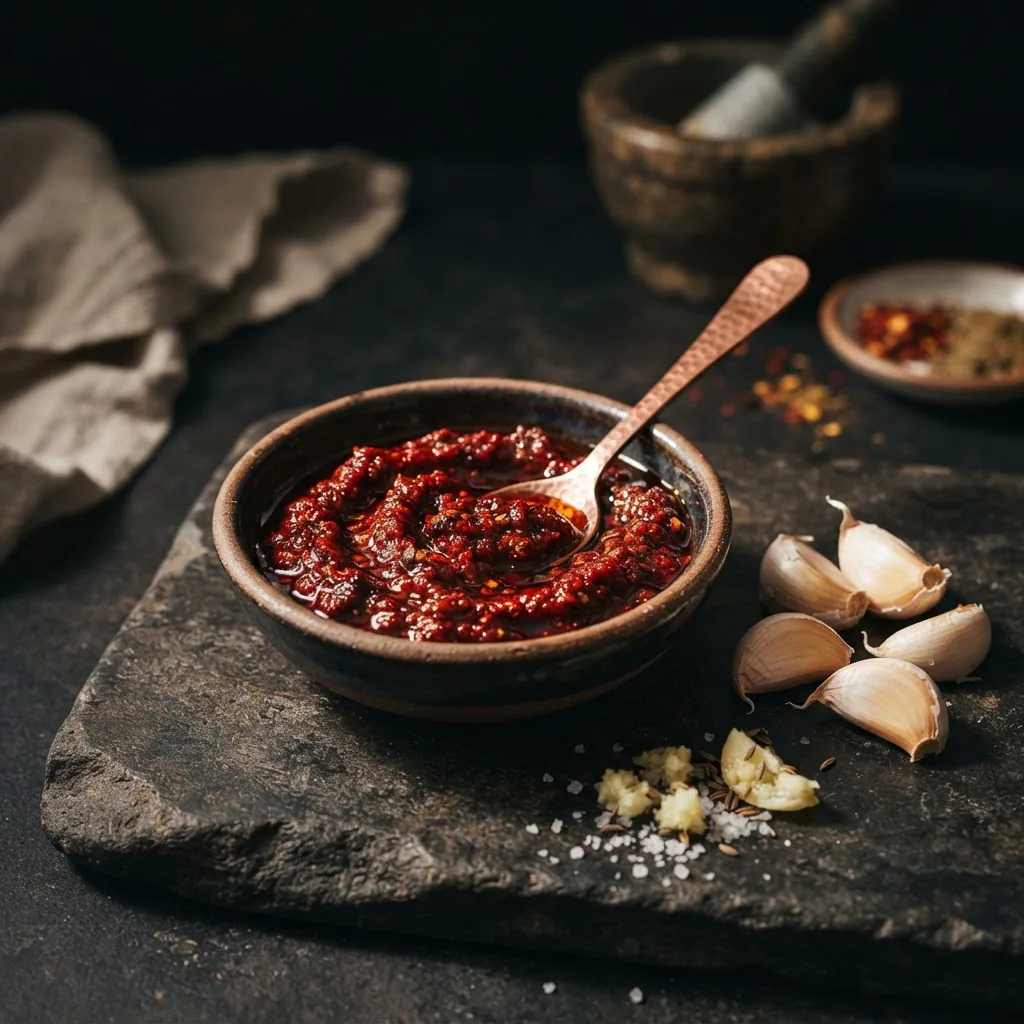
The filfel chuma is the #91 harissa's Tripolitanian sibling — the Libyan kitchen's own pepper paste, run at the sweet-hot register the Libyan pot prefers: the dried and sweet paprikas' body, the hot pepper's fire, and the honey's rounding that separates it from the Tunisian jar's straight burn. The corpus's Libyan seats (#61's family, the #84 salona's base, the #70's service) cite this jar; this record is its own law.
Quantities live in the recipe card.
Ingredients
- **The filfel's law: the honey is structural, not a sweetener's afterthought.** The Libyan paste's whole register runs at the sweet-hot balance — the honey's viscosity building the paste's body and its sugar carrying the fire's slow release — and the jar without it is merely a small harissa wearing the Libyan name.
- **The bridge:** the two-fires doctrine runs the family's whole map — the #91's dried depth, the #99's green lift, this jar's honeyed heat — and the corpus's pots cite the three by name: the Tunisian fire, the Yemenite fire, the Libyan fire, one cupboard's peace.
Filfel Chuma — The Libyan Honey-Fire
Prep: 15 min (plus 30 min pepper soak) · Cook: No cook · Total: 45 min · Makes about 300 g (one jar)
Ingredients
Ingredients
- 40 g dried hot chiles (chile de árbol or cayenne), stemmed and seeded
- 30 g sweet paprika (about ¼ cup)
- 6 garlic cloves (about 24 g)
- 1 tbsp caraway seeds (about 6 g), toasted and ground
- 1 tsp ground cumin (about 3 g)
- 1½ tsp salt (about 9 g)
- 2 tbsp honey (about 40 g)
- 3 tbsp red wine vinegar (about 45 ml)
- 90 ml olive oil (about 82 g)
Instructions
- **The soak (30 minutes).** The dried chiles covered in just-boiled water and held submerged to the full plumbness — the #91's own checkpoint carried: the halved pepper folds supple as a fresh roast's skin, without the leather's snap. Checkpoint — the plumpness's proof at the fold: the under-soaked pepper's grit has no later rescue; the drain runs through the sieve and the patience holds.
- **The paste (10 minutes).** The drained peppers, paprika, garlic, caraway, cumin, and salt processed or pounded to the thick paste; the honey, vinegar, and oil's stream worked through to the emulsion's body. Checkpoint — the paste's proof: the spoon's ridge holds, the texture's granular-smooth — and the taste at the fingertip: the fire present but rounded at the first second's edge, the honey's sweetness arriving behind it, the caraway's signature. The filfel's fire runs slower than the harissa's — the honey's sugar is the fire's own brake.
- **The jar and the rest.** The paste packed to the clean jar with the oil's 3 mm seal, rested 1 hour (or the overnight's marriage) before the first service. Checkpoint — eating test: the quarter-spoon on the warm bread — the sweet first face, the fire's build behind it, the caraway-cumin's warmth in the finish — a paste that runs the #84 salona's sweet-sour pot and the #61's Libyan-school base with the same honest duality. It should taste like Tripoli's own register — the fire asked politely, and answered.
Troubleshooting
| Symptom | Cause | Fix |
|---|---|---|
| Paste's fire flat, one-note | The paprika's staleness | The fresh paprika's law — the jar's color runs brick-red, never the dusty brown |
| Paste's sweetness forward, cloying | The honey's excess | The 2-tbsp ceiling — the honey is the brake, not the engine |
| Paste bitter | The scorched caraway | The toast's seconds' vigilance |
Storage, Make-Ahead & Variations
- The sealed jar keeps 2 months refrigerated (the vinegar and the honey's own preservation running longer than the #99's fresh register) — the oil seal's covenant carried from the family's whole law. The variations: the hotter Tripoli dial (the árbol's doubling), the baked-fish's basting use, the soup's suspended spoon at the shorba's service.