Mechouia — The Fire-Roasted Salad of the Council
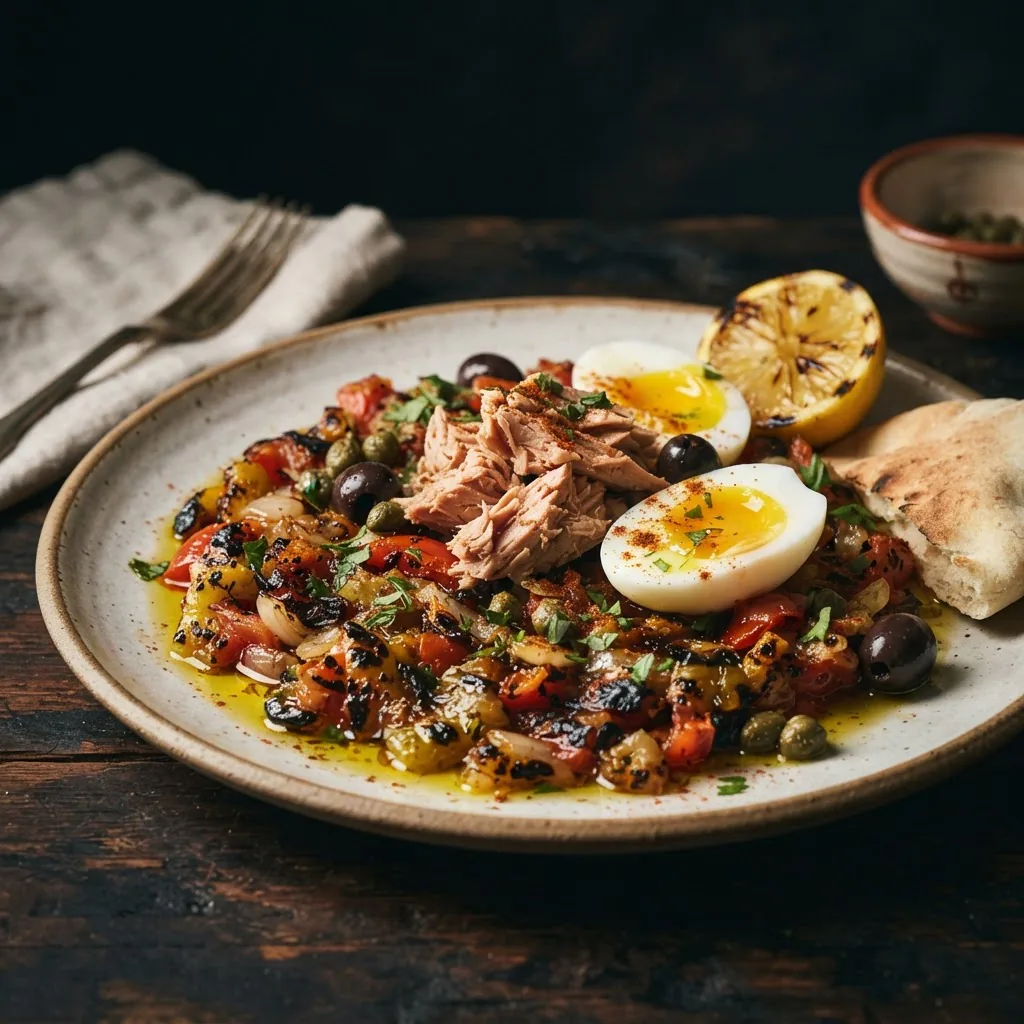
Quantities live in the recipe card.
Ingredients
- the thin-walled frying peppers' honesty, or the bell's mercy at the grocer's limit
- half roasted whole in the skins, half raw
- the mechouia's own signature
- the Tunisian table's own completion
Doneness & Quality Checkpoints
- The pepper's total collapse at the roast — the tongs' yield and the skin's slide
- The colander's 5-minute drain — the tomato's water gone before the pounding
- The rubble's texture — the fork's tine held, never the purée's soup
- The raw-roasted garlic's split — the two fires of the single head
- The council's completion at the service — tuna, olives, capers, eggs
Mechouia — The Fire-Roasted Salad of the Council
Prep: 20 min · Cook: 25 min · Total: 45 min · 6
Ingredients
Ingredients
- 4 green peppers (about 600 g) — the thin-walled frying peppers' honesty, or the bell's mercy at the grocer's limit
- 2 red peppers (about 300 g)
- 4 ripe tomatoes (about 500 g)
- 1 head of garlic (about 10 cloves, 40 g) — half roasted whole in the skins, half raw
- 1 tbsp harissa (#91) or the #99 zhug's spoon
- 2 tsp caraway seeds (about 5 g), toasted and ground — the mechouia's own signature
- 1 tsp ground coriander (about 2 g)
- 1 tsp salt (about 6 g)
- 3 tbsp olive oil (about 40 g), the finish's own
- Juice of half a lemon (about 20 ml)
- The service's law: tuna flakes (about 100 g), olives, capers, and the #98's egg quarters — the Tunisian table's own completion
Instructions
- **The roast (20–25 minutes).** The peppers and tomatoes whole over the open flame (the gas ring's direct law, the grill's, or the broiler's highest at the 250 °C order) — turned at the intervals as each face blisters — to the skins' full blackening and the flesh's collapse: the tomato's skin splitting, the pepper's body running soft at the wall. Checkpoint — the roast's proof: the pepper yields wholly at the tongs' grip — the collapse's edge, the skin's black leather sliding loose at the touch — the firm pepper's return to the flame is the patience's own law; the under-roast runs the salad's raw edge and no pounding forgives it.
- **The sweat and the peel (10 minutes).** The blackened vegetables to the bowl, covered, the steam's 10-minute sweat loosening the skins' last grip — then the peel's rub under the running water's film (or the towel's tradition), every seed's honesty removed, the flesh's pulp torn or drained to the colander's mercy. Checkpoint — the peel's proof: the flesh runs clean and smoke-dark, the skins' every black trace gone — the char's flavor lives in the flesh's own smoke, not the skin's carbon (the retained flake runs the salad's bitter grit); the colander's drain runs 5 minutes' honesty, the tomato's water departing before the pounding's stage.
- **The pound (5 minutes).** The roasted garlic squeezed from its skins and the raw half minced; the flesh, the garlic's split, the caraway, coriander, salt, and the fire's jar pounded to the coarse, wet rubble — the mortar's twenty strokes' tradition or the knife's patient mince (the processor's road runs the soup's purée, and the mechouia's texture lives at the rubble's law). Checkpoint — the texture's proof: the salad holds the fork's tine with visible fleck and fragment — the caraway's perfume forward at the nose, the smoke's depth beneath, the raw garlic's fire and the roasted garlic's sweetness running the split's two registers at once.
- **The finish and the service.** The olive oil and lemon's brightness folded through; the salad spread to the plate's expanse and the council's completion laid over — the tuna's flakes, the olives, the capers, the eggs' quarters — the bread's ceremony at the table's opening. Checkpoint — eating test: the bread's swipe through the rubble and the toppings — the smoke-sweet depth of the flame's own sugar, the caraway's signature, the fire jar's slow burn behind, the tuna's salt-protein richness and the egg's cool rounds, the lemon's cut carrying the whole plate's richness. It should taste like the council's own fire seat — the salad that begins at the flame and ends at the bread's ceremony.
Finish & Plate
The salad spread to the platter's wide expanse — the rubble's smoke-dark surface — and the council laid in the quarters' own order: the tuna's flakes at the center, the eggs' quarters and the olives' scatter at the rim, the capers' freckle, the oil's final thread and the lemon's last squeeze. The bread's basket beside, the #61's pan or the #70's platter following — the mechouia's plate is the meal's own overture, and the flame's register is the kitchen's first signature.
Troubleshooting
| Symptom | Cause | Fix |
|---|---|---|
| Salad's flavor raw-edged, flat | The under-roast's mercy | The collapse's law — the pepper returns to the flame |
| Salad's texture a purée | The processor's overwork | The mortar's twenty strokes or the knife's mince |
| Bitter grit at the bite | The char's retained flakes | The peel's rub and the water's film — the carbon's removal |
| Salad watery at the plate | The drain's rush | The colander's 5 minutes — the tomato's water's law |
Storage, Make-Ahead & Variations
- The salad keeps 3 days refrigerated (improving at the second day's marriage), the council's toppings laid only at the service — the make-ahead's own mercy, the Friday salad and the Saturday table. The variations: the winter's jarred-pepper's honesty (the roast still run at the flame), the hotter zhug's dial, the summer's added cucumber at the cooler register.