Karantita
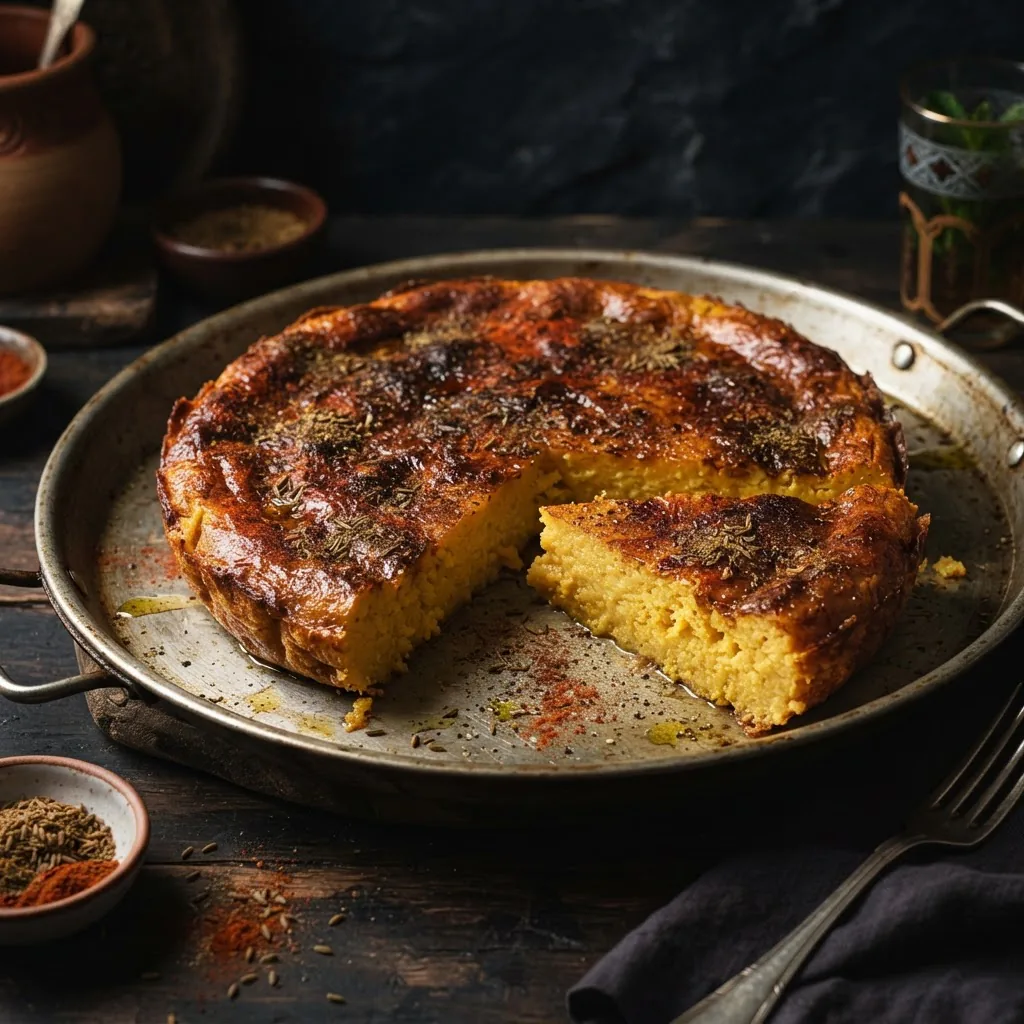
Karantita — the Algerian street snack, carried to the carts of Casablanca and Oran and Marseille — is chickpea flour's custard: a loose batter of besan, water, and olive oil baked into a set, quivering golden cake, cut into squares and eaten warm from paper with cumin and harissa. In Algeria it is garantita or karantita, in Nice its cousin is socca, in Italy farinata — one Mediterranean shoreline, one bread. This is the western version: softer, spiced with cumin, and always, always eaten standing.
Quantities live in the recipe card.
Ingredients
- the 1:3 flour-to-water law)
The finish (the cart's law)
- **Rest the batter 30 minutes — or better, 2 hours.** The chickpea flour hydrates slowly, and an unrested batter bakes grainy. Whisk it well, let the foam settle, and rest it at room temperature; the bowl's surface should be smooth and lazy when it goes to the oven.
- **The bridge:** chickpea flour (besan) is in every Indian and Middle Eastern grocery. The pan: a preheated cake tin or a black steel pan — the batter's contact with hot oiled metal sets the crust, the crust is half the dish, and the oven does the rest.
Karantita
Prep: 10 minutes, plus 2 hours cooling · Cook: 35 minutes · Total: About 2 hours 45 minutes · Serves 6
Ingredients
Ingredients
- 250 g chickpea flour; 750 ml water (about 750 g — the 1:3 flour-to-water law)
- 3 tbsp olive oil (about 40 g), plus more for the pan and the finish (another 20 g)
- 1 tsp salt; 1 tsp cumin; ½ tsp turmeric or paprika for color
- 2 cloves garlic, grated (optional but right), whisked in at the end
The finish (the cart's law)
- Ground cumin and a pinch of salt, mixed for sprinkling; harissa (#91) thinned with oil; lemon wedges; bread for the true sandwich version
Instructions
- **Make and rest the batter.** Whisk the chickpea flour with the water, oil, salt, cumin, and turmeric until smooth; rest 30 minutes to 2 hours, whisking once at the end and folding in the grated garlic. Checkpoint — the batter should be the texture of thin cream, smooth, with a faint beige cast — no dry flour pockets, no foam. Taste the raw batter: it should read distinctly of cumin and salt, both of which will fade slightly in the bake.
- **Bake hot in the oiled pan (30–35 minutes at 230 °C).** Preheat the oven with the oiled pan inside until the oil shimmers; pour in the batter — it should sizzle faintly at the pour — and bake until the top is set, deeply freckled, and the edges are browned and pulling from the pan's sides. Checkpoint — the finished karantita should be golden-blotched on top with darker edges, its center just set — a firm jelly's wobble, not a custard's — and its bottom a solid, oil-crisped crust. The pan's sizzle at the pour was the crust's promise.
- **Cut, season, serve in paper.** Cut into squares straight from the pan; each square sprinkled with the cumin-salt, a dash of the thinned harissa, a squeeze of lemon — and served in paper or bread halves, the street's own packet. Checkpoint — eating test, warm: the crust's slight chew, the interior's soft, faintly nutty custard — chickpea's sweetness under cumin's warmth — the harissa's fire and the lemon's cut arriving at the swallow. It should be soft-centered, never dry, and the cumin-salt sprinkle is not optional: it is the cart's signature, the seasoning that makes the cake a street food.
Troubleshooting
| Symptom | Cause | Fix |
|---|---|---|
| Interior grainy | Batter under-rested or under-whisked | The full rest; the final whisk |
| Cake stuck to the pan | Pan under-oiled or under-heated | Preheat the oiled pan till it shimmers |
| Top pale, soggy | Oven under-hot | 230 °C, the top must freckle |
Storage, Make-Ahead & Variations
- The batter keeps 2 days refrigerated (bake to order — the cart's own rhythm); the baked cake keeps 1 day and re-crisps 8 minutes at 220 °C. Assembled sandwiches wait no one. - Variations: the cheese-topped Marseille version, the onion-flecked batter. The #12 mahjouba and this recipe are the cluster's two chickpea-and-semolina streets; the #9 ta'ameya is besan's other register.