Lablabi Chickpea Bowl
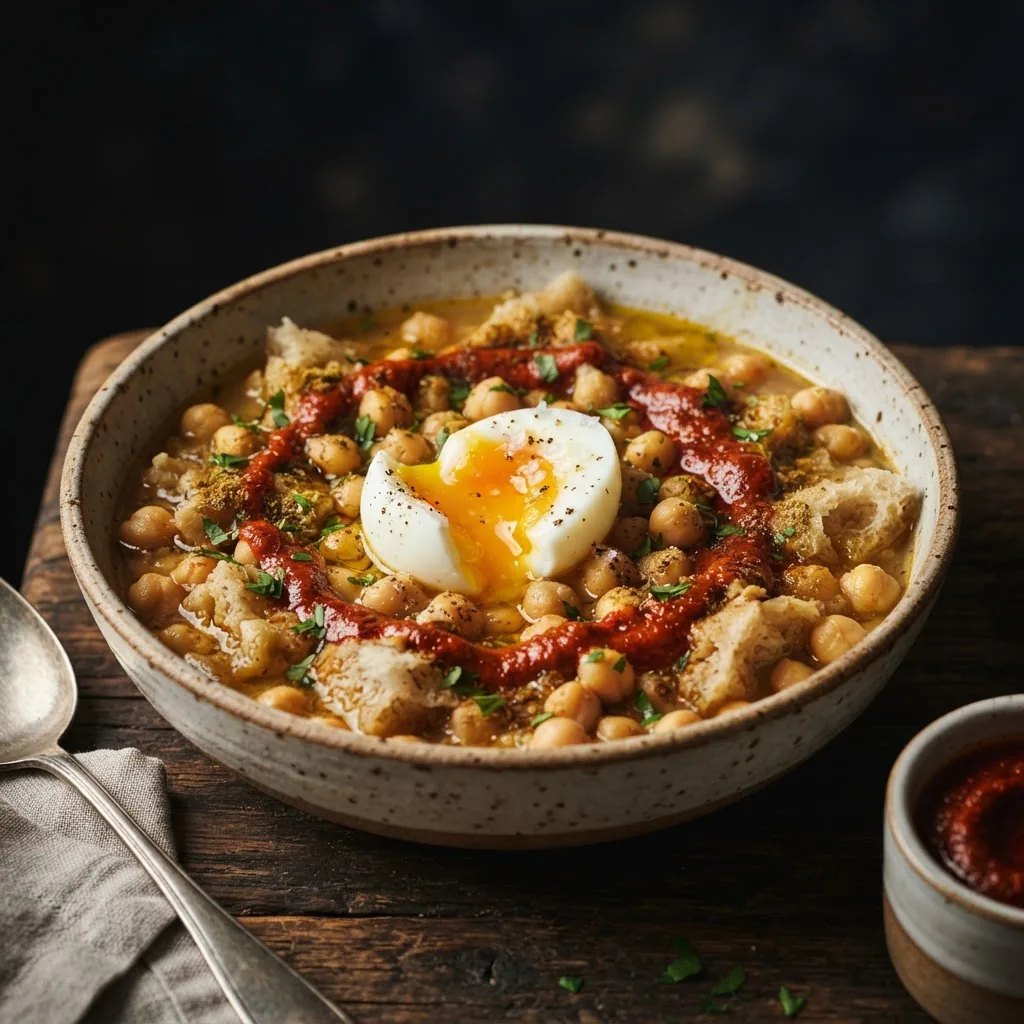
Lablabi is the Tunisian morning's furnace: stale bread torn into a bowl, soaked with chickpeas and their broth, fired with harissa and cumin, capped with a soft egg and olive oil, and eaten fast and hot at a counter before the day's work. It is poverty's engineering — old bread, cheap legumes, fierce seasoning — raised by the addition at the bottom of every great lablabi: a poached or soft egg whose yolk breaks into the broth and turns the whole bowl to velvet.
Quantities live in the recipe card.
Ingredients
- **Cook the chickpeas to collapse-adjacent.** Lablabi's chickpeas go past salad-tender to the edge of falling apart — 60 to 90 minutes from dried — because they and their broth are the bowl's sauce. Canned chickpeas bridge honestly if simmered 10 minutes further with a crushed garlic clove to deepen them.
- **The bridge:** stale bread is the recipe's own economy — it exists for this dish. Any dense day-old loaf works; the bread should be dry enough to need the broth and soft enough to drink it.
Lablabi Chickpea Bowl
Prep: 20 minutes · Cook: 10 minutes · Total: About 30 minutes (plus cooking the chickpeas) · Serves 4
Ingredients
Ingredients
- 600 g cooked chickpeas (about 300 g dried, soaked and simmered until very tender) with 500 ml of their broth — or two 400 g cans, drained, plus broth or water
- 4 eggs
- 4 small stale bread rolls or 300 g day-old bread (the sourdough of the fridge works), torn to bites
- 3 tbsp harissa (#91), thinned with a spoon of its oil; 2 tsp cumin, more at the table
- ½ tsp salt; 4 tbsp olive oil (about 50 g)
- 2 cloves garlic (about 8 g), grated; a splash of red wine vinegar or lemon
- To finish: 2 tbsp capers, a handful of olives, a small can of tuna (the full carts' argument), sliced onion soaked in vinegar, and a fist of cilantro (about 10 g)
Instructions
- **Heat the chickpeas and broth (10 minutes).** Warm the chickpeas in their broth with the garlic, cumin, and salt to a low simmer — the broth should be savory and warm with cumin's earth, seasoned one notch past comfortable. Checkpoint — taste the broth alone: it should be a soup worth drinking on its own — cumin-forward, salted boldly — because it is about to season a bowl of bread.
- **Build each bowl (5 minutes).** In each wide bowl: the torn bread covering the base, a spoon of thinned harissa over the bread, a scatter of capers and onion. Ladle the chickpeas and broth over — enough to soak the bread thoroughly, the chickpeas sitting in a shallow soup, not a flood. Checkpoint — the bread should be soaked to its core but the bowl should not swim — the ratio runs about 1:1 bread to chickpeas-and-broth by volume. The harissa's layer between bread and broth fires the bowl's floor.
- **The egg, and speed.** Poach the eggs in the simmering broth itself for 3 minutes (the Tunisian method — the broth seasons them) or soft-boil ahead; slide one onto each bowl's center. Olive oil over, cilantro scattered, and the tuna and olives at the table. Checkpoint — eating test, immediately: break the yolk — it runs into the broth and turns the bowl to a spiced, golden silk — and eat fast, the bread and chickpeas together in each spoonful, the harissa's fire building, the cumin's warmth under, the vinegar onion cutting, olive oil's green finish. A lablabi finished cold is a lablabi half-eaten; the bowl's whole clock is the egg's heat.
Troubleshooting
| Symptom | Cause | Fix |
|---|---|---|
| Bowl soured to mush | Broth over-poured or bread too fresh | 1:1 ratio; day-old bread only |
| Broth one-dimensional | Cumin or harissa shy | Both bold \u2014 the broth leads |
| Egg's yolk set hard | Over-poached | 3 minutes in the barely-simmering broth |
Storage, Make-Ahead & Variations
- The chickpeas and broth keep 3 days (the make-ahead station — the bowls assemble in 10 minutes); the built bowl waits no one. The garnish plate keeps as its parts. - Variations: the full carts' tuna-and-olives argument, the fierce doubling of harissa for the returning regular. The #7 bessara is lablabi's fava sibling on this site — the same dawn, a different legume.