Egyptian Koshari
Quantities live in the recipe card.
The grains and legumes
The sauce
The crispy onions (the crown — non-negotiable)
The finishing sauce (daqqah — the sharp cut)
Doneness & Quality Checkpoints
- The parts: lentils intact, rice toasted and separate, pasta salted, sauce cooked past its acid.
- The onions: snapped-crisp, salted, crowned last.
- The bowl: layers distinct, daqqah at the table.
Egyptian Koshari
Prep: 40 minutes · Cook: 50 minutes · Total: About 1 hour 35 minutes · Serves 6
Ingredients
The grains and legumes
- 200 g brown or green lentils, picked over
- 200 g long-grain rice, rinsed; 50 g vermicelli or small macaroni broken short
- 150 g elbow macaroni (the street runs both pastas; one is honest)
- 1 can (400 g) chickpeas, drained, or 200 g cooked
- 2 tsp cumin, divided; salt
The sauce
- 3 tbsp neutral oil; 1 onion (about 150 g), minced
- 6 cloves garlic (about 25 g), minced; 1 tbsp tomato paste (about 15 g)
- 800 g crushed tomatoes or tomato passata
- 2 tsp cumin; 1 tsp coriander; ½ tsp chile flakes (or 1 tsp harissa, #91)
- 1 tsp salt, 1 tsp sugar; a splash of water as needed
The crispy onions (the crown — non-negotiable)
- 3 large onions (about 500 g), sliced thin
- Neutral oil for frying, 1 cm deep at 175 °C; or the shallow-pan method below
- A pinch of salt
The finishing sauce (daqqah — the sharp cut)
- 4 tbsp white or apple-cider vinegar (about 60 ml); 2 tbsp water
- 4 cloves garlic, minced fine; 1–2 tsp chile flakes or 1 tsp harissa
- ½ tsp cumin; a pinch of salt
Instructions
- **The lentils and the rice (35 minutes).** Simmer the lentils in salted water with 1 tsp cumin until tender but intact — 20–25 minutes; drain. In a pot, toast the vermicelli in 2 tbsp oil to deep gold, add the rinsed rice and a further 2 minutes of toasting, then salted water (1:1.5 rice to water), cover, and cook 15 minutes off the flame's residual heat. Checkpoint — the lentils must hold their shape — mushy lentils collapse the bowl's layers. The vermicelli should be a shade darker than feels safe; its toast is the rice's flavor.
- **The sauce (30 minutes at a murmur).** Soften the onion in the oil, add the garlic and tomato paste and fry 2 minutes to darken, then the tomatoes, spices, salt, and sugar. Simmer gently, half-covered, until the sauce thickens and darkens — the raw-acid edge cooked out — about 25 minutes. Checkpoint — taste: the sauce should be savory-sweet with cumin's warmth, noticeably seasoned — it must sauce a mountain of starch. Blend half for smoothness if you like the street's texture; leave half rustic.
- **The onions (15–20 minutes, watched).** Fry the sliced onions in the oil over medium-high, stirring, until they pass pale, pass golden, and reach a deep even crisp brown — this last stage takes courage; the line between crisp and burnt is under a minute. Drain on paper, salt immediately. Make the daqqah by warming its elements together for 2 minutes off any real heat. Checkpoint — a cooled onion strand should snap, not bend. They crisp further as they cool — pull them one shade before the target color.
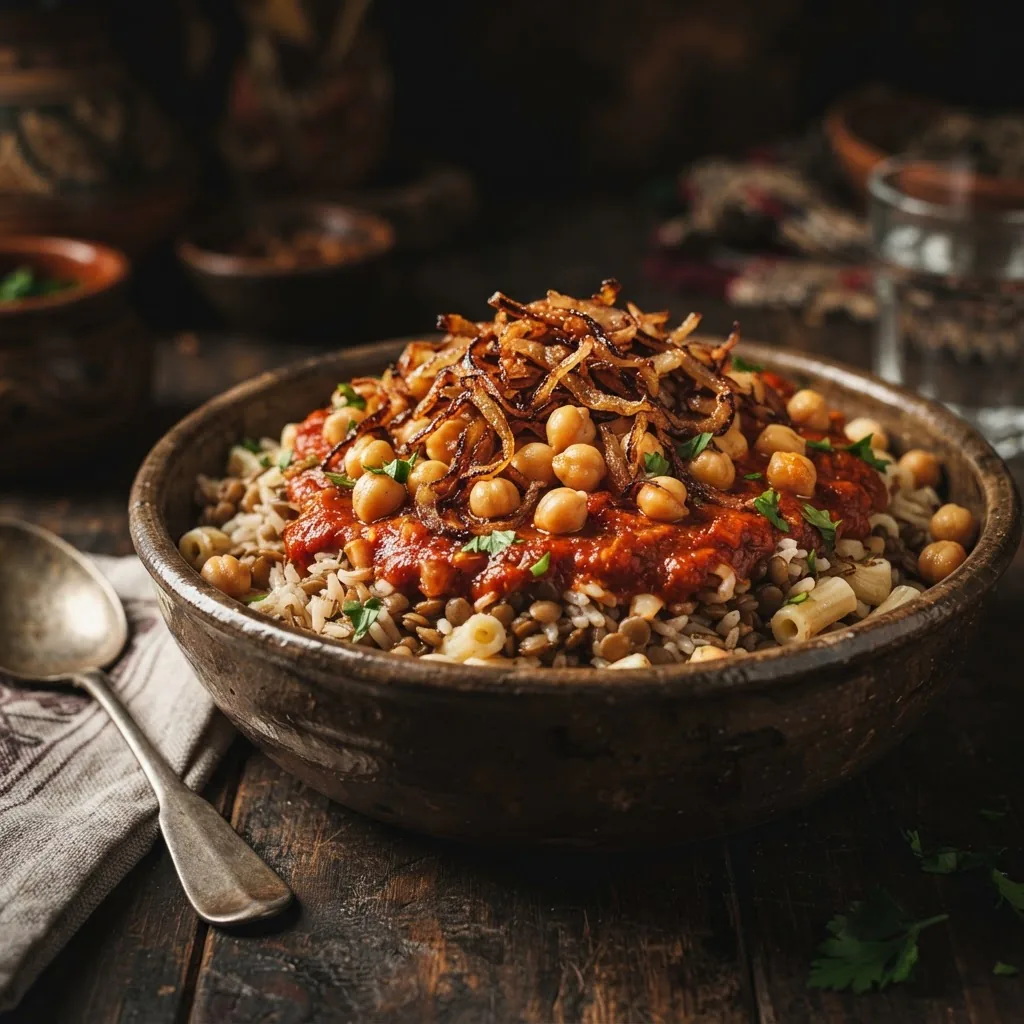
- **Assembly — the layering, in order, per bowl.** A base of rice, lentils spooned over, macaroni next, chickpeas scattered, the hot sauce ladled generously, the crispy onions piled on in a golden heap — and the daqqah dashed over by the diner's hand at the table. Checkpoint — eating test: the first spoonful runs the full stack — soft rice, earthy lentil, giving pasta, the sauce's tomato-cumin warmth — then the onions shatter through everything, and the daqqah's vinegar-garlic fire lands at the swallow. Each element should stay distinct in the bowl: koshari is layered, never mixed until the spoon does the mixing. The crispy onions must survive the sauce's steam, which is why the crown goes on at the last second — and why the second bowl is always better planned than executed.
Finish & Plate
Served in wide bowls, the onions' gold crown over the sauce's red — a dish whose appearance is its recipe. Extra daqqah and hot sauce at the table for the fire-eaters; a spoon deep enough to reach the bottom in one pass.
Troubleshooting
| Symptom | Cause | Fix |
|---|---|---|
| Bowl heavy, monotone | Daqqah skipped | The vinegar cut is structural — never omit |
| Onions gone soft | Crowned under hot sauce too early | Last-second crowning; extra batch if needed |
| Lentils mushy | Over-boiled or soaked long | 20–25 minutes checked, drained at intact |
Storage, Make-Ahead & Variations
- Every component keeps 3 days refrigerated separately — koshari is the original meal-prep street food; reheat each element and assemble to order. The onions keep 2 days airtight at room temperature and re-crisp 2 minutes in a 180 °C oven. - Variations: the Alexandrian school runs a spicier sauce; the home versions add fried liver for the meat eaters. The #18 lablabi is koshari's Tunisian cousin — the same grain-and-cumin instinct on a different base.