Mombar Rice Sausage
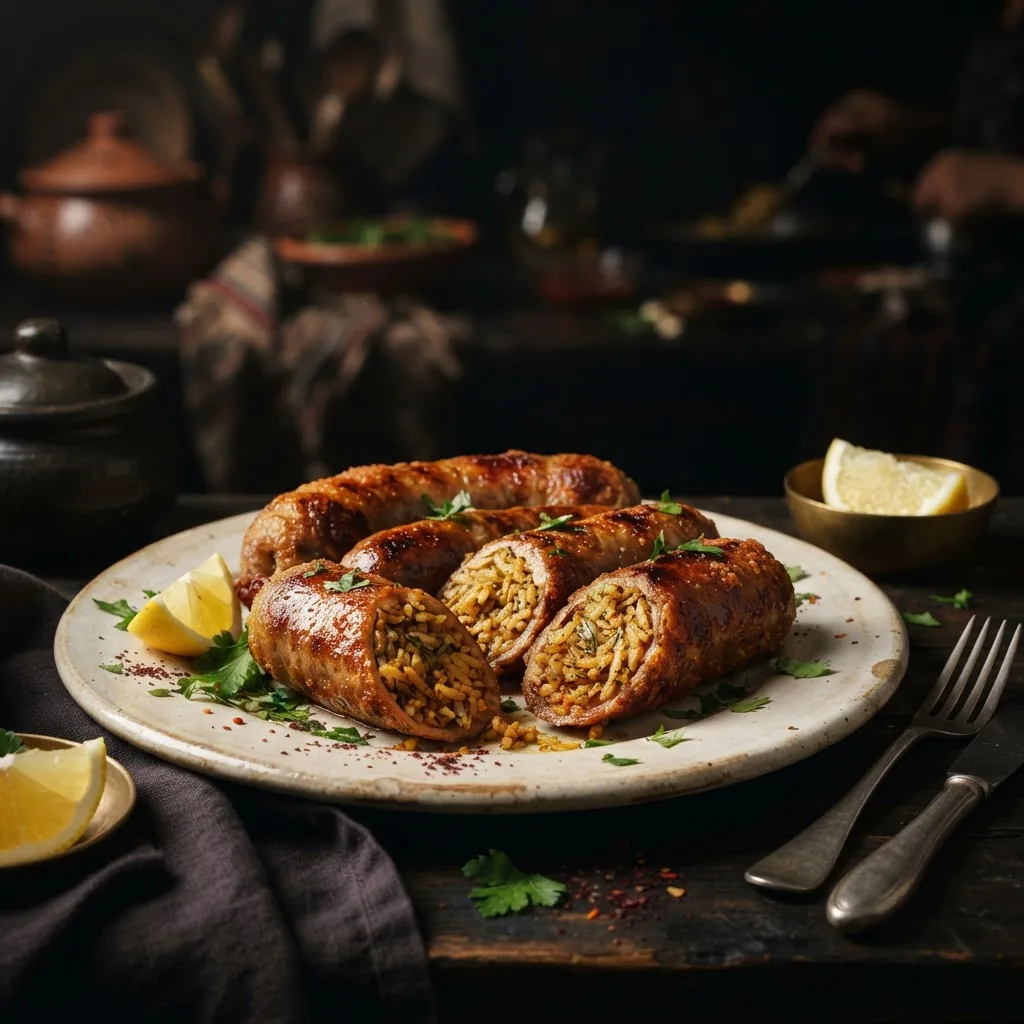
Mombar is the Egyptian Suez canal's great stuffed craft: lamb or beef casing — the large intestine, cleaned to translucence — packed with a herbed, spiced rice, tied into links, and simmered gently until the rice swells to fill its skin tight as a drum. It is offal cookery's most elegant turn: the casing not the dish but the vessel, and the vessel not eaten so much as honored, gone soft and faintly chewy around the fragrant rice it shaped. The Alexandrian and Suez cooks sell it by the link, sliced to show the rice's mosaic.
Quantities live in the recipe card.
The casings
- or see the bridge), turned inside out, soaked in salted water with a splash of vinegar 2 hours, rinsed repeatedly until the water runs clear
The filling
- mombar is rice-forward)
- the rice drinks it raw)
The simmer and service
- or the fuller plate with salad
- **Clean the casings beyond doubt.** The butcher's initial cleaning is the beginning: turn them inside out (a running faucet's flow does half the work), soak in salted vinegar water 2 hours, and rinse until every trace of odor is gone. This step is the dish's first half, and no shortcut survives it. The bridge: the well-cleaned casing is also sold ready-to-use frozen at Egyptian and Middle Eastern butchers — the honest working shortcut, and this recipe's own concession.
- **Mix the filling wetter than a stuffing feels.** The rice cooks inside the casing in its own measured water — the filling should be a moist, spoonable mixture, the raw grains suspended in seasoning, because the skin holds every drop: what goes in dry comes out hard.
Doneness & Quality Checkpoints
- The cleaning: rinsed to odorless, soaked in vinegar-salt.
- The fill: two-thirds, pricked a dozen times.
- The simmer: barest tremble, 60–75 minutes, the center's rice fully tender.
Mombar Rice Sausage
Prep: 1 hour, plus soaking · Cook: 1 hour 15 minutes · Total: About 3 hours (plus casing prep) · Makes about 12 mombar (serves 6)
Ingredients
The casings
- About 1.5 m lamb or beef large intestine (mombar casing), cleaned and salted by the butcher (ask specifically — or see the bridge), turned inside out, soaked in salted water with a splash of vinegar 2 hours, rinsed repeatedly until the water runs clear
The filling
- 300 g Egyptian rice or short-grain, rinsed
- 1 onion (about 150 g), grated fine; 4 cloves garlic (about 15 g), grated
- 100 g ground beef or lamb (the flavor anchor — mombar is rice-forward)
- A large handful each dill and parsley (about 20 g each), minced; 1 tbsp dried mint or a handful fresh
- 2 tsp cumin; 1 tsp coriander; ½ tsp cinnamon; ½ tsp allspice; ½ tsp chile flakes or 1 tsp #91 harissa; 1½ tsp salt; black pepper
- 3 tbsp tomato paste (about 45 g) or 2 grated ripe tomatoes; 3 tbsp neutral oil (about 40 g); 250 ml warm water (approximately — the rice drinks it raw)
The simmer and service
- A large pot of water or light stock with 2 bay leaves and a whole onion; a plate or weight to hold the links under
- Lemon wedges, #91 harissa thinned with oil, and bread — or the fuller plate with salad
Instructions
- **Fill the casings loosely — the rice doubles (30 minutes).** Tie one end of each casing length tightly with string; with a funnel or a piping bag's neck, spoon the filling in, pressing gently down the casing — filling to about two-thirds full, no more — and tie off at intervals of 12–15 cm to make links. Prick each link's surface a dozen times with a fine needle. Checkpoint — each link should feel floppy and half-empty — the swelling rice needs its third of slack, and an over-filled mombar bursts in the simmer. The pricks are the pressure's release: a link pricked thoroughly stays whole; an unpricked one tests the knot.
- **The patient simmer (60–75 minutes).** Bring the pot of seasoned water to the barest simmer — around 90 °C, the surface barely moving — add the links (weighted under with an inverted plate so they cook evenly), and poach gently 60 to 75 minutes, until a link pierced at its center yields fully swollen, tender rice and the casing feels taut and slightly glossy. Checkpoint — the mombar's clock is the rice's: pull a test link at 60 minutes, slice it, and press the center's grains — they should be fully tender, the filling holding as a slice. The casing turns from rubbery-firm to softly yielding somewhere in the hour, and the change is felt more than timed. Never boil: a bubbling pot shakes the links against the pot and each other, and burst mombar is rice soup.
- **Two finishes — the Suez split (10 minutes).** The classic: drain the links, cool 10 minutes, then fry or griddle them whole in a lightly oiled pan until the casing blisters gold in patches — the fry's maillard over the simmer's softness — and slice to serve. The simpler street finish: sliced and served straight from the simmer, hot, with the garnishes. Checkpoint — eating test: the slice holds — the rice's mosaic in its soft, faintly chewed sheath, the herbs' green visible, the dill's anise and mint's cool riding cumin's warmth, the casing's gentle resistance giving way — with lemon and harissa cutting the richness. It should taste like the canal's exchange: a rice culture's grain, a sausage culture's skin, one dish.
Finish & Plate
The links sliced on the bias, the mosaic up, lemon and harissa at the table — bread beside, and the fuller plate's salad for the company.
Troubleshooting
| Symptom | Cause | Fix |
|---|---|---|
| Links burst in the simmer | Over-filled, unpricked, or boiled | Two-thirds fill; the needle; the tremble |
| Rice hard at the center | Under-simmered or filling too dry | The wetter filling mix; the full clock |
| Casing rubbery | Under-simmered | The softness arrives in the hour's last half |
Storage, Make-Ahead & Variations
- The raw links freeze 1 month (simmer from frozen, +15 minutes); cooked mombar keeps 2 days and the fried revival is the intended second life. The filling mix keeps 1 day. - Variations: the tomato-heavier Alexandria school, the chickpea-added version. The #8 hawawshi and the #54 osban are this craft's siblings on this site — the stuffed-offal canon's three seats.