Lamb M'hammar
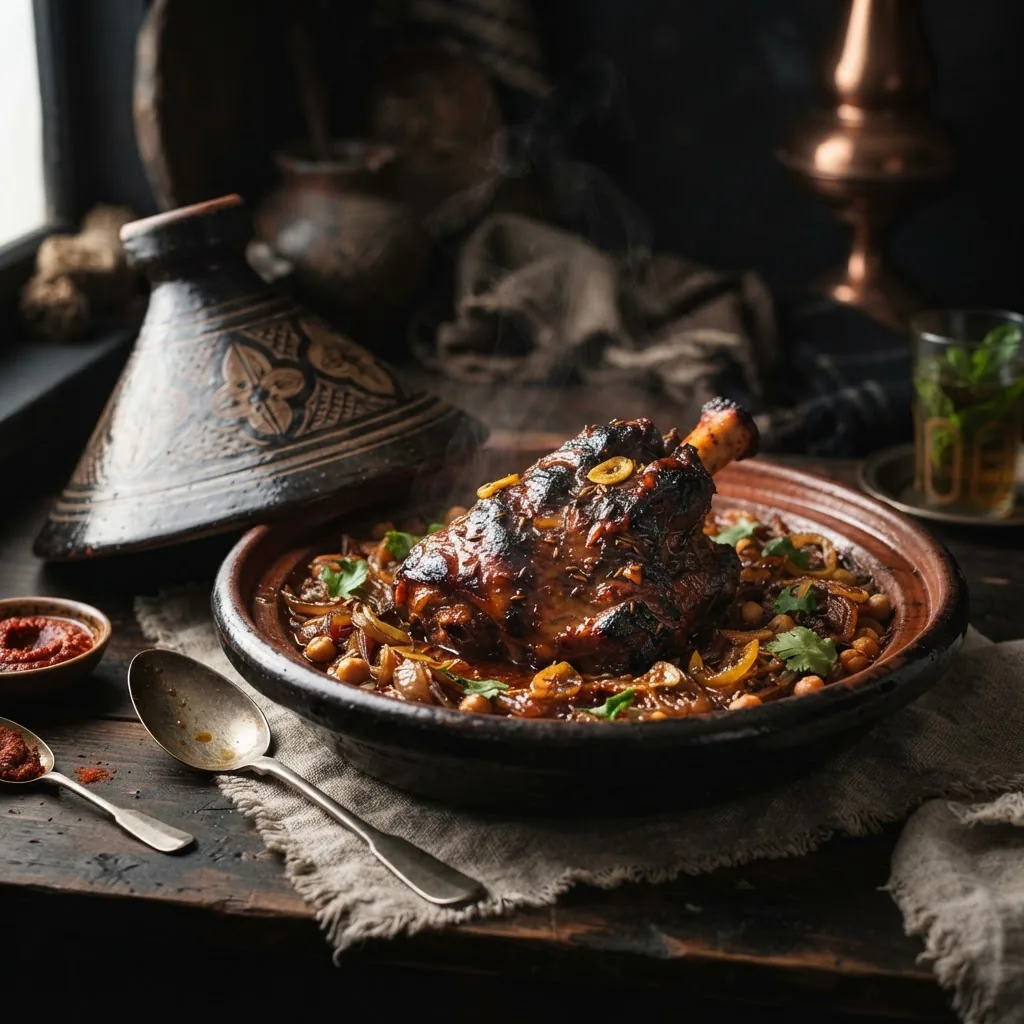
Quantities live in the recipe card.
Ingredients
- barely a beginning; the meat's own moisture is the pot's liquid
Doneness & Quality Checkpoints
- The marinade: 4 hours minimum, butter-carried to the bone.
- The steam-roast: barest murmur, onions dissolved, a centimeter of juice.
- The reddening: lacquered mahogany, edges crisp, glaze not gravy.
Lamb M'hammar
Prep: 20 minutes, plus 4 hours marinating · Cook: 2 hours 30 minutes · Total: About 7 hours (mostly marinating) · Serves 4–6
Ingredients
Ingredients
- 1.5 kg lamb shoulder or leg, on the bone, cut to 4–5 cm pieces (or a whole small shoulder)
- The rub: 3 tbsp butter, softened (about 45 g); 2 tsp sweet paprika; 1 tsp turmeric; 1½ tsp ground ginger; ½ tsp cinnamon; ½ tsp black pepper; 1½ tsp salt; 3 cloves garlic (about 12 g), grated
- 2 onions (about 300 g), sliced thin; a fist of cilantro and parsley (about 30 g), tied
- 100 ml water (about 100 g) — barely a beginning; the meat's own moisture is the pot's liquid
- The finish: 1 tbsp butter (about 15 g); a pinch more paprika; toasted sesame or almonds (about 30 g) to crown
Instructions
- **The slow pot (2 hours at the barest tremble).** Lay the onions as the pot's bed, the marinated lamb over them, the herb bundle tucked in, and the water — the scant half-cup — around the edges. Cover tightly, set over the lowest flame (a diffuser under a true tagine), and cook 2 hours, turning the pieces once at the hour, without lifting the lid otherwise: the lamb cooks in its own condensing steam, and the onions melt beneath to a jam that becomes the dish's only sauce. Checkpoint — at the hour's turn: the pot should murmur, not bubble — a tap on the lid answers with the steam's hiss — and the lamb's exposed faces should run a deep spice-gold. At 2 hours: the meat should yield to a spoon's firm press, the onions dissolved entirely, the pot's bottom holding barely a centimeter of concentrated, buttery juice. If the pot runs dry before tenderness, a splash more water — sparingly, for the sauce must stay a glaze, not a gravy.
- **The reddening (10–15 minutes uncovered).** The flame raised — the pot's base past 150 °C — Uncover, raise the flame to medium-high, and turn the pieces in the glaze as it reduces and sizzles to a lacquer on their surfaces — 8 to 10 minutes of attentive turning, until the lamb's faces carry the m'hammar's namesake red-brown and the edges crisp. The final butter and a pinch more paprika swirled into the last of the glaze, spooned back over. Checkpoint — the reddening's target: lacquered, not sauced — each piece glazed to a mahogany shine, the edges faintly crisp, the pot's bottom holding only a spoonable film of the concentrated juice. This stage is the dish's name and its crown, and it wants the cook standing there, turning.
- **The rest and the crown.** Off the flame, rest 10 minutes covered, and crown — sesame seeds or the toasted almonds scattered over the lamb at the table. Checkpoint — eating test, with bread and the #105's mechouia or a simple salad: the lacquered surface's spice-butter crackle giving to lamb so tender it pulls from the bone at the fork's suggestion — the flavor intensely lamb-and-saffron-register, the glaze's concentration the whole of the sauce, the almonds' toast over. It should taste like the mountain kitchen's argument: meat, spice, butter, patience, and nothing poured over it that the animal did not carry.
Finish & Plate
The pot to the table's center — the lacquered pieces crowned with sesame or almonds, the glaze's spoonfuls over — with khobz, the salad's bite, and the mint tea (#119) to close. The mountain's own service.
Troubleshooting
| Symptom | Cause | Fix |
|---|---|---|
| Meat tough at 2 hours | Pot trembled too hard or lamb too lean | The barest murmur; shoulder, on the bone |
| Glaze boiled away to burn | The reddening un-watched | Medium-high, turning, attentive \u2014 it is 10 minutes |
| Dish watery, no glaze | Water over-splashed during the roast | The scant half-cup; trust the steam |
Storage, Make-Ahead & Variations
- Keeps 3 days refrigerated (the glaze re-lacquers in a hot pan in 5 minutes — a strong second life); freezes 2 months. The cold lamb, sliced thin, is the bread's finest filling. - Variations: the honey-glazed m'hammar (a spoon at the reddening — the #41's doorstep), the almond-crowned celebration version. The #35 tangia is m'hammar's Marrakech cousin on this site — the same doctrine in the city's urn.