Kefta Mkaouara
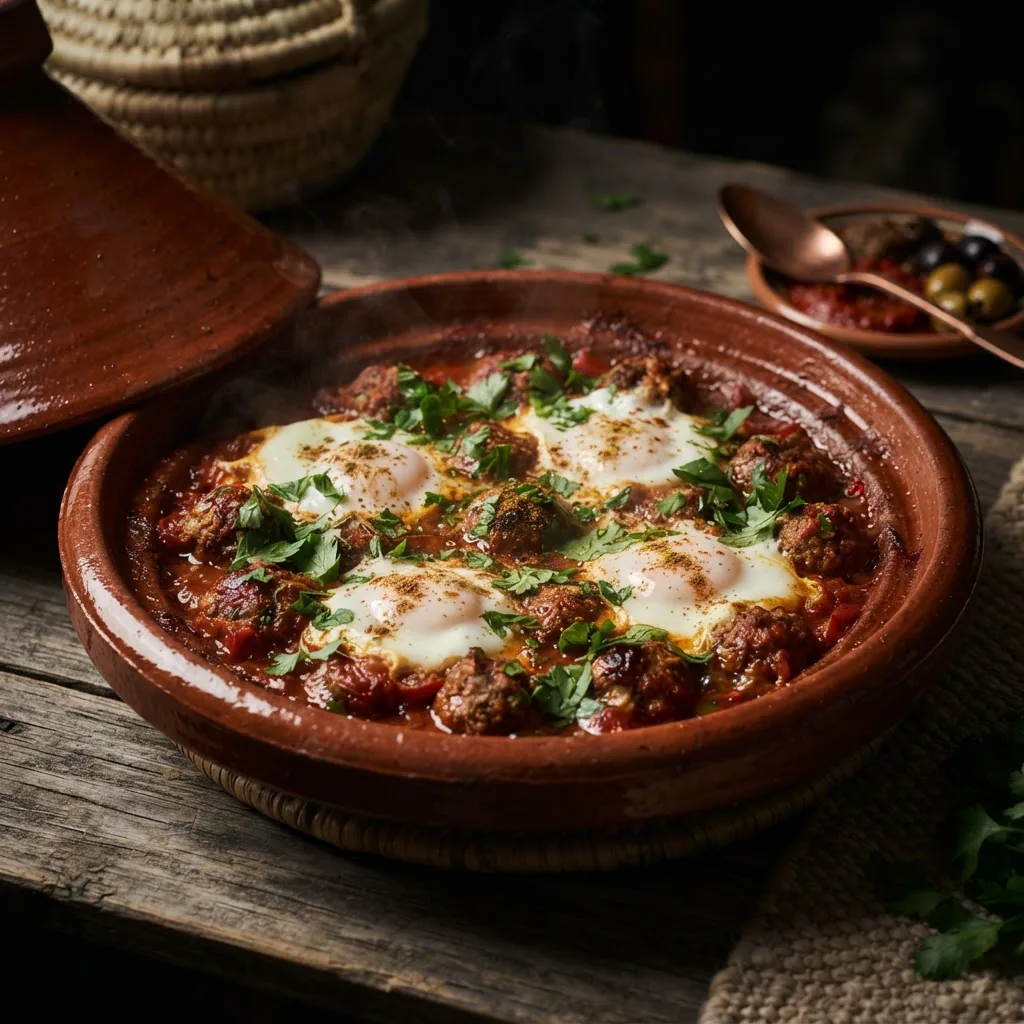
Kefta mkaouara — meatballs "cooked in the tagine" — is the canon's most beloved everyday record: small spiced meatballs simmered in a cumin-scented tomato sauce until the two become one, and then, in the dish's final act, eggs cracked over the bubbling pan to poach in the sauce's surface. It is the home cook's tagine — an hour from the board to the table, served in the tagine it cooked in, bread for the sopping, and no ceremony beyond the pot itself.
- **Make the kefta small — walnut-size — and brown them honestly.** The meatball's surface flavor is built in the pan before the sauce joins, and the small size lets each spoonful carry a kefta, a sauce, and an egg's trace together. The bridge: none needed; the recipe's whole pantry is the daily row.
- **The eggs' clock is the last three minutes of the meal.** Everything else can wait gently; the eggs cannot. Time the bread and the table to the eggs.
Doneness & Quality Checkpoints
- The kefta: walnut-small, browned at the faces, finished in the sauce.
- The sauce: cumin-forward, spoon-coating, one notch past salted.
- The eggs: three minutes' cover, molten yolks, to the table at once.
Kefta Mkaouara
Prep: 30 minutes · Cook: 40 minutes · Total: About 1 hour 15 minutes · Serves 4
Ingredients
The kefta
- 500 g ground beef (or lamb — the fat should run 20 percent)
- 1 onion (about 150 g), grated; 3 cloves garlic (about 12 g), grated
- A fist of parsley (about 20 g), minced; 1 tsp cumin; ½ tsp paprika; ½ tsp cinnamon (the quiet note); ½ tsp chile flakes or 1 tsp #91 harissa
- 1 tsp salt; black pepper
The sauce
- 3 tbsp olive oil (about 40 g); 1 onion (about 150 g), grated; 3 more cloves garlic, sliced
- 800 g tomatoes, grated, or 1 large can crushed; 1 tbsp tomato paste (about 15 g)
- 1½ tsp cumin; ½ tsp paprika; ½ tsp chile flakes; 1 tsp salt
- 100 ml water (about 100 g); a fist of cilantro (about 15 g), half in the sauce, half at the finish
The finish
- 4 eggs (about 200 g); more cilantro; bread (about 300 g) for the table
Instructions
- **Brown the kefta (10 minutes).** Roll the mixed meat to small balls (about 20 of them); brown in the oil in the tagine or wide pan over medium-high — the oil running near 180 °C — — turning to catch color on all faces, in two batches if the pan crowds — and lift out to a bowl. Checkpoint — the kefta should be browned at their faces but not cooked through — the center finishes in the sauce, and a gray-through meatball at this stage is over-done at the next. The pan should hold a browned fond; it becomes the sauce's floor.
- **The sauce, and the kefta's return (25 minutes).** Soften the onion and garlic in the pan's oil and fond, 5 minutes; add the tomatoes, paste, spices, salt, and water, and simmer 10 minutes to a thick, fragrant sauce. Return the kefta (and any of their bowl's juices), cover, and simmer gently 15 minutes more, until the meatballs are cooked through and the sauce has thickened to coat them heavily. Checkpoint — the sauce should be reduced to a spoon-coating, cumin-forward intensity — the kefta visible at the surface, half-submerged, their flavor now in the sauce and the sauce's now in them. Taste: salt one notch past comfort (the eggs will calm it), the heat at the table's tolerance.
- **The eggs (3–4 minutes uncovered).** Uncover, raise the flame to a steady bubble, and make four wells in the sauce's surface with the spoon's back; crack an egg into each. Cover again 3 minutes — the whites just set, the yolks still molten — off the heat, cilantro over, and to the table immediately. Checkpoint — eating test, straight from the tagine with bread: the sauce's tomato-cumin depth around a tender kefta, and then the egg — its yolk broken into the sauce at the diner's own spoon-stroke, turning a bite to velvet. The bread's job is everything the sauce gives it. It should taste like the home kitchen's own tagine — unpretentious, complete, and better than nearly anything the same hour and ingredients could otherwise become.
Finish & Plate
The tagine itself to the table's center — the eggs' gold in the sauce's red, the cilantro's green over — a spoon in the pot and bread in every hand. The dish serves itself; the bread is the service.
Troubleshooting
| Symptom | Cause | Fix |
|---|---|---|
| Sauce thin, pools at the bread | Under-reduced | The coating stage before the kefta's return |
| Kefta dense, heavy | Over-mixed or lean meat | A light hand; the 20 percent fat |
| Eggs' yolks set hard | Over-covered or held | Three minutes; to the table at once |
Storage, Make-Ahead & Variations
- The kefta-and-sauce pot keeps 3 days (improves); the eggs are always the minute's own. The leftover pot, picked of half its meatballs, becomes the #21 batbout's filling or tomorrow's chakchouka base. - Variations: the merguez-substituted version (the #4's sausage), the fierce doubled-harissa register, the cheese-melted modern pan. The #22 wrap and the #86 ojja are the eggs-in-sauce family's other seats on this site.