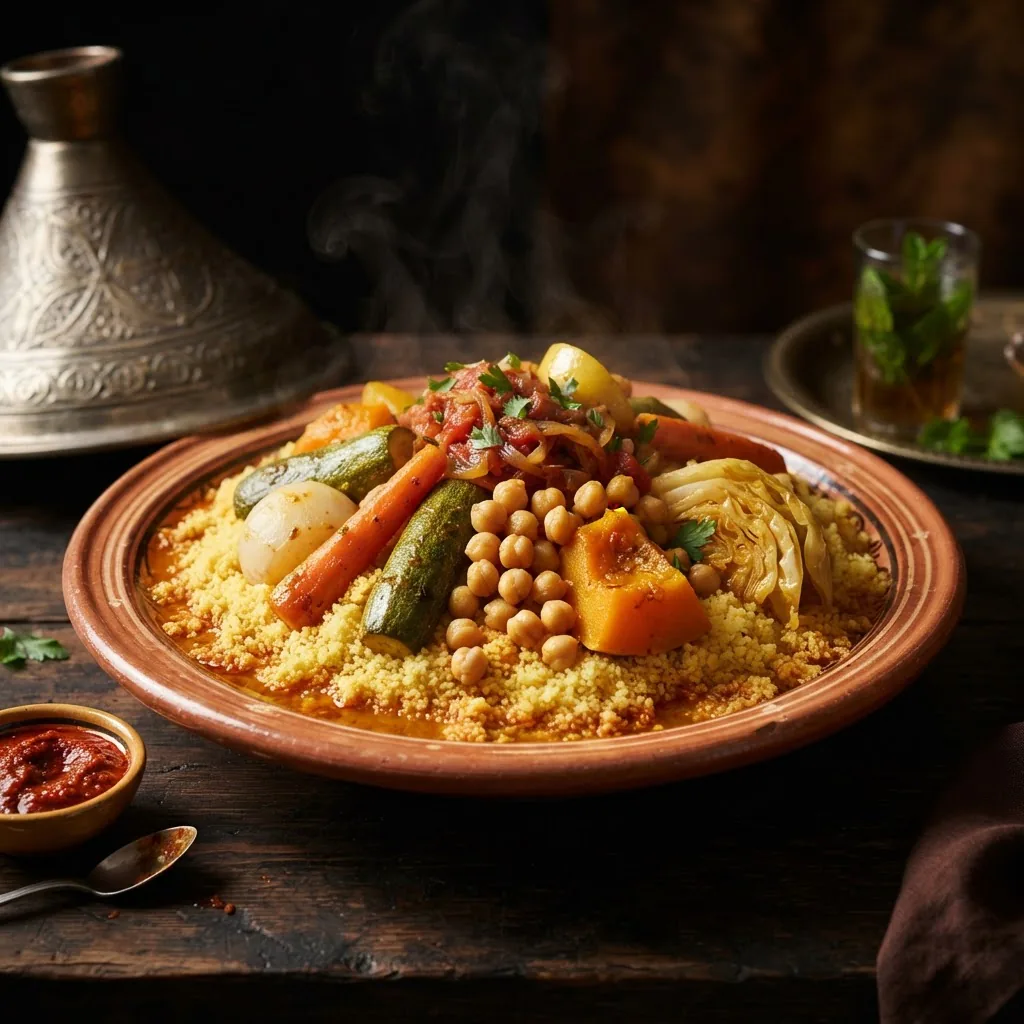
Seven-Vegetable Couscous
Quantities live in the recipe card.
The stew (the bottom story)
The seven vegetables (the count, in the market's order)
The couscous (the top story)
Doneness & Quality Checkpoints
- The stew: deep-brothed, meat at the bone's yield, chickpeas tender.
- The vegetables: staggered, each holding its form for the ring.
- The grain: three steamings, three workings, distinct and perfumed.
Seven-Vegetable Couscous
Prep: 45 minutes · Cook: 1 hour 30 minutes · Total: About 2 hours 20 minutes · Serves 6–8
Ingredients
The stew (the bottom story)
- 500 g lamb or beef on the bone (shank, neck, short rib), cut to 5 cm pieces
- 2 onions (about 300 g), one sliced thin, one grated; 4 cloves garlic (about 15 g), sliced
- 1 tsp saffron (about 1 g), steeped in 3 tbsp hot water (#120); 2 tsp ginger; 1 tsp turmeric; 1 tsp white pepper; ½ tsp cinnamon; 1 tbsp tomato paste (about 15 g)
- 2 preserved lemon pulps (#92) or 1 whole lemon's juice; 100 g chickpeas, soaked 8 hours; 3 tbsp olive oil (about 40 g); 2 tsp salt; a fist of cilantro and parsley (about 30 g), tied
- 2 litres water
The seven vegetables (the count, in the market's order)
- 2 carrots (about 200 g), halved lengthwise; 2 turnips (about 300 g), quartered
- ½ a small cabbage (about 300 g), in wedges; 2 zucchini (about 300 g), halved
- 1 large potato (about 250 g) and 1 sweet potato or pumpkin quarter (about 250 g), in large pieces
- 1 bunch coriander stems or 2 celery stalks (the seventh, argued, and honest either way)
The couscous (the top story)
- 500 g medium couscous (the rolled grain — not the instant's promise); 2 tbsp olive oil (about 25 g); 1 tsp salt; butter (about 40 g) for the final working
Instructions
- **The stew's first hour.** Brown the meat lightly in the oil; add the onions, garlic, spices, tomato paste, and preserved lemon; 3 minutes to the pot's perfume. The water, the chickpeas, the herb bundle, and the salt — bring to the barest tremble (95 °C), cover, and simmer 1 hour, until the meat is nearly tender and the broth runs deep. Checkpoint — the broth at the hour: deep gold-brown, saffron-scented, one notch under final salt (the vegetables will calm it). The chickpeas should be tender to the bite's center.
- **The vegetables' staggered entry (25 minutes).** Add the carrots and turnips first; 10 minutes, then the cabbage and the seventh's celery or coriander stems; 10 more, and finally the zucchini, potato, and pumpkin — 5 to 8 minutes only, each vegetable to its own tenderness, all holding their shapes. Checkpoint — the law of the late vegetables: every piece must hold its form on the platter — a dissolved vegetable has missed its clock. Taste each kind at its pull: carrot tender-firm, zucchini just yielding, potato at the fork's edge. Lift all the vegetables to a warm bowl; the meat stays in the broth.
- **The couscous's three steamings (while the stew runs).** Work the dry couscous with the oil and a cup of the stew's broth, rubbing the grains apart between the palms; steam it over the stew 10 minutes. Turn it out, salt it, work it again with a cup of broth and let it drink 5 minutes; steam 10 more. A third time — the last working with butter, the grains rubbed to separate — and steam 10 final minutes, until the couscous is twice its dry volume, each grain distinct and tender. Checkpoint — the three-steam law: each steaming sets and swells the grain, and each working separates what the steam has joined — the couscous should end light, distinct, and never pasty, its perfume unmistakably the stew's own. This is the craft the instant grain never learned.
- **The assembly — the great platter.** The couscous mounded to the platter's center, a ladle of broth worked through it; a well made at the crown's center, the meat set in it; the vegetables arranged in their ring — each kind in its own arc — around; more broth poured at the table until the platter's edge drinks, the reserved broth's cup beside. Checkpoint — eating test, everyone from the platter's shared expanse: the couscous's perfumed lightness soaked with the broth's depth, a vegetable and a piece of meat in the same scoop — the cabbage's silk against the carrot's sweet-firm, the pumpkin's gold against the chickpea's earth — the preserved lemon's register running through the whole. It should taste like Friday: the week's work ending in the week's one certain plate.
Finish & Plate
The great platter to the table's center — the crown of meat, the ring of vegetables, the broth's ladle at the diner's own hand — and everyone eating from the shared expanse, which is the dish's oldest instruction.
Troubleshooting
| Symptom | Cause | Fix |
|---|---|---|
| Couscous pasty, dense | Under-worked or under-steamed | The three workings, the three steamings |
| Vegetables dissolved | All in at once | The staggered clock — roots first, gourds last |
| Broth weak, thin | Meat under-stewed or water over-run | The hour before the vegetables; the 2 litres' measure |
Storage, Make-Ahead & Variations
- The stew keeps 3 days refrigerated and improves (the Friday pot running into the week — the canon's own economy); the couscous is steamed to the day, though the leftover grain re-steams passably. The stew freezes 2 months as the canon's mother-broth. - Variations: the tfaya-crowned sweet version, the fish-brothed coastal one. This record is the canon's master; the #57 berkoukes and the #70's osban service are its family's other seats on this site.