Lamb Tangia
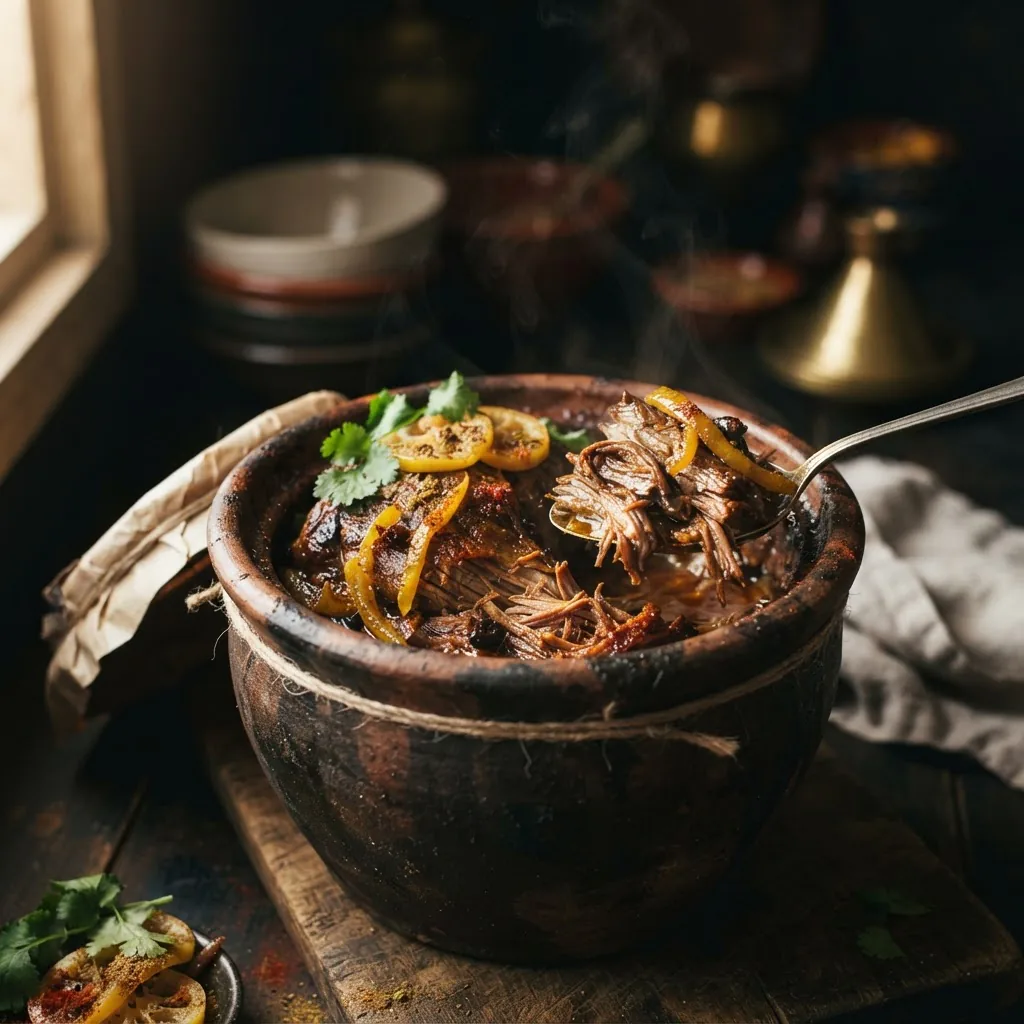
Quantities live in the recipe card.
Ingredients
- the bone gives the deeper pot)
- the scant measure that becomes the sauce
Doneness & Quality Checkpoints
- The seal: dough-ring tight or foil double-crimped — the steam's whole trust.
- The clock: four hours at the lowest hold, unlifted, unstirred.
- The essence: a scant inch, intensely concentrated, at the break.
Lamb Tangia
Prep: 25 minutes · Cook: 4 hours (largely unattended) · Total: About 4 hours 30 minutes · Serves 4–6
Ingredients
Ingredients
- 1.2 kg lamb shoulder, cut to 5 cm pieces (on the bone or off — the bone gives the deeper pot)
- 2 preserved lemon pulps (#92) or 1 whole lemon's juice and a strip of peel
- 1 head garlic (about 30 g), cloves separated and smashed; 1 tbsp grated fresh ginger (about 10 g)
- 1½ tsp cumin; 1½ tsp paprika; 1 tsp turmeric; ½ tsp saffron (about 0.5 g), steeped in 3 tbsp warm water (#120); ½ tsp black pepper; 1½ tsp salt
- 3 tbsp olive oil (about 40 g) or 2 tbsp smen (#95 — the traditional); a fist of parsley and cilantro (about 30 g), tied
- 150 ml water (about 150 g) — the scant measure that becomes the sauce
- Optional, the finish: a handful of olives or preserved lemon peel threads; rice or couscous to serve
Instructions
- **Mix, seal, and trust (15 minutes).** Combine the lamb, all the spices, the garlic, the preserved lemon pulp, the saffron water, the oil, the herbs, and the scant water in the vessel; mix thoroughly with the hands — every piece coated — and seal the lid with a dough ring or a double foil crimped tight. Into the 130 °C oven (or the ashes' equivalent): four hours, untouched. Checkpoint — the seal is the recipe's whole law: the vessel must hold its steam entire — a dough ring (a simple flour-water rope laid at the lid's rim) or a foil crimp pressed double. The old test: the urn was sealed with paper and string, and a torn paper at noon meant a ruined tangia. Trust the seal and do not lift it; the first hour's lifting loses the steam the four hours depend on.
- **The four hours — the unwatched clock.** Nothing. Do not stir (there is nothing to stir); do not peek; do not add. The meat cooks in the sealed steam, and the oven's low hold is the hammam's ashes translated: dying heat, gently, for hours. Checkpoint — at the fourth hour's end, the vessel opened at the table (the seal broken with the ceremony it has earned): the lamb should be falling from any bone, the herbs collapsed, and the pot's bottom holding a scant inch — barely a sauce-cup's worth — of the most concentrated lamb essence the canon produces. The smell at the seal's break is the dish's own theater.
- **The finish and the service.** Off the heat (or out of the oven, rested 10 minutes sealed): the olives or the preserved lemon threads stirred through the essence, the herbs lifted out, and the tangia served from its own vessel with bread or over rice — the tradition's own simplest service. Checkpoint — eating test: the lamb spooned from the urn with the essence — each piece so tender it yields to the bread's pressure, the flavor intensely lamb-spice-lemon, the scant sauce so concentrated that a spoonful dresses a plate. It should taste of hours no attention bought: the dish's whole argument is that the cook's work ended at the seal.
Finish & Plate
The vessel to the table and the seal broken before the diners — the pot's own ceremony — the lamb spooned with its essence over rice or into bread, the olives' brine or the lemon threads at the last. The dish's service is its opening.
Troubleshooting
| Symptom | Cause | Fix |
|---|---|---|
| Pot dry, meat tough | Seal leaked or the heat too high | The dough-ring seal; the lowest hold |
| Essence thin, plentiful | Water over-measured at the start | The scant 150 ml — trust the steam |
| Meat dried at the edges | Oven running hot | 120–140 °C, a check at the third hour |
Storage, Make-Ahead & Variations
- The finished tangia keeps 3 days refrigerated and improves (the essence deepening) — the reheat is a covered simmer of 10 minutes, no more. The frozen essence, ice-cubed, is the canon's strongest stock. - Variations: the winter's version with the #30 chestnuts folded at the end, the fierce harissa stirred register. The #32 m'hammar is tangia's fast sibling on this site — the same doctrine at a tenth the patience — and the #35 urn's story is Marrakech's own.