Fish Tagine Chermoula
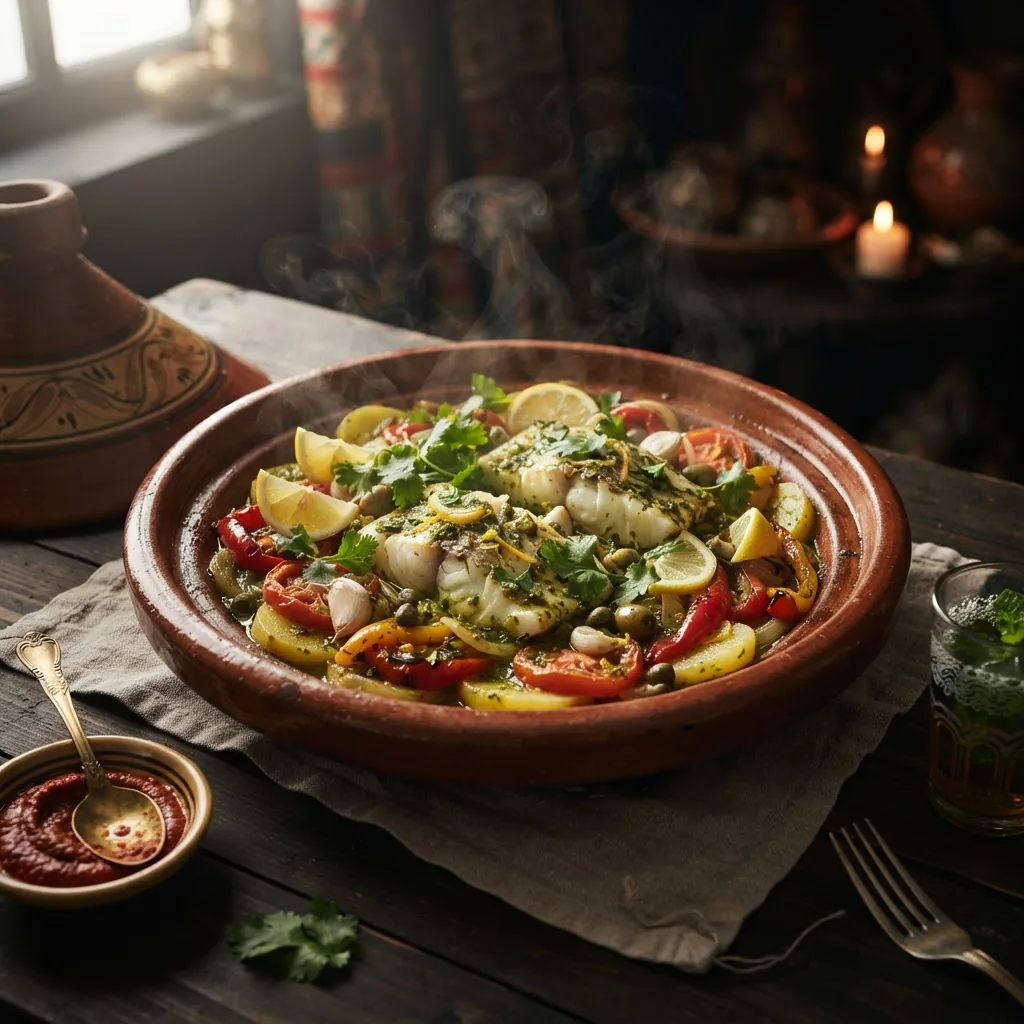
Quantities live in the recipe card.
Ingredients
Doneness & Quality Checkpoints
- The marinate: an hour, the scores drunk with chermoula.
- The bed: layered and painted, the potatoes the floor, the water at the side.
- The steam: the gentlest murmur, the fish at the bone's pull, the raw sauce at the end.
Fish Tagine Chermoula
Prep: 35 minutes, plus 1 hour marinating · Cook: 35 minutes · Total: About 2 hours 15 minutes · Serves 4
Ingredients
Ingredients
- 1 whole fish (about 1.2 kg — bream, sea bass, or snapper), cleaned, scaled, scored three times a side; or 4 thick steaks (about 200 g each)
- 1 full recipe chermoula (#93) — or the quick build: 2 fists cilantro (about 40 g), 6 cloves garlic (about 25 g), 2 tsp cumin, 1 tsp paprika, ½ tsp saffron water (#120's steep), the juice of 1½ lemons (about 45 ml), 5 tbsp olive oil (about 65 g), salt — half for the fish, half for the vegetables
- 3 potatoes (about 400 g), sliced to 5 mm rounds; 3 tomatoes (about 300 g), sliced thick
- 1 onion (about 150 g), sliced to rings; 1 green or red pepper (about 120 g), sliced in rings; a handful of green olives (about 80 g)
- 2 preserved lemon peels (#92), sliced to threads; a fist of cilantro (about 15 g) at the end
- 100 ml water (about 100 g)
Instructions
- **Build the vegetable bed (10 minutes).** In the tagine or wide heavy pot, layer the potato rounds as the base's floor, the onion and pepper rings over them, the tomato slices last — each layer painted with strokes of the reserved chermoula as it is laid. The water poured gently down the pot's side. Checkpoint — the bed should be level and generous — the fish steams upon it, and the vegetables (the sauce's future) want the even depth. Taste a tomato slice: the chermoula's paint should be distinctly on it; the bed is seasoned layer by layer.
- **The fish's steam (25–30 minutes at the gentlest tremble).** Lay the marinated fish on the bed, pour its marinade's remains over, the olives and the preserved lemon threads around, and cover. Cook at the barest simmer — the pot's faintest murmur, roughly 90 °C at the surface — 25 minutes for steaks, 30 for a whole fish, until the flesh at the thickest score pulls at the bone's nudge and the vegetables have collapsed into a chermoula-perfumed, spoonable bed beneath. Checkpoint — the fish's doneness at the bone: the flesh opaque and just-parting at the score's depth — the pull test at the thickest point, not the clock's guess. The bed beneath: the potatoes tender to the fork, the tomatoes melted, the whole carrying chermoula's green through the steam's perfume. Do not over: a fish tagine held past its moment falls to the pot (a good fallen dish, but not the one intended).
- **The finish — bright, never cooked.** Off the heat: the remaining reserved chermoula spooned over the fish's back (the raw sauce's fire, the two-moments law's close), the fresh cilantro scattered, and the pot rested 5 minutes before the table. Checkpoint — eating test, with bread or the #34 couscous: the fish's silk over the vegetable bed's perfume — the chermoula's herb-garlic-citrus running through every element, the preserved lemon's salt-bitter thread and the olives' brine between — and the raw sauce's finish over the steamed, the two registers meeting only in the mouth. It should taste like the Atlantic's tagine: the day's fish, the coast's marinade, and the pot's gentlest steam.
Finish & Plate
The tagine to the table's center — the fish on its bed, the raw chermoula's green over its back, the lemon threads and olives visible — bread at every hand, and the pot's own serving as the ceremony.
Troubleshooting
| Symptom | Cause | Fix |
|---|---|---|
| Fish fell to the pot | Over-steamed or held past the pull | The bone's-pull test, not the clock |
| Bed watery, no sauce | Water over-poured or under-steamed | The scant 100 ml; the potatoes are the binder |
| Chermoula perfume absent | The raw sauce skipped at the end | The two-moments law — the raw sauce is the voice |
Storage, Make-Ahead & Variations
- The fish is served the hour (the reheated fish tagine is a lesser thing; the fallen pot becomes the next day's chermoula-flavored sauce for rice). The chermoula keeps 3 days; the vegetable bed's leftovers are the cook's own prize. - Variations: the sardine version, the #51 meatballs' chermoula seat, the fennel-fringed Atlantic build. The #93 chermoula and the #92 preserved lemons are this record's pantry parents.