Rfissa with Fenugreek
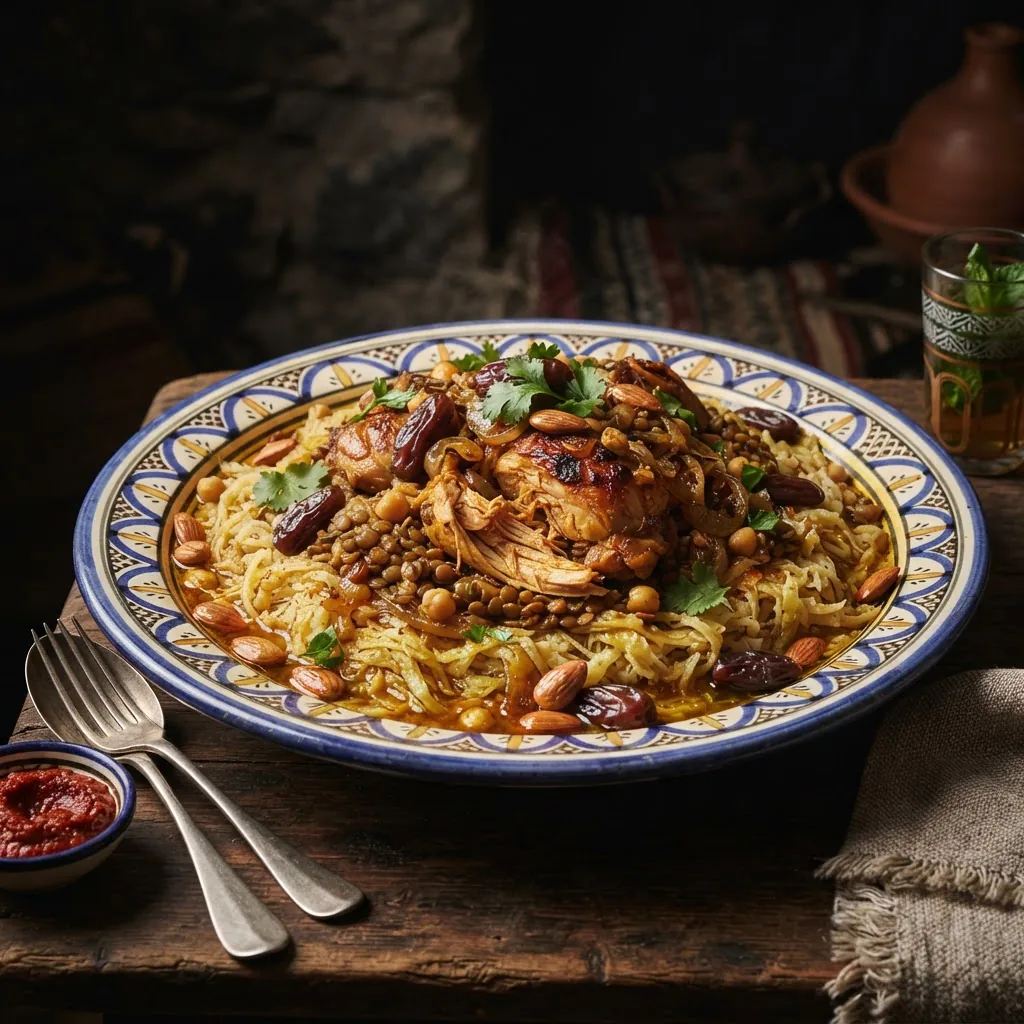
Rfissa is the dish Morocco feeds its new mothers and its aching joints: chicken slow-cooked with fenugreek seeds — the grain whose bitter-medicinal depth runs through the region's oldest pharmacopoeia — and ras el hanout, ladled over torn msemen (#16) or store-bought mille or trid pastry, which soak the broth to a soft, spoonable mass. It is the canon's most medicinal record after the #15 babbouche, and the most beloved: a dish served to restore, eaten with the hands' bread-torn ceremony, and defended fiercely by everyone who has been fed it back to strength.
Quantities live in the recipe card.
Ingredients
- the soaking tames the bitterness, and the water is discarded)
- and a large handful more, chopped, at the end
The base (the bread that is not bread)
- the restorative's everyman base
- **Soak the fenugreek the night before.** The seeds' bitterness is the dish's medicine and its danger: the overnight soak and the water's discard leave the seed's savory-medicinal depth without the raw edge. The bridge for the whole record is honesty itself — this is restorative food, and its base has been every torn starch the kitchen held.
- **The msemen (or the bridge) is made or bought before the pot's end** — the base wants to be fresh-torn and hot-topped, and the pot's last 20 minutes are its window.
Doneness & Quality Checkpoints
- The fenugreek: soaked overnight, water discarded, tamed in the pot.
- The broth: cloudy gold, viscous-faint, the bitter thread present but met.
- The base: hot-torn, broth-soaked, the five-minute rest before the table.
Rfissa with Fenugreek
Prep: 45 minutes · Cook: 1 hour 20 minutes · Total: About 2 hours 15 minutes (plus the msemen or store bridge) · Serves 4–6
Ingredients
Ingredients
- 1 whole chicken (about 1.5 kg), cut to 8 pieces
- 2 tbsp fenugreek seeds, soaked overnight in water to cover (about 20 g — the soaking tames the bitterness, and the water is discarded)
- 3 onions (about 450 g), sliced thin; 5 cloves garlic (about 20 g), sliced
- 1 tbsp ras el hanout (#94); 1 tsp ginger; ½ tsp turmeric; ½ tsp black pepper; a good pinch of saffron (about 0.5 g) in 3 tbsp warm water (#120)
- 1 tsp salt; 3 tbsp olive oil or 1 tbsp smen (#95); a fist of cilantro (about 25 g), tied — and a large handful more, chopped, at the end
- 1 litre water (about 1 kg); 1 tbsp lentils (optional, the restorative's addition, about 15 g)
The base (the bread that is not bread)
- 8 msemen (#16's recipe — a half-batch, made plain), or the working bridge: 400 g store mille-feuille/trid pastry or even thick crepes, torn to bites
- Or the most honest bridge of all: 300 g of day-old khobz or crustless bread, torn — the restorative's everyman base
Instructions
- **The pot's beginning (10 minutes).** Warm the oil in the tagine or wide heavy pot; add the chicken pieces, turning to gold at the edges, 4 minutes. Add the onions, the drained fenugreek, the garlic, the spices, and the saffron water; stir 3 minutes to the perfume — the fenugreek's scent rising with the ras el hanout, a smell the region knows as medicine. Checkpoint — the pot's fragrance should be warm-bitter-savory, the fenugreek present but tamed (the soak's work) and the ras el hanout's row behind it. The onions beginning to soften.
- **The long simmer (1 hour at the tremble).** The water, the herbs, the lentils if running, and the salt — cover, adjust to the barest tremble (95 °C), and cook 1 hour, until the chicken is falling-tender and the broth runs a deep, cloudy gold, the fenugreek seeds plump and soft through it. Halfway, taste and hold the salt — the broth reduces and concentrates. Checkpoint — the broth at the hour: deep gold, faintly viscous from the fenugreek's and the onions' work, the flavor savory with a bitter-medicinal thread that the table's cilantro and lemon will meet. The chicken should yield at the bone's twist; lift half the pieces and strip their larger bones (the dish is eaten with the spoon, and the bones' removal is the cook's courtesy).
- **The assembly — the torn base, the ladled pot, the raw green.** In the wide serving dish: the hot torn msemen (or the bridge's torn pastry) spread to a deep, irregular layer. The chicken and the broth ladled generously over — the base drinks the broth and softens to the spoon's work — and the dish rests 5 minutes for the soaking's work. The last handful of cilantro scattered over, and the table's lemon. Checkpoint — eating test, by spoon from the shared dish: the soaked base's soft mass — msemen's layered silky chew gone broth-tender — carrying the broth's deep savor and the fenugreek's distinctive thread, the chicken's silk through it, and the cilantro's green brightness meeting the medicinal register at each bite. It should taste like restoration itself: the dish does not pretend to be anything but strengthening, and its honest depth is its flavor.
Finish & Plate
The great dish to the table's center — the soaked base under the chicken's gold, the cilantro's green over — spoons for every hand, the lemon's wedge at the side, and the household's blessing as the service.
Troubleshooting
| Symptom | Cause | Fix |
|---|---|---|
| Broth's bitterness sharp | Fenugreek un-soaked or over-measured | The overnight soak, water discarded |
| Base soured to paste | Over-ladled or over-rested | Broth by ladles; the five-minute rest |
| Broth thin | Water over-measured or simmer short | The litre's measure; the full hour |
Storage, Make-Ahead & Variations
- The pot keeps 3 days refrigerated and improves (the broth's restorative logic deepening); the base is always fresh-torn and the assembly at the meal. The pot freezes 2 months. - Variations: the lentil-added restorative, the lamb version, the store-trid weeknight. The #16 msemen is the base's own record; the #94 ras el hanout and the #120 saffron are this pot's parents.