Khobz — The Round Loaf of the Everyday Table
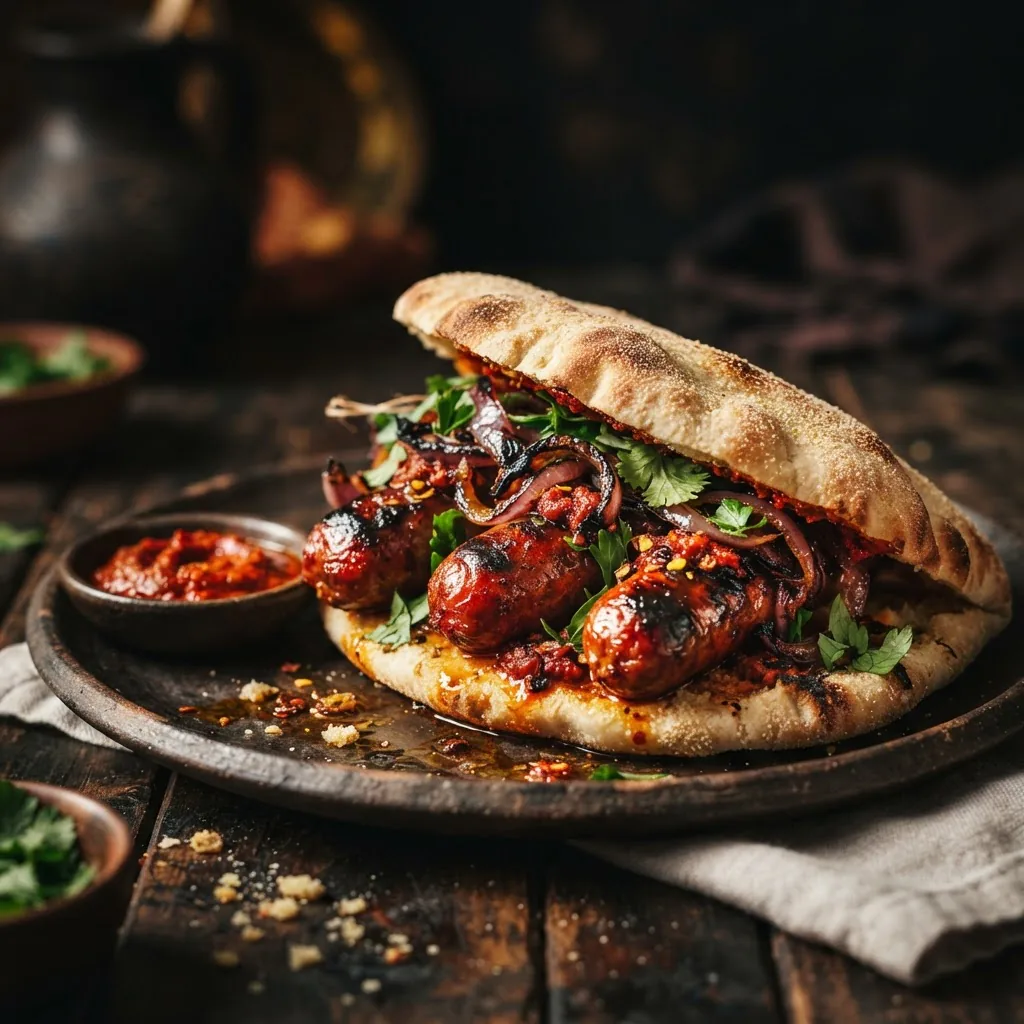
Quantities live in the recipe card.
Ingredients
Doneness & Quality Checkpoints
- The autolyse's 20-minute rest before the salt's entry
- The three fold-rounds' patience at the wet dough's strength-building
- The second proof's edge — the dimple's slow fill, the shake's jiggle
- The 240 °C stone's law, the hollow drum, the light loaf's weight
- The full hour's cool at the rack's air
Khobz — The Round Loaf of the Everyday Table
Prep: 30 min (plus 1 h 40 min rising) · Cook: 25 min · Total: 2 h 35 min · Makes 2 loaves (8 pieces each)
Ingredients
Ingredients
- 500 g flour (about 4 cups), the bread flour's strength — or the half-and-half: 250 g white, 250 g whole wheat's honest depth
- 100 g fine semolina (about ⅔ cup), the dough's and the peel's both
- 7 g instant yeast (about 2¼ tsp)
- 10 g salt (about 2 tsp)
- 20 g olive oil (about 1½ tbsp)
- 380 ml lukewarm water (about 380 g), the dough's own law below
- The finish: more semolina for the peel, and the optional milk-wash or egg-wash's shine
Instructions
- **The dough's first mix (10 minutes, the autolyse's mercy).** The flours, semolina, and yeast whisked; the water and oil added and stirred to the shaggy whole — then the 20-minute rest before the salt's entry (the autolyse's own law: the flour's hydration and the gluten's first development running at the salt-free mercy, the dough's later work halved by the rest's patience). Checkpoint — the autolyse's proof at the rest's end: the shaggy mass has run to the soft, supple, faintly-smooth puddle's edge — the flour's own work begun — and the salt's scattering and the fold-ins follow at the wet dough's law (the squeeze-and-fold's technique, never the floured board's traditional knead: this dough never touches the bench's flour at the making's stage).
- **The bulk rise and the folds (about 1 hour, the fold's law).** The dough covered at the room's warmth (the 22–24 °C register) — and the fold's discipline: at every 20-minute interval, the wet hand's reach under the dough's edge and the fold-over's stretch, the bowl's quarter-turn, the second fold — four folds' round, three rounds' patience through the hour. Checkpoint — the bulk's proof at the hour's end: the dough domed and jiggly, the surface run to the smooth gloss — and the windowpane's test at the walnut's pinch: the wet dough's stretch runs to the translucent's membrane (the wet hands' mercy at every touch). The fold's whole architecture lives here: the slack dough's strength built by the turn's patience, the crumb's even openness run at the fold's three rounds.
- **The shape and the second rise (40 minutes).** The dough halved at the wet hand's divide; each half shaped at the scruffy round's law — the wet surface's gather to the boule's tension, the semolina's bed laid at the peel's expanse — and the rounds rested at the semolina's dust, covered loosely, to the puffy-domed second proof. Checkpoint — the second proof's edge: the rounds domed and slack-jiggly at the peel's shake, the floured finger's dimple filling slowly — the khobz's own law runs the proof to the edge's fullness (the over-proof's collapse at the oven's heat runs the flat's road, and the under-proof's density runs the close crumb's).
- **The bake (22–25 minutes at the 240 °C stone's law).** The oven at its highest's preheat (the 240–250 °C register, the stone or the upturned tray's own heat-mass), the rounds slid to the hot stone at the peel's confidence — scored at the surface's quick, shallow cross or the khobz's own pinwheel — and baked 22–25 minutes to the deep gold and the hollow base. Checkpoint — the doneness's three proofs together: the crust's deep-gold evenness (the semolina's toast at the base's face), the hollow drum's tap at the loaf's underside, and the loaf's own weight's honesty — the khobz's finished loaf runs light for its size at the open crumb's own architecture (the dense loaf's weight runs the close crumb's failure at the hand's own scale).
- **The cool's law.** The loaves rested at the rack's air — the full hour's patience at the everyday's mercy (the crust's crackle setting, the crumb's structure's finishing at the steam's own escape). Checkpoint — eating test: the first tear — the crust's semolina crackle giving to the crumb's open, spongy, faintly-chewy sponge (the pot's sopping architecture: the bread's torn face run through the #61's pan or the #18's broth, the crumb's open cells carrying the sauce's whole weight) — the wheat's honest sweetness, the olive oil's faint fruit, the salt's right edge. It should taste like the table's own ground — the everyday loaf that every pot in this corpus was written to meet.
Finish & Plate
The loaf's own service is the corpus's whole running stage-direction: the basket's tear at the pot's side (#18's bowl, #61's pan, #34's couscous, the #1's brik's ceremony), the heel's sopping at the sauce's last, the day-two's toast's mercy at the breakfast's honey and the #96 amlou's swipe. The two loaves' own week: the first's day at the crackle's fullness, the second's keeping at the bread box's law, the third-day's toast's honest second life.
Troubleshooting
| Symptom | Cause | Fix |
|---|---|---|
| Crumb close, dense | The hydration's rescue-flour or the fold's shortfall | The wet hand's law; the three rounds' patience |
| Loaf flat, the spread's disc | The over-proof's edge | The dimple's slow-fill's watch — the oven meets the loaf at the edge, not past it |
| Base pale, soft | The stone's under-preheat | The full 40-minute preheat's mercy at the stone's mass |
| Crust leathery, not crackled | The cool's rush at the bag | The rack's full hour — the bag's seal runs the leather's steam |
Storage, Make-Ahead & Variations
- The loaf keeps 3 days at the bread box's or the paper bag's law (the refrigerator's humidity runs the staling's acceleration — the fridge's own myth) and the sliced loaf's freezer-month runs the toast's standing supply. The variations: the whole wheat's deeper register (the half-and-half's own law above), the anise's whisper at the festival loaf, the barley's winter honesty, the stuffed khobz's own feast-road at the #25's filling.