Djej Bil Zaytoun
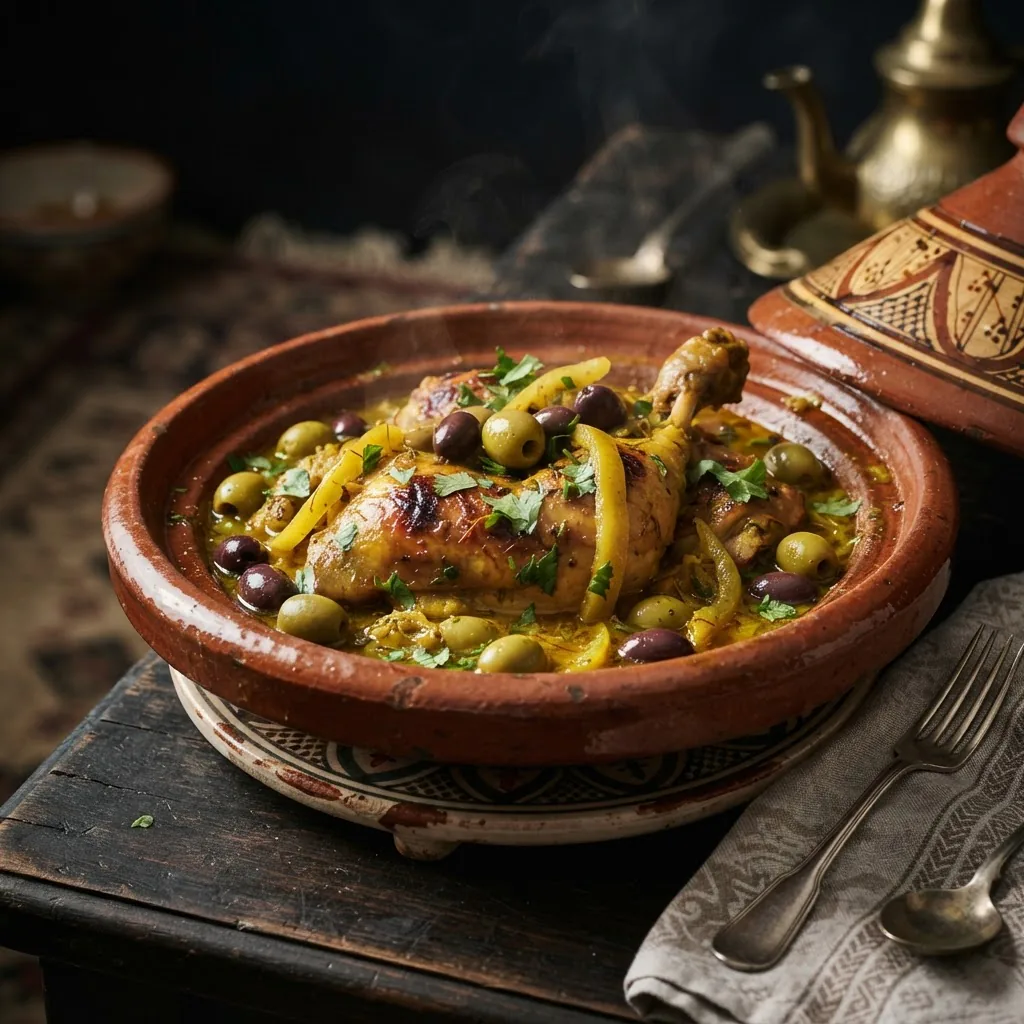
Quantities live in the recipe card.
Ingredients
- the doubled measure, this record's signature
Doneness & Quality Checkpoints
- The pot: the #31's tremble, the half-height liquid, the hour's marinade held.
- The olives: blanched, doubled, the last 10 minutes' entry, holding their bite.
- The finish: peel off the flame, lemon's juice, the butter's gloss — brighter than the master.
Djej Bil Zaytoun
Prep: 25 minutes, plus 1 hour marinating · Cook: 50 minutes · Total: About 2 hours 15 minutes · Serves 4
Ingredients
Ingredients
- 1 whole chicken (about 1.4 kg), cut to 8 pieces (about 175 g each), or 1 kg bone-in thighs
- 1 onion (about 150 g), grated; 4 cloves garlic (about 15 g), grated
- 1 tsp saffron (about 1 g), steeped in 3 tbsp hot water (#120); 1½ tsp ginger; ½ tsp turmeric; ½ tsp white pepper
- 250 g green olives, cracked (the bitter-cured style, about 60 olives), blanched 2 minutes and drained — the doubled measure, this record's signature
- 1 preserved lemon (#92, about 60 g): the pulp (about 15 g) to the pot, the peel in threads at the end
- 2 tbsp olive oil (about 25 g); 1 tsp salt; a fist of parsley (about 20 g), tied; 200 ml water (about 200 g)
- The finish: a knob of butter (about 15 g), the juice of ½ a lemon (about 15 ml), a handful of parsley and cilantro (about 15 g), chopped
Instructions
- **The pot (40 minutes at the tremble).** Marinate the chicken 1 hour as the #31's law. In the tagine or heavy pot, warm the oil, coat the chicken with the onion, garlic, remaining spices, and the saffron water, 3 minutes to the perfume; add the preserved lemon's pulp, the herb bundle, the salt, and the water — barely half the chicken's height. Cover, tremble (95 °C), and cook 30 minutes. Add the blanched olives, cover, and 10 minutes more, until the chicken is tender to the bone and the sauce a scant, golden inch. Checkpoint — the sauce at the 40th minute: gold, saffron-scented, and already carrying the olives' brine-bitter thread — the olives' 10 minutes have flavored the pot without cooking them to mush (their texture is the dish's bite, and they hold at 10; the m'qualli's longer olive clock runs softer).
- **The bright finish (5 minutes off the flame).** Off the heat: the preserved lemon's threads stirred through, the butter's gloss, the lemon's juice — this record's brighter hand — and the chopped parsley-cilantro over. Rest 10 minutes. Checkpoint — the sauce should read brighter and more brine-forward than the #31's — the lemon juice's addition is the sibling's own voice — with the olives' bitterness in balance rather than the m'qualli's deeper saffron-quiet.
- **Serve over bread or rice — the Casablanca weeknight's way.** Checkpoint — eating test: the chicken's saffron tenderness, the olives' bitter-salt chew in every other bite, the lemon peel's perfume and the fresh juice's brightness over the sauce's gold — the whole register a step brighter than the #31's, which is the sibling's argument. Bread or rice beneath, and the weeknight has been met with the canon's own.
Finish & Plate
The tagine to the table's center over bread or rice — the crusty khobz's under-layer drinking the sauce, or the rice's neutral mound beneath — the olives scattered gold-green through the sauce — lemon and parsley at the table, the weeknight met with the canon's own. > **Chef's Note —** the olives' blanch is a two-minute mercy worth its own sentence: the cracked olive's brine-cure carries a salt-shock that a straight-from-the-jar entry delivers to the pot all at once, and the blanch's quick bath lifts the excess while keeping the cure's bitter depth — the same taming the #40's master record runs at gentler scale, and the doubled-olive register this sibling carries makes the step non-negotiable. Taste an olive before and after the blanch once, and the step explains itself. > **Chef's Note —** the #31 and this record are the canonical chicken tagine's two dials on the same chassis: the m'qualli's deep saffron-quiet against the zaytoun's olive-bright — and every Moroccan household's version lands somewhere on the line between them (olives measured, lemon squeezed, the family's own argument). Cook both within a month and the canon's own flexibility becomes the lesson: the chassis holds, the dials turn, and the family's hand is the recipe's last author.
Troubleshooting
| Symptom | Cause | Fix |
|---|---|---|
| Olives mushy | Cooked from the pot's start | The last 10 minutes' entry |
| Sauce too briny-bitter | Olives un-blanched or over-measured | The 2-minute blanch; taste the pot at 40 |
| Chicken dry | Boiled, not trembled | The #31's law, whole |
Storage, Make-Ahead & Variations
- Keeps 3 days and improves (the olives' flavor deepening — the household's standing pot); the chicken, picked, fills the #21 batbout. The #31 m'qualli is the master record and the doctrine's home. - Variations: the olive-doubled celebration version, the preserved-lemon-heavy Fès register. The #92 preserved lemons and the #120 saffron are this record's parents.