Mrouzia Honey Lamb
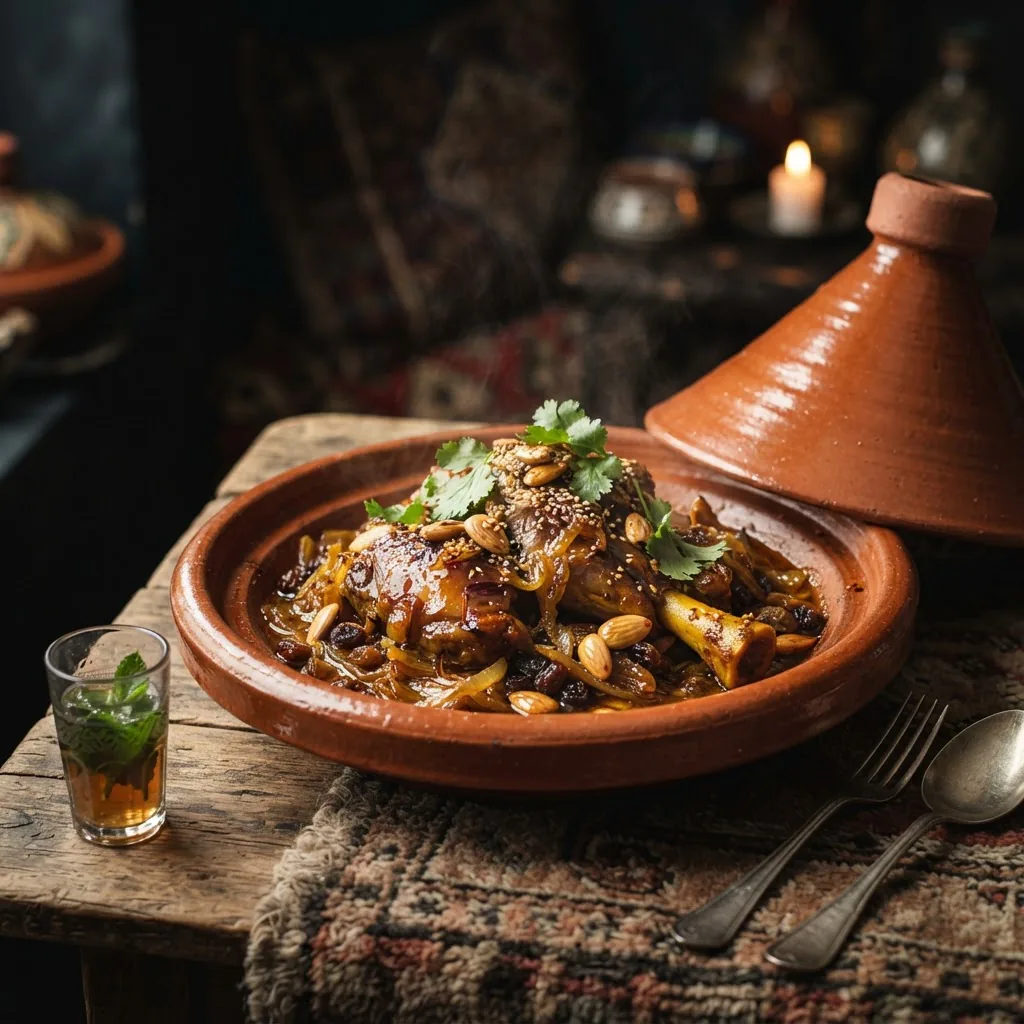
Mrouzia is the Eid al-Adha dish — the feast of the sacrifice's own tagine: lamb cooked long with ras el hanout and saffron, then sweetened with honey and raisins that plump in the pot's own broth, and crowned with the almonds of celebration. Where the #36 prune tagine is the sweet canon's weekday flagship, the mrouzia is its festival argument — richer, spicer, the meat from the holiday's own sacrifice, and the honey measured generously because the occasion calls for it. It keeps for days in its honeyed depth, and that keeping is part of the design: the feast outlasts its day.
Quantities live in the recipe card.
Ingredients
- **Marinate 2 hours — the festival's head start.** The lamb massaged with the ras el hanout, saffron water, half the garlic and onions, and the salt, held in the refrigerator while the raisins soak separately in warm water to cover. The mrouzia's depth begins here.
- **The bridge:** ras el hanout (#94) is the pot's backbone — the blend carries the warm dozen (cinnamon, ginger, pepper, mace, and the row behind them), and a good purchased blend bridges honestly where the #94's recipe runs its own. The honey wants the floral kind; the raisins the golden. Smen (#95) is the traditional fat — its aged depth carries the honey's sweetness against it.
Doneness & Quality Checkpoints
- The braise: saffron-gold, savory-complete, before any sweetness joins.
- The glaze: mahogany, honey-lacquered, the raisins plump and glossy.
- The balance: sweet first, the spice row behind, the salt holding the line.
Mrouzia Honey Lamb
Prep: 30 minutes, plus 2 hours marinating · Cook: 2 hours 15 minutes · Total: About 4 hours 45 minutes · Serves 6
Ingredients
Ingredients
- 1.5 kg lamb shoulder, cut to 5 cm pieces
- 1 tbsp ras el hanout (#94); 1 tsp cinnamon; ½ tsp black pepper; 1 tsp saffron (about 1 g) steeped in 3 tbsp warm water (#120)
- 2 onions (about 300 g), grated; 5 cloves garlic (about 20 g), grated
- 2 tbsp smen (#95) or butter (about 30 g); 1½ tsp salt
- 400 ml water (about 400 g); a fist of cilantro (about 20 g), tied
- 100 g raisins, golden or mixed; 3 tbsp honey (about 60 g); 1 cinnamon stick; 1 tbsp orange blossom water (#107), optional
- 80 g almonds, toasted whole; 1 tbsp sesame seeds (about 8 g), toasted
Instructions
- **The long base (1 hour 45 minutes at the tremble).** Melt the smen in the tagine or heavy pot; add the marinated lamb with the remaining onion and garlic, turning to coat, 5 minutes to the perfume. The water, the herb bundle, and the cinnamon stick — cover, adjust to the barest tremble (roughly 95 °C, one bubble at a time), and cook 1 hour 45 minutes, turning once at the hour, until the lamb is tender to the bone's twist and the onions have dissolved into a scant, saffron-gold sauce. Checkpoint — the sauce at the braise's end: a centimeter of gold silk, intensely savory with the ras el hanout's warm row — one notch under-salted, because the honey's sweetness will need the salt's counter. If the sauce runs thin, uncover for the last 15 minutes to reduce.
- **The honeyed turn (20 minutes).** Add the drained raisins, the honey, and the orange blossom water if running; stir gently through and simmer uncovered 15–20 minutes more, until the sauce darkens to a mahogany glaze that coats the lamb heavily and the raisins have plumped glossy through the pot. Checkpoint — the glaze's test: a lifted piece of lamb wears a mahogany coat that sets as it cools on the spoon's edge — the honey's shine over the saffron's gold. The taste: sweet first, then the ras el hanout's warm depth, the salt holding the line beneath — the mrouzia's balance is sweeter than the prune tagine's, and the balance is the festival's own call.
- **The crown (5 minutes).** Off the flame, rest 10 minutes. The almonds and sesame scattered over at the table, and the mrouzia served with the bread or the couscous that the feast provides. Checkpoint — eating test: the lamb's honey-lacquered silk — so tender the spoon serves it — the raisins' concentrated sweetness bursting between bites, the ras el hanout's warm row carrying the honey's richness against its own depth, and the almonds' toast and the sesame's crackle over all. It should taste like the feast's second day: the mrouzia made after the sacrifice's fresh lamb has rested, cooked to keep, and better on the third day than the first — the pot's honeyed depth steeping overnight into the canon's finest leftover.
Finish & Plate
The tagine to the table's center — the lamb's mahogany under the almonds' gold and the sesame's scatter — with bread or couscous, and the #105 mechouia's sharp bite beside to cut the richness as the table's own mercy.
Troubleshooting
| Symptom | Cause | Fix |
|---|---|---|
| Glaze thin, no lacquer | Honey under-measured or sauce not reduced | The 20-minute open simmer to mahogany |
| Lamb tough beneath the sweet | Honey boiled with the meat too long | The two-stage order — sweet at the end |
| Dish cloying past pleasure | Honey over-run, salt shy | The salt's counter holds; taste at the glaze |
Storage, Make-Ahead & Variations
- Keeps 3 days refrigerated in its glaze (improving — the festival's design); freezes 2 months. The #36 prune tagine is the sweet canon's sibling; the #53 marqa hlowa is its other wing. - Variations: the beef version, the prunes-added register. The #94 ras el hanout, #95 smen, and #120 saffron are this pot's parents — the festival's own pantry row.