Camel Meat Tagine
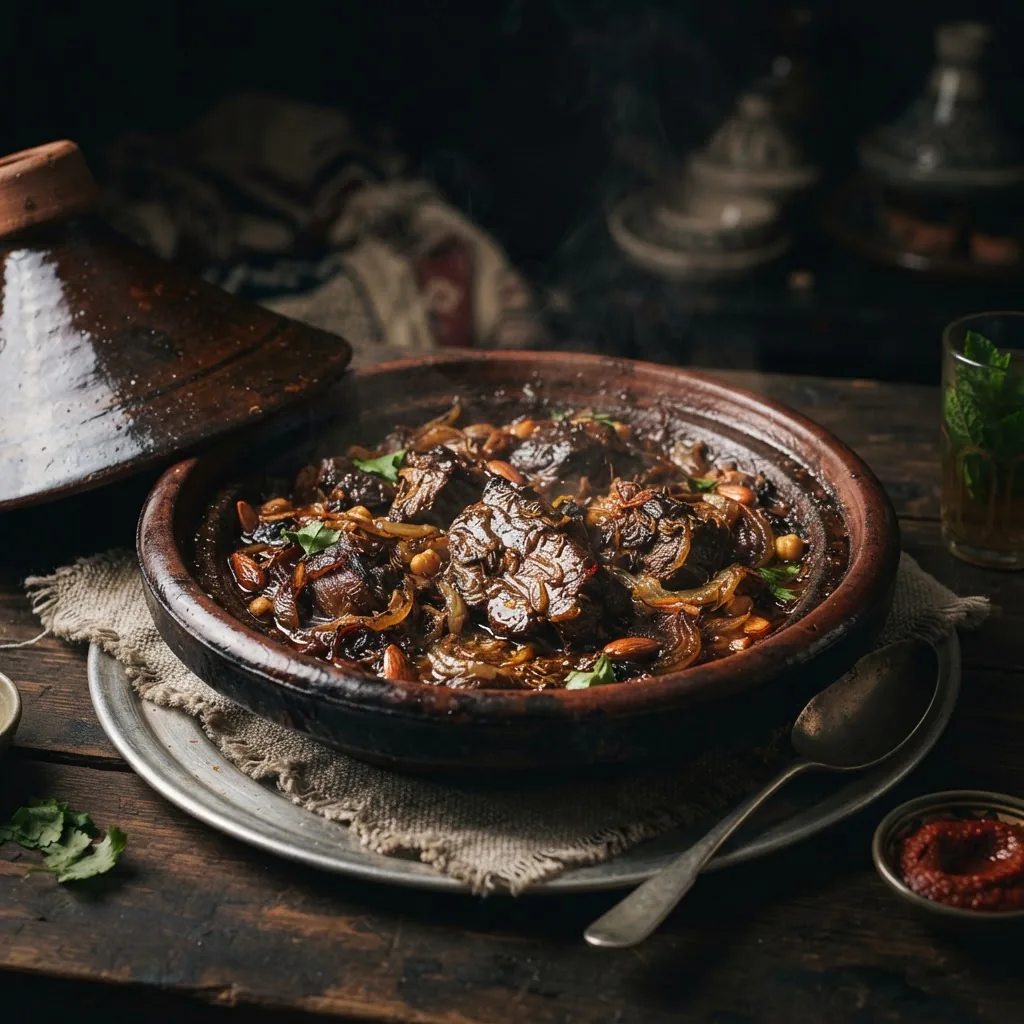
The camel is the Sahara's beef and the deep-south souks' daily red meat — the animal that carried the trade now feeding the traders' tables, and its tagine is the desert's own: lean, deep-flavored meat marinated long, braised gently with the warm spice row until its firm grain finally surrenders, most often toward the sweet register (the prunes or the raisins) because the camel's lean depth carries the sweetness against it beautifully. The record is honest about the protein's clock — camel is a long, patient braise — and equally honest about the bridges: the camel runs where the camel runs; the beef runs everywhere.
Quantities live in the recipe card.
Ingredients
- the bridge below
- **Marinate 2 hours — and know the protein's truth.** The camel's lean, dense grain takes both the marinade and the braise slower than beef — the record's clock runs a full hour longer than the #36's — and the marinade's hours (the saffron water, half the spices, and the garlic driven inward) are the tenderizing's head start. The bridge, honestly: beef shoulder or shank runs the identical doctrine at the shorter clock, and every technique here translates whole.
- **The bridge continued:** camel meat is carried by the Saharan-region butchers (Mauritanian, North African, and some Gulf grocers' freezers) — where it is found, it is found cheaply, and its flavor is worth the search: somewhere between beef and venison's lean depth, entirely its own.
Doneness & Quality Checkpoints
- The marinade: 2 hours, the saffron water inward.
- The braise: the tremble held 2+ hours, the fork's twist the only honest clock.
- The sweet: separate pot, glossy fruit, married at the plate.
Camel Meat Tagine
Prep: 30 minutes, plus 2 hours marinating · Cook: 2 hours 30 minutes · Total: About 5 hours (mostly marinating) · Serves 4–6
Ingredients
Ingredients
- 1 kg camel meat (shoulder or leg), cut to 4 cm pieces — the bridge below
- 1 tsp saffron (about 1 g) steeped in 3 tbsp warm water (#120); 1 tbsp ras el hanout (#94); 2 tsp ginger; ½ tsp cinnamon; ½ tsp black pepper
- 2 onions (about 300 g), grated; 5 cloves garlic (about 20 g), grated
- 2 tbsp olive oil (about 25 g) or 1 tbsp smen (#95); 1½ tsp salt; a fist of cilantro and parsley (about 25 g), tied
- 500 ml water (about 500 g)
- The sweet register: 200 g prunes or 150 g raisins, simmered 15 minutes in a syrup of 250 ml water, 2 tbsp honey (about 40 g), and a cinnamon stick (the #36's two-pots law, whole); 50 g toasted almonds
Instructions
- **The long braise (2 hours 15 minutes at the tremble).** Warm the fat in the tagine or heavy pot; add the marinated camel with the onions and the remaining spices, turning to coat 4 minutes. The water and the herbs — cover, adjust to the barest tremble (roughly 95 °C, one bubble at a time), and cook 2 hours to 2 hours 15 minutes, turning twice, until the meat's dense grain finally yields to the fork's twist and the onions have dissolved into a deep, savory sauce. Uncover the last 15 minutes if the sauce runs thin. Checkpoint — the camel's doneness is the fork's twist, not the clock's guess: the grain parts along its fibers at the gentle twist, tender but still holding its character (the camel never falls apart as lamb does — it yields while remaining itself). The sauce: a centimeter of deep gold-brown, intensely savory, the saffron and the ras el hanout running through.
- **The sweet pot (15 minutes, alongside).** Simmer the prunes or raisins in their honey-cinnamon syrup to glossy plumpness — the #36's separation law carried whole: the camel's pot stays savory, the fruit's pot runs sweet, and the marriage happens at the plate. Checkpoint — each fruit glossy, intact, in a syrup that coats a spoon's back; the taste sweeter than the pot — the two sweetnesses meeting in the mouth, not in the braise.
- **The marriage and the crown (5 minutes).** The fruit and its syrup folded gently through the camel's sauce; the rest 10 minutes; the almonds scattered at the table. Checkpoint — eating test, with the #34 couscous or bread: the camel's deep, lean savor — beef's authority with a wilder, cleaner register — against the prune's honeyed plump and the almonds' toast, the saffron running through all. It should taste of the deep south's argument: the desert's own protein, the oasis's sweet register, and the patience both demand.
Finish & Plate
The tagine to the table's center — the camel's dark pieces under the fruit's gloss and the almonds' scatter — with couscous or bread, and the #105 mechouia's bite beside. The second day's pot, the fruit steeped through, is the desert kitchen's own.
Troubleshooting
| Symptom | Cause | Fix |
|---|---|---|
| Meat still firm at 2 hours | The camel's honest clock | More time at the tremble \u2014 30 minutes more |
| Pot boiled dry | Heat too high for the lean meat | The one-bubble tremble; a splash of water |
| Sweet dominates the lean | Fruit simmered in the braise | The two-pots law \u2014 the separation holds |
Storage, Make-Ahead & Variations
- Keeps 3 days refrigerated (improving — the lean meat drinking the sauce overnight); freezes 2 months. The beef bridge runs the #36's own clock. - Variations: the fig's autumn register (#60's door), the plain savory version. The #41 mrouzia and the #36 prune tagine are the sweet canon's siblings; the camel is this record's own argument.