Artichoke & Pea Tagine
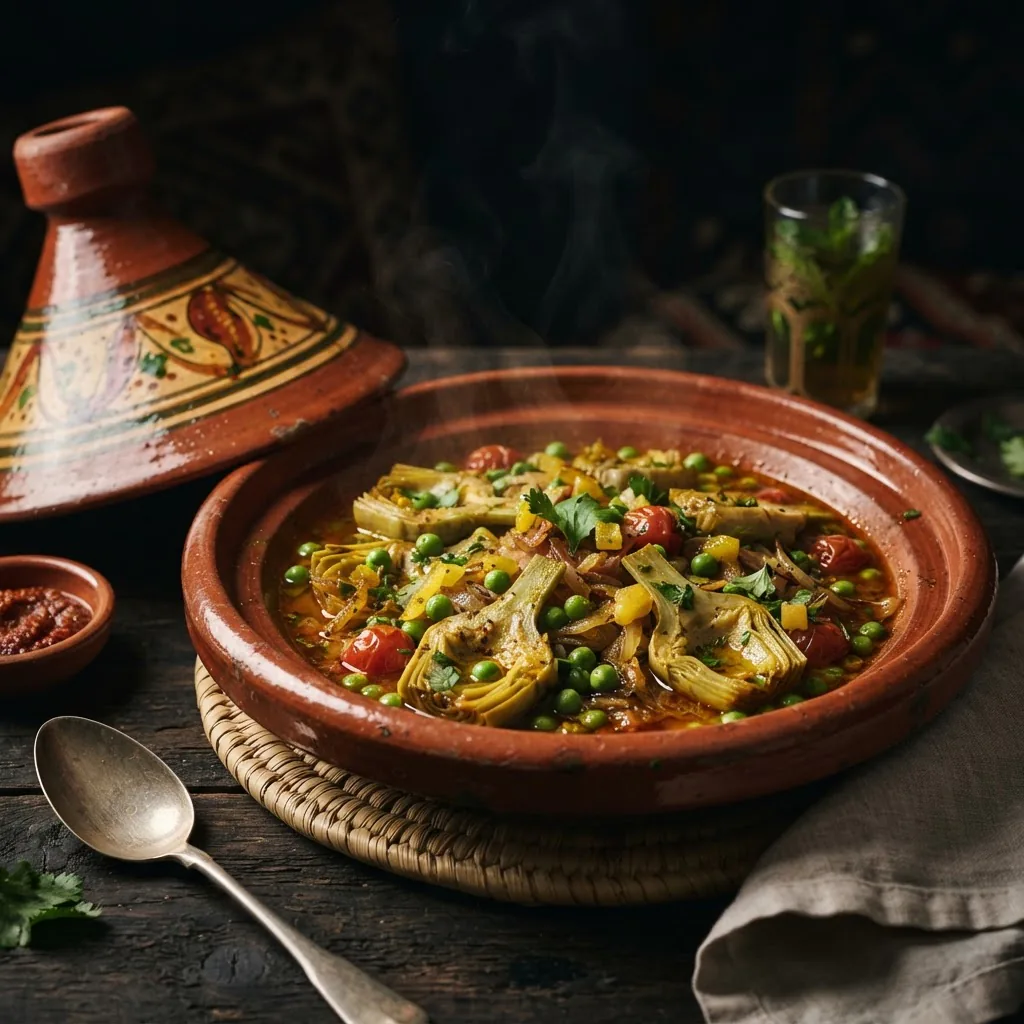
The spring tagine is the canon's lightest hour: artichoke hearts and fresh peas in a lemony, herbed pot — the meat optional and often absent — cooked briefly by the tagine canon's standards and served over couscous or with bread, the season's first warm day on a plate. Where the winter tagines braise for hours, this one simmers for minutes: the spring's vegetables ask only to be perfumed, not subdued.
Quantities live in the recipe card.
Ingredients
- the spring tagine's signature
- the fuller table
- **Trim the artichokes with lemon in hand.** The hearts brown as fast as the #47's quince: each trimmed heart rubbed with a lemon's cut face and dropped into acidulated water until its moment. The frozen heart skips the whole craft honestly — thawed and patted, it runs the pot truly.
- **The bridge:** the preserved lemon (#92) is the pot's soul and this site's own record; the saffron runs warm, not dominant — the spring pot's perfume is lemon-and-green first. The peas: frozen run truly; the fresh pod's season is the pot's own festival.
Artichoke & Pea Tagine
Prep: 20 minutes · Cook: 25 minutes · Total: About 45 minutes · Serves 4
Ingredients
Ingredients
- 6 artichokes, trimmed to the hearts (about 500 g hearts) — or 400 g frozen hearts, thawed (the working truth, honestly good)
- 300 g fresh or frozen peas
- 2 tbsp olive oil (about 25 g); 1 onion (about 150 g), sliced thin; 3 cloves garlic (about 12 g), sliced
- 1 preserved lemon (#92): the pulp mashed into the pot, the peel in threads for the end — the spring tagine's signature
- 1 tsp cumin; ½ tsp turmeric; a good pinch of saffron (about 0.5 g) in 2 tbsp warm water (#120); 1 tsp salt
- 200 ml water or light stock (about 200 g); a fist each of cilantro and parsley (about 20 g), half tied, half at the end
- Optional: 300 g small lamb pieces or kefta meatballs (the #33's), browned first — the fuller table
- The finish: more olive oil, lemon juice, and the #34 couscous to serve
Instructions
- **The quick base (8 minutes).** Warm the oil; soften the onion and garlic 5 minutes; the spices, the preserved lemon's pulp, and the saffron water stirred 1 minute; the water poured in and brought to a bare simmer. Checkpoint — the pot's fragrance: lemon-bright over the warm row — the preserved lemon's fermented salt already in the broth, the cilantro's green rising. This base wants 8 minutes, not the winter pots' fried depth: the spring's vegetables bring their own.
- **The vegetables' brief clock (15 minutes).** The artichoke hearts and the tied herbs in; a bare simmer 10 minutes; the peas (and the browned meat's juices, if the fuller table ran) in for the last 5, until the hearts are knife-tender and the peas just cooked, bright. Checkpoint — the hearts: tender to the knife's tip at their base, still holding — an over-cooked heart's mash is the pot's failure. The peas: just past raw, sweet and vivid. The broth: a light, lemony gold-green, looser than the winter tagines' — a sauce for the couscous, not a glaze.
- **The finish — raw and bright.** Off the flame: the preserved lemon's threads, the fresh herbs, a thread of raw olive oil, and the lemon's squeeze at the table's taste. Checkpoint — eating test, over couscous: the hearts' faint bitterness and silken bite, the peas' sweetness, the broth's lemon-salt perfume over the grain — light, green, complete, the table's argument that the tagine canon owns the spring as surely as the winter. The meat, where run, is the guest; the vegetables are the pot's own.
Troubleshooting
| Symptom | Cause | Fix |
|---|---|---|
| Hearts browned at the trim | No acidulated bath | Lemon water from the first cut |
| Hearts mushy, peas khaki | Over-simmered | The 15-minute clock, bright peas last |
| Broth flat | Preserved lemon shy | The pot's salt-soul \u2014 the pulp and the threads both |
Storage, Make-Ahead & Variations
- Best the day made (the spring's colors fade overnight); the base holds a day, the vegetables always to the pot's hour. The frozen hearts keep months. - Variations: the fava bean's spring cousin, the fuller meat's table. The #92 preserved lemon and the #34 couscous are this pot's parents; the #48 artichoke is the spring canon's own seat.