Bakoula Mallow Stew
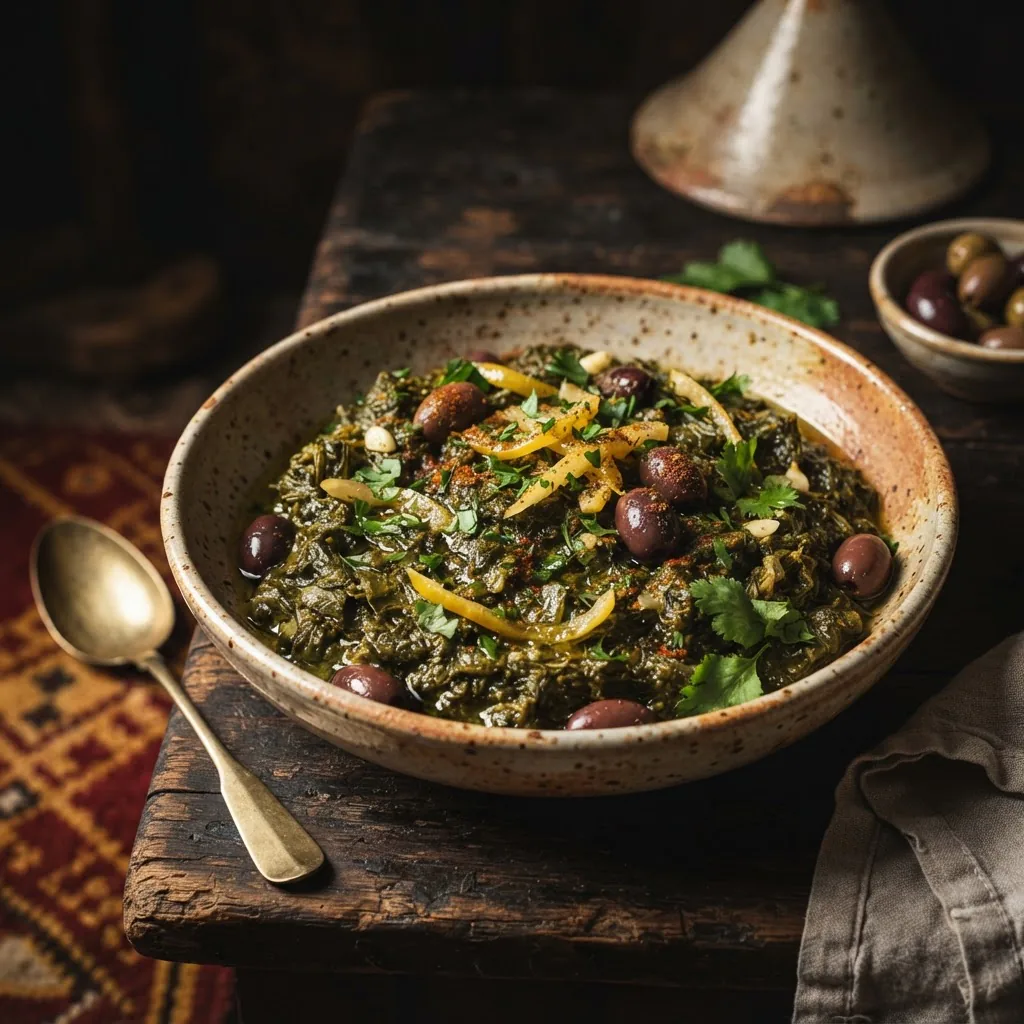
Bakoula is the medina's wild-greens pot: mallow — the volunteer green that grows in every fallow field and roadside after the rains — simmered with garlic, paprika, and a little preserved meat or olive oil until its leaves melt to a dark, mineral silk, served over bread or rice with a raw olive oil's finish. It is the greens canon's most rustic record — the leaf that costs nothing and feeds like a feast — and the olive season's own companion, for bakoula and the #115's new oil arrive together.
Quantities live in the recipe card.
Ingredients
- or the whole spinach-or-chard row as the bridge), stripped from their stems, washed twice
- or honestly omitted (the olive-oil-only vegetarian week's own pot)
- **Wash the greens twice and cook them long.** The mallow's leaves carry the field's grit and the leaf itself — like the molokhia's (#44) — is a texture that surrenders: 30 to 35 minutes' simmer takes the leaf from tough to dark silk. The bridge, honestly: spinach (a shorter clock) or chard runs the pot truly; the mallow's faint mucilage — its own quiet slipperiness, the molokhia's gentle cousin — is the only register lost.
- **The preserved meat's law:** the kaddid's salt-cured depth is the traditional anchor (a small handful of the #52's own), and its brine seasons the pot — the fresh lamb or the honest omission all run true, and the vegetarian week's pot runs on the olive oil's generosity doubled.
Bakoula Mallow Stew
Prep: 20 minutes · Cook: 40 minutes · Total: About 1 hour · Serves 4
Ingredients
Ingredients
- 800 g mallow leaves (bakoula, khobiza — or the whole spinach-or-chard row as the bridge), stripped from their stems, washed twice
- 3 tbsp olive oil (about 40 g); 1 onion (about 150 g), sliced
- 6 cloves garlic (about 25 g), sliced; 1 tbsp sweet paprika (about 8 g); 1 tsp cumin; ½ tsp chile flakes
- 100 g kaddid (#52) or 150 g lamb, small pieces — or honestly omitted (the olive-oil-only vegetarian week's own pot)
- 1 preserved lemon pulp (#92) or 2 tbsp its brine; 1 tsp salt
- 300 ml water (about 300 g)
- The finish: a thread of the year's new olive oil, lemon, and the #116 cumin salt at the table; bread (about 300 g)
Instructions
- **The base (8 minutes).** Warm the oil; soften the onion 4 minutes; the garlic, the paprika, the cumin, and the chile 1 minute more; the meat (if running) turned in the perfume 2 minutes. Checkpoint — the pot's fragrance warm and paprika-forward — the same small base the #43's loubia runs, the region's shared beginning.
- **The greens' long melt (30–35 minutes).** The water, the preserved lemon's pulp, and the salt in; the washed greens added — they will collapse to a fraction of their volume — and the pot covered and trembled (95 °C) 30–35 minutes, until the leaves have melted to a dark, soft mass and the broth runs faintly viscous and green-black. Checkpoint — a leaf's test: it should crush to silk against the pot's side with no stringiness — the mallow's surrender is the dish. The broth: dark, mineral, faintly thickened by the leaf's own body, the salt balanced by the preserved lemon's depth. If the pot runs wet, uncover the last 10 minutes.
- **The finish and the service.** Off the flame: a generous thread of the raw, new olive oil stirred through, the lemon at the table, the cumin salt beside — served ladled over the torn bread or beside the rice. Checkpoint — eating test: the greens' dark, mineral silk — the garlic and paprika running through, the preserved lemon's fermented salt beneath — the raw oil's green fire and the lemon's lift at each swallow, the bread sopping the dark broth. It should taste like the field's own argument: the volunteer green, the season's oil, and nothing purchased beyond the bread.
Troubleshooting
| Symptom | Cause | Fix |
|---|---|---|
| Greens gritty | One wash only | The second wash \u2014 always |
| Leaves stringy at the bite | Under-simmered | The full melt, the pot-side crush test |
| Pot flat, mineral-bitter only | Cured depth or oil shy | The kaddid, the brine, or the doubled oil |
Storage, Make-Ahead & Variations
- Keeps 2 days refrigerated (the greens' color fades but the flavor deepens); the reheat wants the oil's fresh thread. The #52 kaddid is the preserved meat's own record. - Variations: the chard's clock (shorter), the lamb's fuller table, the pkaila's (#63) fried-spinach cousin. The wild row rotates; the pot's economy holds.