Kaddid Dried Beef Couscous
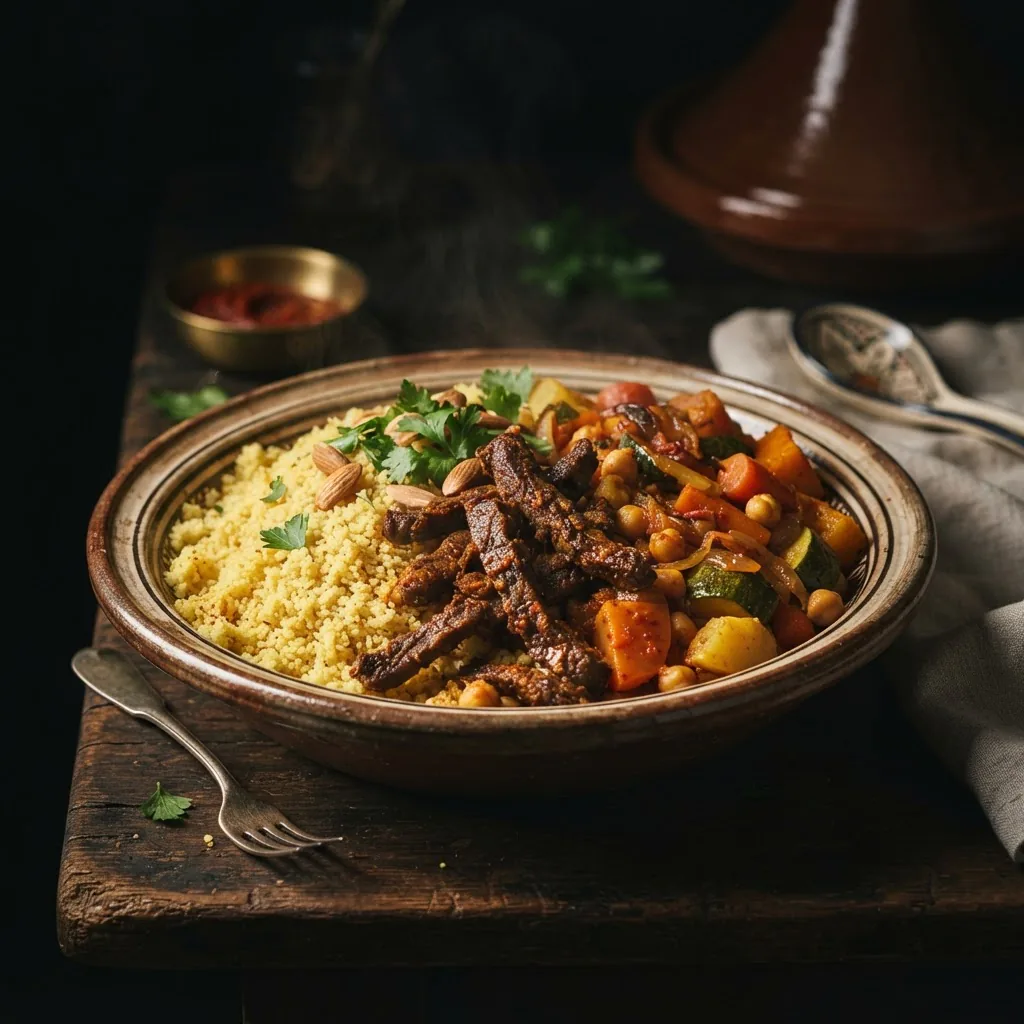
Kaddid is the desert's pantry: strips of beef or lamb, rubbed with salt, cumin, coriander, and garlic and dried in the sun and wind until hard as wood — the preservation that carried the caravans, made in the autumn, kept through the year, and cooked in the couscous pot until its salt-cured depth runs through the broth. This record runs both crafts: the making of the kaddid (a week of dry weather and patience — or the honest bridge to the store's cured beef), and the couscous it seasons, the desert kitchen's own argument.
Quantities live in the recipe card.
The kaddid (the pantry's own batch)
- or the dehydrator/oven's honest bridge (see the note)
The couscous pot
- the kaddid carries its own)
- **The kaddid's two truths: the week's weather and the safety's salt.** The traditional drying runs 5–7 days of dry sun and moving air — the strips hung or laid on nets, cured hard by the weather's honesty. The home bridges: a dehydrator at its meat setting (follow the unit's jerky guidance — the strips are thin), or the oven at its lowest (60–70 °C) with the door propped, 6–8 hours to fully dry. The salt's measure is the preservation's insurance — do not cut it — and the week's batch keeps months in cloth or paper (never sealed plastic: the cured meat breathes).
- **The working bridge:** the store's good cured beef or even a firm beef jerky (the unsweetened, unsoked kind), soaked the same 12 hours, runs the pot honestly — the salt-cured depth is the flavor's argument, and the from-scratch batch is the pantry's own pride.
Doneness & Quality Checkpoints
- The cure: the bend's break, the week's weather or the bridge's dry hours.
- The soak: 12 hours, the water discarded, the salt lifted.
- The pot: the kaddid chew-tender, the salt tasted last, the #34's grain steamed thrice.
Kaddid Dried Beef Couscous
Prep: 40 minutes (plus the week's kaddid, or the bridge) · Cook: 2 hours 15 minutes · Total: About 3 hours (plus curing and soaks) · Serves 6
Ingredients
The kaddid (the pantry's own batch)
- 1 kg lean beef (leg or shoulder — the camel runs traditionally in the deep south), cut to long strips 3 cm thick — makes about 400 g dried
- 2 tbsp coarse salt (about 30 g); 2 tbsp ground coriander (about 12 g); 1 tbsp cumin (about 6 g); 6 cloves garlic (about 25 g), grated
- The week's dry sun and moving air — or the dehydrator/oven's honest bridge (see the note)
The couscous pot
- 300 g kaddid, soaked 12 hours in water to cover (the water discarded, the rehydration's mercy)
- 500 g couscous; 3 tbsp olive oil (about 40 g); 1 tbsp butter (about 15 g)
- 2 onions (about 300 g), sliced; 4 cloves garlic (about 15 g); 1 tbsp tomato paste (about 15 g)
- 2 tsp paprika; 1 tsp cumin; ½ tsp saffron (about 0.5 g) in 2 tbsp warm water (#120); 1 tsp salt (tasted last — the kaddid carries its own)
- 2 litres water; 100 g chickpeas, soaked 8 hours; 3 carrots (about 250 g), 2 turnips (about 250 g), in coarse pieces; a fist of cilantro (about 20 g), tied
Instructions
- **The kaddid's week (or the bridge's day).** Rub the beef strips thoroughly with the salt, spices, and garlic; lay on nets or hang in the dry sun and wind, covered with cloth against the flies, 5–7 days, until hard, dark, and fully dry — the bend's break, not flex, the cure's proof. (Or the dehydrator/oven's honest hours to the same break.) Checkpoint — a finished strip: dark, hard, breaking at the bend — the cure's salt visible at the surface's crystal. The smell: garlic-coriander over the cured depth. The week's patience is the recipe; the weather's cooperation is the craft's own honesty.
- **The soak and the pot's beginning (30 minutes).** Soak the kaddid 12 hours (the water discarded — the salt's excess lifts, the cure's depth stays); cut to pieces and add to the pot with the onions, garlic, tomato paste, spices, saffron water, the chickpeas, the herbs, and the 2 litres of water — brought to a bare simmer, covered, and trembled (95 °C) 1 hour. Checkpoint — the broth at the hour: deep brown, the kaddid's salt-cured depth unmistakable — the cured meat's own register, deeper than any fresh pot's. The kaddid itself: yielding at its edge but still firm (its full tender runs 30 minutes more). The salt: taste now, and only now — the kaddid's salt may run the whole pot alone.
- **The vegetables' entry and the couscous's steamings (45 minutes).** The carrots and turnips in; 20 minutes. The couscous's three steamings over the pot (the #34's whole doctrine: worked with oil and broth between each, steamed thrice to distinct, perfumed grain) running while the pot's final clock ticks; the kaddid lifted when tender to the chew — 30 minutes from its check — and the broth's final taste at the salt's balance. Checkpoint — the kaddid's end: chew-tender — its texture a satisfying, dense yield (never falling), its flavor concentrated through every broth-ladle. The broth: a deep, cured-savory gold. The grain: the #34's own — three steamings, distinct and perfumed.
- **The assembly.** The couscous mounded, a broth-ladle worked through, the kaddid's pieces and the vegetables' ring — the #34's format, the desert's own pot. Checkpoint — eating test: the grain's perfume over the cured broth's depth — the kaddid's chew, dense and salt-savory, unlike any fresh meat's register — the chickpeas' earth and the turnips' bite between. It should taste like the caravan's own pantry: the autumn's cure running the year's table, and the desert's patience in every ladle.
Finish & Plate
The great platter's mound — the cured pieces and the vegetables' ring, the broth's ladle at the table's hand — the desert's own service, run on the Friday canon's format.
Troubleshooting
| Symptom | Cause | Fix |
|---|---|---|
| Kaddid still wood-hard at 2 hours | Under-dried or under-soaked | The 12-hour soak; more pot-time at the tremble |
| Pot over-salted | The cure's salt plus the added salt | The salt tasted last, and only then |
| Kaddid spoiled in storage | Sealed plastic or under-cure | Cloth or paper's breath; the bend's break is the proof |
Storage, Make-Ahead & Variations
- The kaddid keeps 6 months in cloth or paper in a cool, dry place (the pantry's own shelf); the pot keeps 3 days and improves. The #34 couscous is the grain's master; this record is the cured-meat pot's own. - Variations: the camel's deep-south original, the lamb's mountain cousin. The #52 kaddid is the pantry's record and this pot's own parent.