Osban Stuffed Tripe
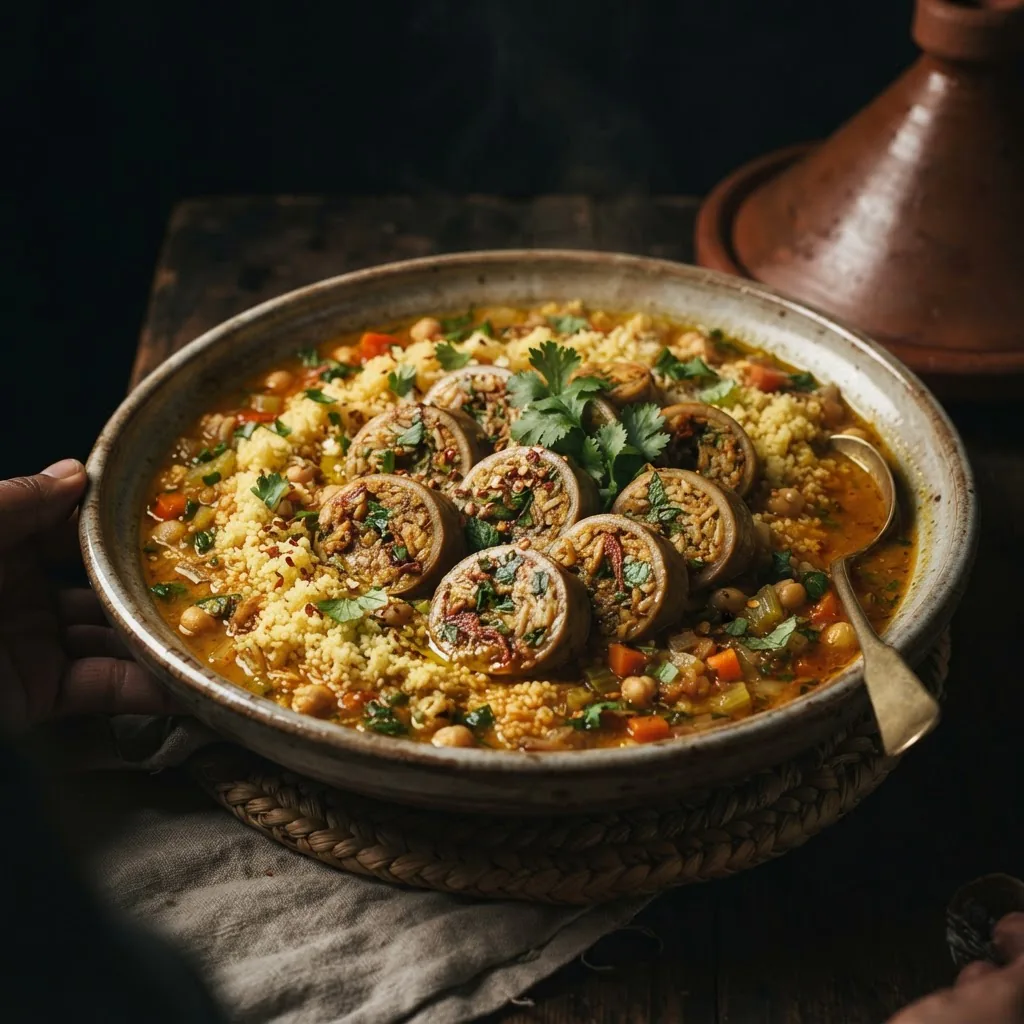
Quantities live in the recipe card.
The casing and the meats
The filling
- the rice's measure, see the law)
The simmer
Doneness & Quality Checkpoints
- The cleaning: the three mercies, the tripe odorless and blanched.
- The fill: two-thirds, pricked a dozen times, tied at the cross.
- The simmer: the tremble, the hour, the center's swollen-tender rice.
Osban Stuffed Tripe
Prep: 1 hour 30 minutes (plus the tripe's 2-hour soak) · Cook: 1 hour 15 minutes · Total: About 3 hours (plus soaks) · Serves 6 (makes about 8 osban)
Ingredients
The casing and the meats
- About 1 m lamb or beef tripe, well-cleaned by the butcher, then soaked 2 hours in salted water with a splash of vinegar, rinsed repeatedly, and blanched 10 minutes (the cleaning's three mercies)
- 300 g ground beef or lamb; 200 g lamb or beef liver, diced small; 100 g lights or heart (optional, the tradition's full register), diced small and blanched 5 minutes
The filling
- 250 g rice, rinsed; 2 onions (about 300 g), one grated and one minced fine
- A fist each of parsley, cilantro, and dill (about 60 g total), minced
- 2 tsp cumin; 1 tbsp #91 harissa or 1 tsp chile flakes; 1 tsp cinnamon; ½ tsp turmeric; 1½ tsp salt; black pepper
- 3 tbsp tomato paste (about 45 g); 3 tbsp olive oil (about 40 g); 250 ml warm water (approximately — the rice's measure, see the law)
The simmer
- A large pot of water with 2 bay leaves, 1 onion quartered, and 2 tsp salt; a plate to weight the parcels
- The service: lemon wedges, the harissa thinned, bread, and the #105 mechouia beside
Instructions
- **Mix and rest the filling (30 minutes).** Combine the rice, the ground meat, the diced liver and lights, the herbs, the spices, the tomato paste, the oil, and the warm water — mixed thoroughly with the hands to a wet, spoonable mass. Rest 30 minutes (the rice's head start on its drinking). Checkpoint — the filling's taste (a fried spoonful's honest test): savory-deep, the herbs' green forward, the harissa's warmth behind — one notch past salted (the casing's simmer calms).
- **Wrap and tie (45 minutes).** Lay the cleaned tripe flat and cut to squares roughly 15 cm; place a spoonful (about 60 g) of the filling at each square's center, and fold the corners over into a flat parcel — tied with kitchen string at the cross, or secured with toothpicks at the folds (the string's parcel is the tradition's own). Prick each parcel's face a dozen times with a fine needle. Checkpoint — each parcel: flat, firmly tied, and visibly two-thirds full — the slack-fill law (#25's own): the rice doubles in the simmer, and the over-filled parcel bursts. The pricks are the pressure's release.
- **The gentle simmer (1 hour at the tremble).** The parcels into the barest-simmering seasoned water (about 90 °C — the surface barely moving), weighted under with the inverted plate, and poached gently 1 hour — until a test parcel's center yields fully swollen, tender rice and the tripe's sheath runs soft-firm. Checkpoint — the osban's clock is the rice's, read through the parcel: pierce a test's center at the hour, press the grains — fully tender, the filling holding as a slice when the parcel is cooled and cut. The tripe's sheath: soft enough to yield at the tooth, still carrying its faint, satisfying chew — never rubber (under) nor dissolving (over).
- **Two finishes — the pan or the pot (10 minutes).** The classic celebration: the drained parcels cooled 10 minutes, then pan-fried whole in a lightly oiled pan until the tripe's faces blister gold in patches — the fry's maillard over the simmer's softness — and sliced thick to serve. The simpler: sliced and served straight from the simmer, hot, with the service's garnishes. Checkpoint — eating test: the slice's cross-section — the rice's mosaic with the liver's dark and the herbs' green, bound and holding — wrapped in the tripe's soft, faintly chewed sheath: the cumin's warmth and the harissa's fire running through the filling, the dill's anise arriving late — the lemon's cut and the harissa thinned at the table between the slices. It should taste like the whole animal honored: the celebration's craft, the pantry's economy, and the table's greatest honest dish.
Finish & Plate
The parcels sliced thick — the mosaic's cross-section up, the sheath's gold where the pan ran — the lemon and harissa at the table, the mechouia's bite beside, and the celebration's own service: the platter passed and every slice's cross-section an argument.
Troubleshooting
| Symptom | Cause | Fix |
|---|---|---|
| Parcels burst at the simmer | Over-filled, unpricked, or boiled | The slack fill; the needle; the tremble |
| Rice hard at the center | Filling's water short or clock short | The wet law's measure; the hour's full |
| Tripe's chew past pleasure | Simmer short | The softness arrives in the hour's last half |
Storage, Make-Ahead & Variations
- The raw parcels freeze 1 month (simmer from frozen, +15 minutes); the cooked keep 2 days, and the fried revival is the intended second life. The #25 mombar is the sibling craft; this record is the tripe's own. - Variations: the Tunisian osban's leaf-wrapped cousin, the chard-leaf vegetarian register. The offal canon's seats on this site: the #25, the #28, and this record's own.