Lamb & Cardoon Tagine
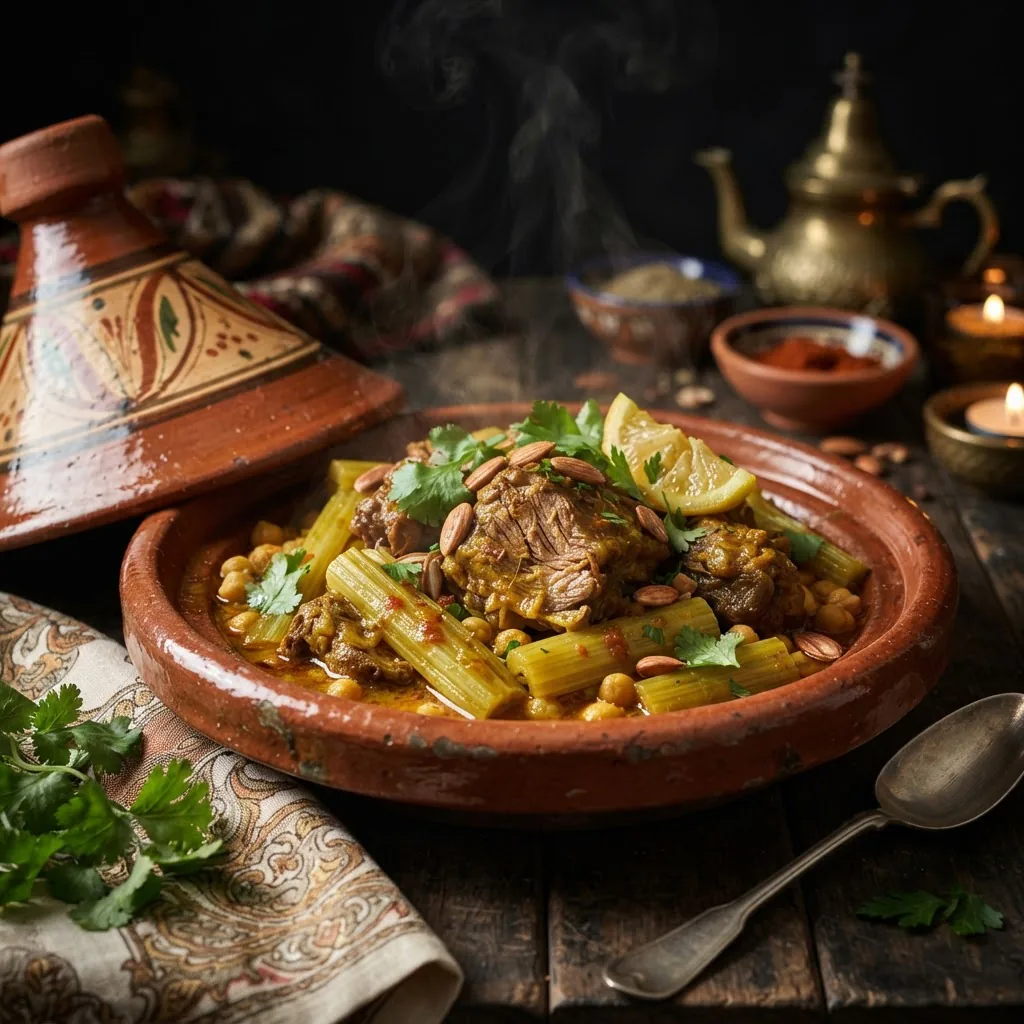
The cardoon — the artichoke's wild, thistly cousin, a winter stalk that the Fès and Marrakech cooks peel and string and blanch to its celery-meets-artichoke tenderness — is the winter tagine's own vegetable, run with lamb in the pot until the stalks drink the braise's gold and the two become the season's deepest argument. The craft is the cardoon's own: the peeling's strings, the blanch's bitterness-lift, and the patience's clock — and the record teaches the winter-vegetable doctrine the #58's title carries.
Quantities live in the recipe card.
Ingredients
- held in water with a lemon's juice from the first cut
- **The cardoon's three mercies: peel, acid, blanch.** The stalks' outer strings peeled with a knife's edge (the celery's stringing at the thistle's scale); each cut piece dropped into the lemoned water (the cardoon browns faster than the artichoke — the acid's bath is its whole color); and the drained pieces blanched in boiling salted water with a lemon squeeze 10 minutes — the bitterness's lift, the tenderness's head start. The three mercies are the recipe's first hour, and each is felt at the table.
- **The bridge:** the cardoon is the winter market's own (December through March in Mediterranean and Middle Eastern grocers; the #108's wild cardoon pickle its cousin) — and the honest bridge is the artichoke heart itself (#48's pot, a shorter clock) or the celery heart's milder register. What you lose with the bridge is the cardoon's bitter-mineral depth, which is the dish's own argument.
Doneness & Quality Checkpoints
- The cardoon's mercies: peeled, acid-bathed, blanched — the bitterness lifted.
- The braise: the lamb's hour before the cardoon's 45 — two clocks, one pot.
- The finish: silk-tender stalks in a thickened gold, the lemon's lift at the end.
Lamb & Cardoon Tagine
Prep: 1 hour (the cardoon's mercies) · Cook: 1 hour 45 minutes · Total: About 3 hours · Serves 4–6
Ingredients
Ingredients
- 1 kg lamb shoulder, cut to 5 cm pieces
- 800 g cardoon stalks (about 1.2 kg untrimmed), the tough outer strings peeled (the celery-string's own labor), cut to 8 cm lengths — held in water with a lemon's juice from the first cut
- 3 tbsp olive oil (about 40 g); 2 onions (about 300 g), grated
- 5 cloves garlic (about 20 g), grated; 1 tsp saffron (about 1 g) in 3 tbsp warm water (#120)
- 2 tsp ginger; ½ tsp turmeric; ½ tsp white pepper; 1½ tsp salt; a fist of cilantro and parsley (about 25 g), tied
- 500 ml water (about 500 g); the juice of ½ a lemon (about 15 ml)
- Optional: 100 g green olives, blanched; a spoon of #95 smen in the oil's place
Instructions
- **The lamb's braise (1 hour at the tremble).** Warm the oil; the lamb turned in the grated onions, the garlic, the saffron water, and the spices 4 minutes; the water and the herbs — cover, tremble (95 °C), and cook 1 hour, until the lamb approaches its yield and the onions have dissolved into the saffron-gold. Checkpoint — the #31 m'qualli's own base at the hour: a centimeter of gold silk, the salt one notch past comfort. The cardoon joins a braise already deep.
- **The cardoon's entry (45 minutes).** The blanched, drained cardoon pieces stirred gently through the pot; covered, and trembled 40–45 minutes more, until the stalks run silk-tender to the fork's pierce and the braise's gold has run through them. The olives (if running) in the last 10 minutes. Checkpoint — the cardoon's doneness: the stalk yields to the fork's gentle pierce along its length, its texture a yielding silk with the faintest fiber's memory (a stringy cardoon was under-mercied at the blanch) — its flavor the artichoke's mineral depth run through the lamb's gold. The pot's sauce: thickened by the cardoon's own faint body, the season's deepest register.
- **The finish and the service.** Off the flame: the lemon's juice through, the fresh cilantro over, the rest 10 minutes — served with bread or the #34 couscous's grain. Checkpoint — eating test: the lamb's saffron silk and the cardoon's mineral-tender stalk in the same spoon — the braise's gold carrying the vegetable's bitter depth, the lemon's lift at the swallow — the bread sopping the season's own. It should taste like the winter's height: the one vegetable whose craft matches the lamb's patience, and the pot where both are answered.
Finish & Plate
The tagine to the table's center — the cardoon's pale stalks through the lamb's gold, the cilantro's green over — bread or couscous beside, and the winter's own service: the pot that answers the cold.
Troubleshooting
| Symptom | Cause | Fix |
|---|---|---|
| Stalks stringy at the bite | Strings un-peeled or blanch short | The first mercy's labor; the full 10-minute blanch |
| Bitterness past pleasure | The blanch's mercy skipped | The lemoned boil lifts the bitter edge |
| Cardoon dissolved to threads | Over-trembled | The fork's silk-pierce, not the clock's overrun |
Storage, Make-Ahead & Variations
- Keeps 3 days refrigerated (the cardoon's depth steeping — the winter pot's own law); the blanched cardoon holds 2 days in its acid bath before the pot. The #48 artichoke is the spring's sister argument. - Variations: the olive-added register, the beef's longer clock. The #108's wild cardoon pickle is the vegetable's own pantry record; this pot is its winter's finest service.