Sfenj Doughnuts
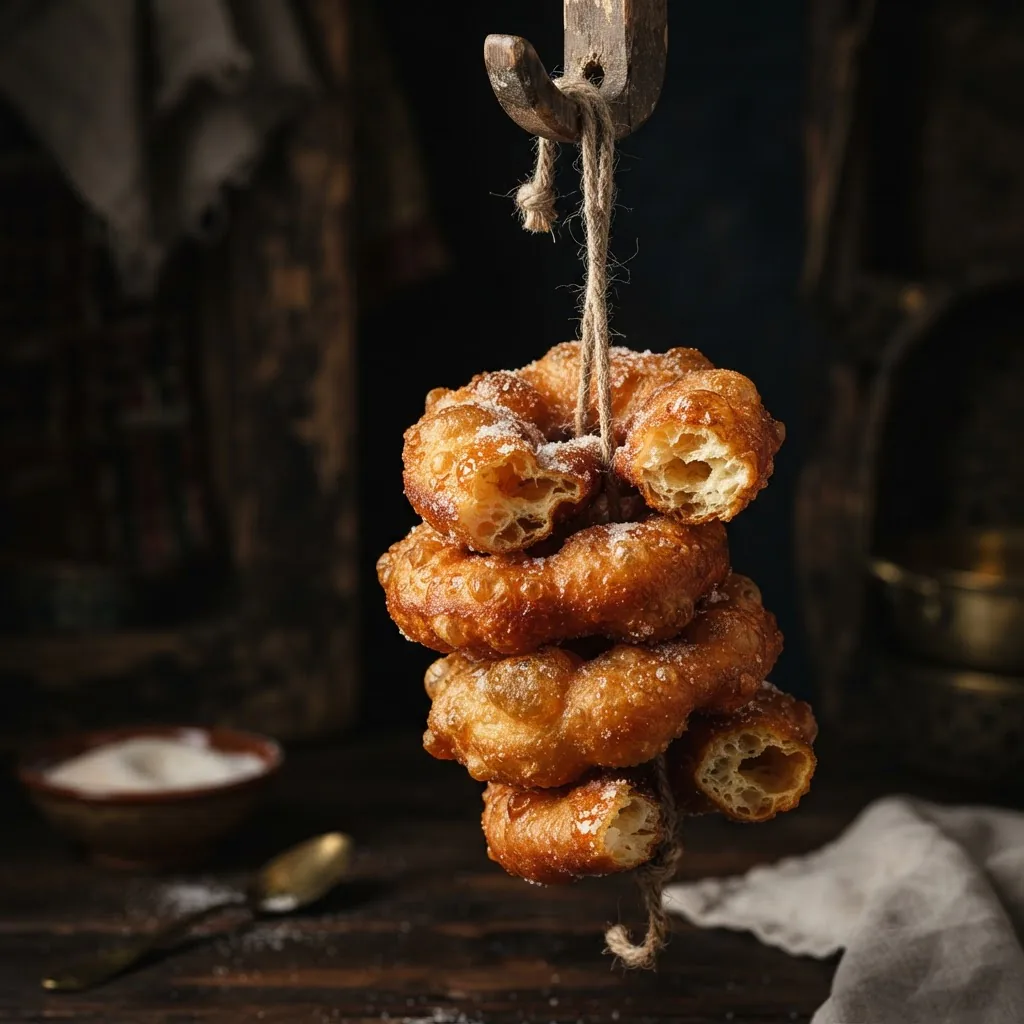
In the morning medina, the sfenj cart announces itself before you see it: the smell of dough hitting hot oil, and the sound — the vendor slapping and stretching a ring of dough between his palms, dropping it into black oil, fishing it out with a stick, and giving it a roll in sugar while the line waits. Sfenj are eaten hot and hollow, their interior empty and their crust blistery, and they are the reason the Moroccan morning runs on sweet tea: the two were made for each other.
Quantities live in the recipe card.
Ingredients
- the dough decides)
- **Make a dough wetter than feels right.** Sfenj dough is sticky and slack — too wet to knead on a board, worked with oiled hands in the bowl — because that wetness is what fries into the hollow center. A stiff dough makes a bread-y doughnut; a slack one makes a sfenj.
- **The bridge:** none needed — flour, water, yeast. The only equipment argument is the oil's depth: sfenj float, so 4 cm suffices, and a small pot keeps it honest.
Sfenj Doughnuts
Prep: 20 minutes, plus 1½ hours rising · Cook: 20 minutes · Total: About 2 hours · Makes about 15 sfenj
Ingredients
Ingredients
- 400 g all-purpose flour; ½ tsp salt; 1 tsp sugar (about 4 g)
- 1 tsp instant yeast (about 4 g); 320 ml lukewarm water (approximately — the dough decides)
- Neutral oil, for frying, 4 cm deep at 180 °C; caster sugar or a cinnamon-sugar mix (100 g) for rolling; honey, warm, as the alternative finish
Instructions
- **Mix, rest, rise (1½ hours).** Stir the flour, salt, sugar, and yeast with the water to a shaggy, sticky dough; then, with an oiled hand, fold and slap it in the bowl 3–4 minutes until it turns smooth and stretchy. Cover and let rise until doubled and bubbly — 1 to 1½ hours in a warm kitchen. Checkpoint — the risen dough should be puffed, glossy on top, and still too sticky to handle unfloured — that is correct. Do not punch it down hard; the air it holds becomes the sfenj's hollow.
- **Shape by hand, straight into the oil.** With well-oiled hands, tear a plum-sized piece (about 60 g), poke a hole through the center with two fingers, and stretch it — slapping it lightly against the oiled palm as the carts do — into a ring 7–8 cm across. Drop it directly into the 180 °C oil, no resting, and repeat for as many as the pot holds. Checkpoint — the ring should be rough and irregular — sfenj are not smooth doughnuts — and it must float and puff within 20 seconds of hitting the oil. If it sinks, the oil is not ready; if it browns instantly, the oil is too hot.
- **Fry, turn, sugar (2–3 minutes total).** Fry until the underside is deep gold, turn once, and cook the second face — the sfenj will swell and may turn themselves. Drain briefly, then roll in the sugar while hot (or leave plain for honey at the table). Checkpoint — eating test, immediately: hot enough to require juggling, the crust blistered and sugar-crusted, the interior mostly hollow with a few strands of soft dough clinging — pulled apart, steaming, dunked in mint tea or honey. A cooled sfenj is bread; a hot one is the point, and the batch exists to be eaten in the ten minutes after the last one leaves the oil.
Troubleshooting
| Symptom | Cause | Fix |
|---|---|---|
| Sfenj dense, bready | Dough too stiff or over-handled at shaping | More water in the dough; the light slap, not the roll |
| No hollow | Oil too hot (crust set too fast) or dough under-risen | 180 °C; the full rise |
| Greasy | Oil too cool | The float-and-puff test before the batch |
Storage, Make-Ahead & Variations
- Made and eaten hot; a cooled sfenj re-crisps 3 minutes in a 160 °C oven (a fair second life, never the first). The dough holds 1 day refrigerated after its rise — bring to room temperature before shaping. - Variations: the honey-dipped finish, the anise-scented dough (#87's kaak kin). The #6's North African cousins and the #68 Hanukkah sfenj are this recipe's family across the cluster.