Goat Tagine with Figs
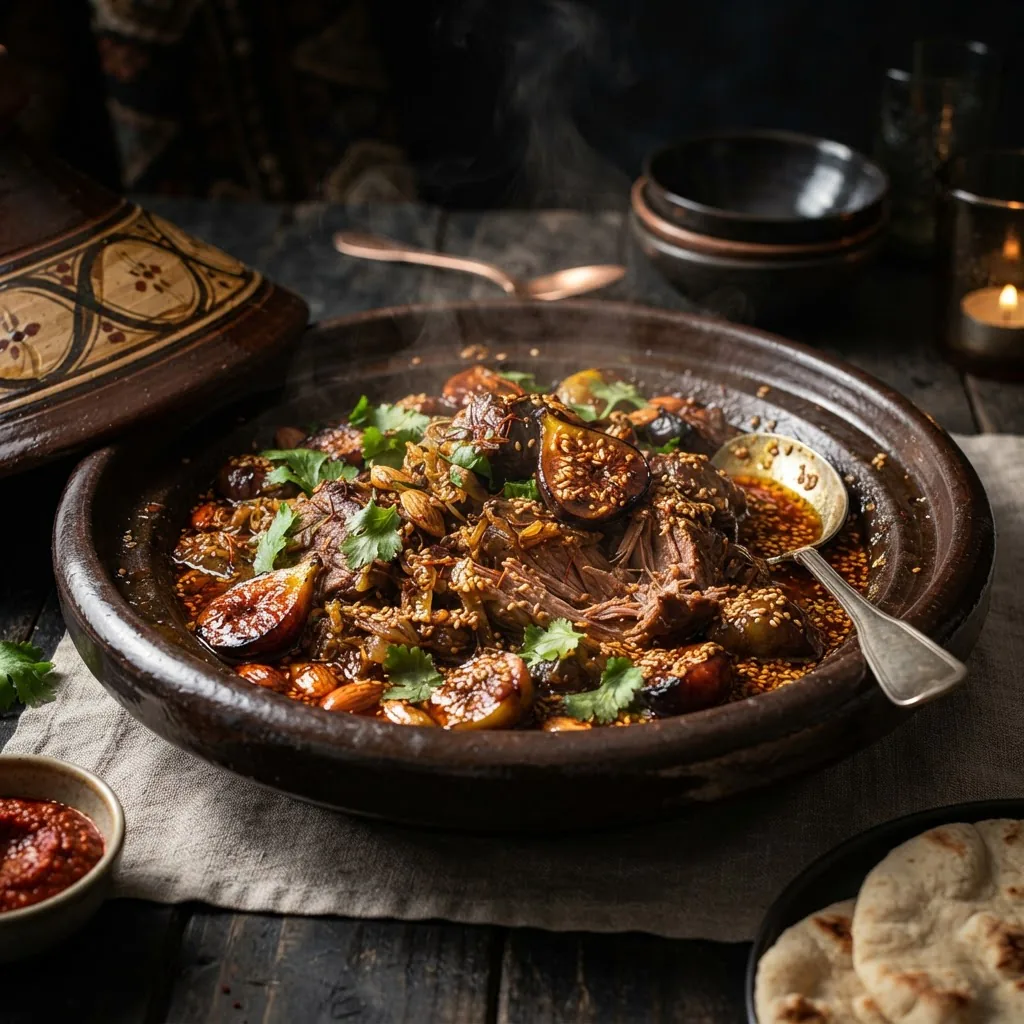
The mountain goat — the high Atlas and the Rif's own animal, browsing the thyme and the wild mint that season its meat from the inside — runs the sweet tagine's fig register: a longer, leaner braise than the lamb's, the goat's firm depth carrying the dried fig's honeyed seed against it, and the whole pot running the two-sweetnesses doctrine that the sweet canon holds. The goat asks the pot's patience; the figs answer it.
Quantities live in the recipe card.
Ingredients
- the bridge below
- **The goat's clock, stated honestly:** the goat's lean, working muscle runs a longer road than the lamb's — 2 hours at the tremble where the #47's lamb ran 75 minutes — and the fork's twist at the thickest piece is the only honest clock. The marinade's hour (the saffron water, the spices, and the garlic driven inward) is the head start. The bridge: the lamb shoulder runs the identical doctrine at the shorter clock, and every technique translates; the goat, when found (the halal butchers' and the farmers' markets' own), is worth its patience — a depth between the lamb and the #46 camel's wilder register.
- **The figs' law:** the two-pots doctrine (#36's whole separation) — the figs simmered in their own honey-cinnamon light, and the marriage at the table. The dried fig's seeds are the texture's argument: they hold their tiny crunch through the syrup's honey.
Doneness & Quality Checkpoints
- The marinade: an hour, the saffron inward.
- The braise: 2 hours at the tremble — the fork's twist the only honest clock.
- The figs: separate pot, glossy, seeds intact, married at the table.
Goat Tagine with Figs
Prep: 30 minutes, plus 1 hour marinating · Cook: 2 hours 20 minutes · Total: About 3 hours 55 minutes · Serves 4–6
Ingredients
Ingredients
- 1.2 kg goat (shoulder or leg), cut to 5 cm pieces — the bridge below
- 2 onions (about 300 g), grated; 5 cloves garlic (about 20 g), grated
- 1 tsp saffron (about 1 g) in 3 tbsp warm water (#120); 1 tbsp ras el hanout (#94); 1½ tsp ginger; ½ tsp cinnamon; ½ tsp black pepper
- 2 tbsp olive oil (about 25 g) or 1 tbsp smen (#95); 1½ tsp salt; a fist of cilantro (about 20 g), tied
- 500 ml water (about 500 g)
- 200 g dried figs, halved if large; the figs' syrup: 200 ml water, 1 tbsp honey (about 20 g), 1 cinnamon stick, a strip of orange peel
- 50 g toasted almonds or sesame; the #116 cumin salt for the sharp table's call
Instructions
- **The goat's long braise (2 hours at the tremble).** Warm the fat; the marinated goat turned in the grated onions and the remaining spices 4 minutes to the perfume; the water and the herbs — cover, tremble (95 °C), and cook 2 hours, turning twice, until the goat yields to the fork's twist at its thickest and the onions have dissolved into the deep gold-brown sauce. Uncover the last 15 minutes if the sauce runs thin. Checkpoint — the goat's doneness: the fork's twist parts the grain along its fibers — tender while still holding the goat's own firm character (the goat, like the #46 camel, yields without falling). The sauce: a centimeter of intense, savory depth — the goat's flavor stronger than the lamb's, asking the figs' sweetness against it.
- **The figs' syrup (15 minutes, alongside).** Simmer the figs in the water, honey, cinnamon stick, and orange peel 12–15 minutes, until the figs are plump and glossy and the syrup runs a light amber coat. Checkpoint — each fig: swollen, intact, its skin shining and its seeds' crunch intact within — the taste gently honeyed with the cinnamon's warmth, the register lighter than the pot (the two sweetnesses' meeting at the mouth, not in the braise).
- **The marriage and the service.** The figs and a spoonful of their syrup folded gently through the goat's sauce; the rest 10 minutes; the almonds or sesame scattered at the table. Checkpoint — eating test, with the #34 couscous or bread: the goat's firm, deep savor — the mountain's own register, thyme-scented from the inside — against the fig's honeyed plump and the seeds' tiny crunch, the saffron running through, the almonds' toast between. It should taste like the high pasture's argument: the animal that ate the wild herbs, the fruit that dried in the same sun, and the pot that joined them.
Finish & Plate
The tagine to the table's center — the goat's dark pieces under the figs' gloss and the almonds' scatter — with couscous or bread, the #105 mechouia's bite beside, and the mountain's own service.
Troubleshooting
| Symptom | Cause | Fix |
|---|---|---|
| Goat still firm at 2 hours | The lean clock's honesty | 30 more minutes at the tremble |
| Pot boiled dry | Heat past the tremble | The one-bubble law; a splash's mercy |
| Sweet dominates the firm | Figs simmered in the braise | The two-pots law \u2014 the separation holds |
Storage, Make-Ahead & Variations
- Keeps 3 days refrigerated (the goat's depth steeping); the two pots hold separately a day, the marriage at the reheat. The lamb bridge runs the #47's own clock. - Variations: the fresh fig's late-summer register (added whole for the last 10 minutes), the prune's darker vote. The #36 prune master, the #47 quince, and this record's figs are the sweet canon's rotating seats.