Fijuelas Fried Ribbons
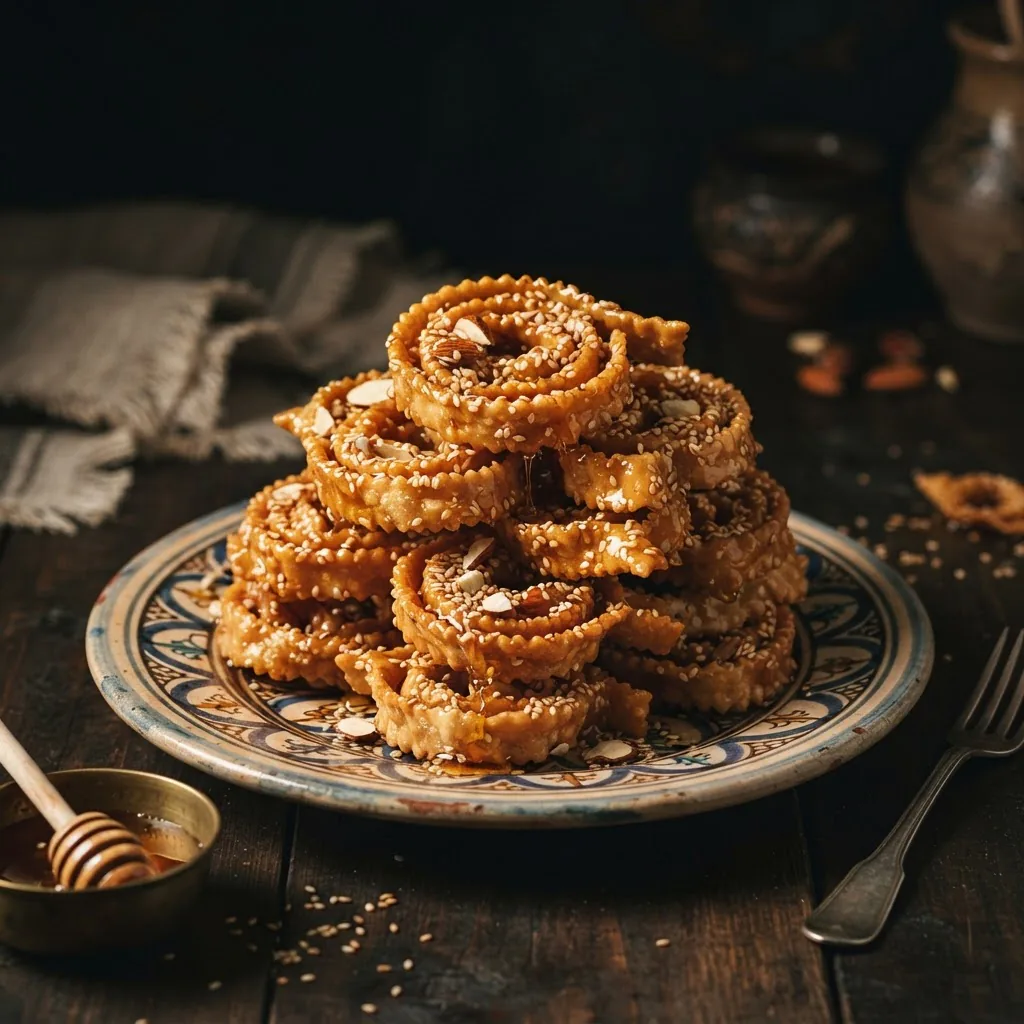
Fijuelas — the Purim festival's fried ribbons, the Sephardic diaspora's answer to the holiday's fried-sweet argument (the cousins: the Pestiños of Andalusia, the Fazuelos of the Ladino ports) — are a stiff, anise-and-orange-perfumed dough rolled thin, cut to ribbons, twisted once, and fried to a shattering gold, then bathed in honey or dusted in sugar. The festival's own: the ribbons that carry the queen Esther's story to the table's sweetest end.
Quantities live in the recipe card.
Ingredients
- plus more as the stiff dough demands
- **Rest the stiff dough a full hour — the ribbon's roll depends on it.** The fijuelas' dough runs stiffer than bread's (the crisp fry's demand), and the stiff dough fights the thin roll until the rest's hour relaxes it. The bridge: none needed — the whole row is the festival's pantry, and the anise-orange's perfume is the record's own identity.
- **The twist's law:** each ribbon twisted once at its center before the fry — the twist fries to a fixed, elegant curl, and the plain ribbon fries flat and dull.
Fijuelas Fried Ribbons
Prep: 35 minutes, plus 1 hour resting · Cook: 20 minutes · Total: About 2 hours · Makes about 30 ribbons
Ingredients
Ingredients
- 300 g flour; 2 tbsp sugar (about 20 g); ¼ tsp salt
- 1 tsp anise seeds, lightly crushed (about 2 g) — or 1 tsp anise liqueur
- The zest and juice of ½ an orange (about 40 ml juice); 1 tbsp olive oil or melted butter (about 13 g)
- 1 egg yolk (about 20 g); 60 ml warm water (approximately) — plus more as the stiff dough demands
- Neutral oil for frying, 3 cm deep at 180 °C
- The finishes: 200 g honey warmed thin (about 250 g) with a splash of orange blossom water (#107), or caster sugar (about 100 g) mixed with cinnamon; the #119 mint tea beside
Instructions
- **Make and rest the dough (1 hour 5 minutes).** Knead the flour, sugar, salt, anise, orange zest and juice, oil, yolk, and water 8 minutes to a smooth, stiff dough — adding water by the teaspoon only if the dough refuses to come together. Rest, covered, 1 hour. Checkpoint — the rested dough: smooth, firm, and relaxed — a pressed dimple fills back slowly, and the dough rolls without springing. The stiff is correct: a soft dough fries to bread, not ribbon.
- **Roll, cut, twist (20 minutes).** Roll the dough thin — to 2 mm, the pasta-thin patience — and cut to ribbons 3 cm wide and 12 cm long; each ribbon twisted once at its center into a loose bow-tie curl, and laid on towels until the batch is shaped. Checkpoint — the ribbons: thin enough to read through (faintly), each twist fixed — the fry will set the curl permanently, and the thin roll is the shatter's whole promise.
- **Fry and finish (20 minutes).** The ribbons fried in small batches at 180 °C — 60 to 90 seconds, turning once, to a deep even gold — drained briefly, and finished while warm: bathed in the warm honey (the traditional) and drained on racks, or rolled in the cinnamon sugar. Checkpoint — eating test: the ribbon's shatter — a crackle that gives to the faintest anise-orange perfume, the honey's sweetness in the fry's dry crisp — the tea's mint cutting between. It should taste like the festival's own end: the story told, the ribbons fried, and the table's sweetest argument closed.
Troubleshooting
| Symptom | Cause | Fix |
|---|---|---|
| Ribbons bread-y, soft | Dough soft or rolled thick | The stiff dough; the 2 mm roll |
| Twist unfolded in the oil | The ribbon untwisted at the shape | The once-twist fixed at the center |
| Honey's bath slid off | The ribbons cooled before the bath | Bath while warm — the honey grips |
Storage, Make-Ahead & Variations
- The honeyed ribbons keep 3 days in a sealed tin (the honey softens them slowly — the sugar-dusted keep their shatter a day longer); the dough keeps 1 day refrigerated after its rest. - Variations: the cinnamon-sugar's finish, the sesame-studded dough. The #68 sfenj is the festival row's other seat; the #6 is the doughnut's master — the fijuelas are the ribbon's own.