Lubia — Black-Eyed Peas for the New Year
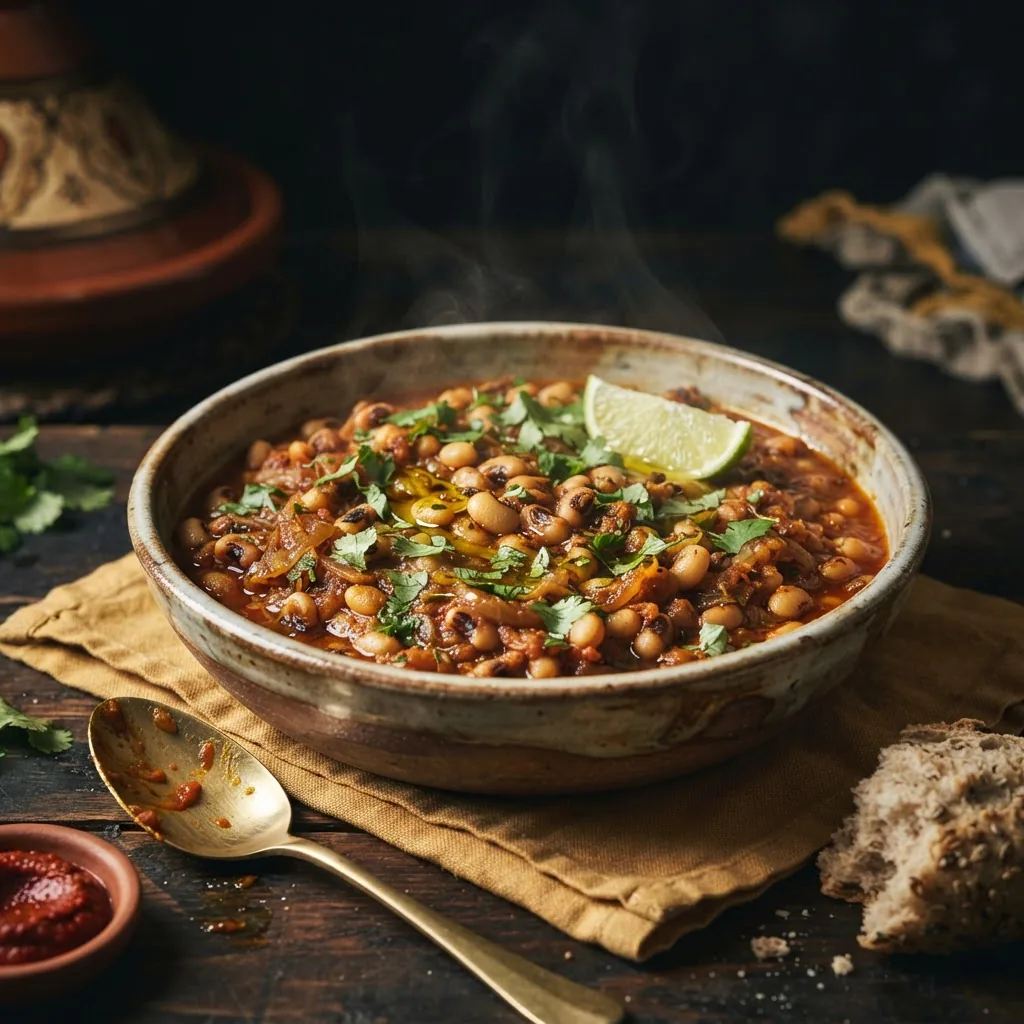
The Rosh Hashanah table's own legume — black-eyed peas for the fortune, the sweetness tuned from the weekday's onion-and-cumin into the New Year's honey-and-cinnamon gentleness, the #43's own bean pot read through the Sephardic seder's law of the symbolic plate.
Quantities live in the recipe card.
Ingredients
- the New Year's own sweetness, the weekday sugar's festive upgrade
- **The variant's law: the sweetness is the holiday's, not the pot's habit.** The #43 master runs the savory onion-and-cumin road; this record dials the same bean architecture toward the seder table's symbolism — the honey for the sweet year, the cinnamon for the festive warmth. The bean technique (the soak, the slow soften, the saucy reduction) is the master's own; consult it for the full doctrine.
- **The bridge:** the black-eyed pea's own quickness — the fastest-cooking of the corpus's dried beans, the New Year's fortune arriving early.
Lubia — Black-Eyed Peas for the New Year
Prep: 15 min (plus 8 h soak) · Cook: 1 h · Total: 1 h 15 min · 6
Ingredients
Ingredients
- 250 g dried black-eyed peas (about 1½ cups), soaked 8 hours or overnight (the quick-soak's 1-hour boil-and-rest mercy)
- 2 tbsp olive oil (about 25 g)
- 1 onion (about 200 g), minced
- 3 garlic cloves, minced
- 1 tbsp tomato paste (about 15 g)
- 2 tbsp honey (about 40 g) — the New Year's own sweetness, the weekday sugar's festive upgrade
- 1 tsp ground cumin
- ½ tsp ground cinnamon
- Salt and black pepper
- 750 ml water or a light chicken stock
- The finish: a handful of chopped cilantro or parsley
Instructions
- **The base (10 minutes).** The oil in the pot over medium; the onion softened and faintly gold (about 8 minutes, the pot's bottom at a steady medium), the garlic following for its final minute. The tomato paste stirred in and fried 30 seconds — the raw sweetness's cooked transformation.
- **The simmer (45–60 minutes).** The drained peas, the water, the cumin, the cinnamon, and a teaspoon of salt in; brought to the barest simmer and held — covered, the surface barely moving — until the peas run tender but intact (the tooth's yield without the burst's mush). Checkpoint — the bean's law: the pot never at the boil (the rolling water's agitation bursts the skins — a mere simmer's 90–95 °C the gentleness's own), the liquid reducing to a loose, spoonable sauce.
- **The sweetness's late entry (final 10 minutes).** The honey stirred in once the beans run tender — never at the start, where the long simmer's reduction concentrates it past the festive into the cloying — and the pot held 10 more minutes, the sauce tightening around the peas. Checkpoint — the balance's proof: the sweetness present but not dessert-like — a festive warmth, the cinnamon's aromatic lifting it — and the bean's earthiness still the pot's center.
- **The finish.** The herbs stirred through, the pepper ground over, and the bowl served — the Rosh Hashanah night's own dish, the fortune's symbol on the seder plate beside the leeks and the dates and the pumpkin. Checkpoint — eating test: the bean creamy within its intact skin, the sauce clinging sweetly, the cinnamon's aroma rising. It should taste like a wish made edible — the sweet year asked for and simmered into the pot.
Troubleshooting
| Symptom | Cause | Fix |
|---|---|---|
| Beans bursting | The simmer run at the boil | The barest bubble's mercy |
| Sauce too sweet | The honey's early entry | The final-10-minute law |
| Beans still firm at 60 minutes | Old stock | The patience's extra 20, the water's top-up |
Storage, Make-Ahead & Variations
- Keeps 4 days refrigerated, improving — the festive flavors marrying. The #43 master is the weekday road; this record the holiday's own. Freeze beautifully (2 months), the honey's sauce thawing intact.