Tbikha — The Vegetable Stew of the Weekday Pot
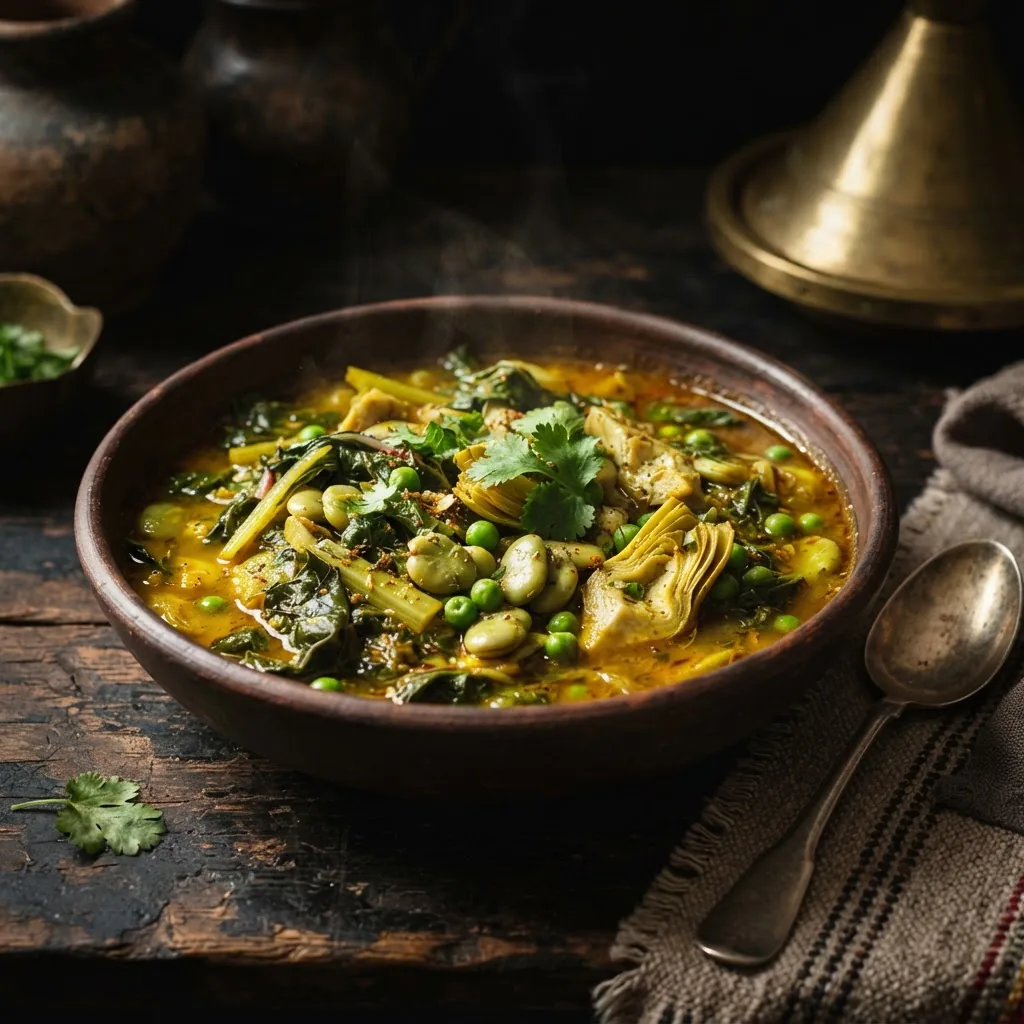
The tbikha is the Sephardic week's quiet backbone — the vegetable stew that answers the question "what does the pot hold tonight" with whatever the market gave: potato, carrot, squash, the chickpeas from the jar, the handful of spinach. Its doctrine is the flexible one — the base's law fixed, the vegetables the season's own.
Quantities live in the recipe card.
Ingredients
- a framework):
- **The flexible pot's law: the base is the recipe; the vegetables are the news.** The onion-garlic-tomato-spice foundation runs fixed — it is the tbikha's signature — and the vegetables rotate by season and household: the winter's potato-and-carrot heaviness, the spring's pea-and-fava lightness, the summer's squash-and-pepper abundance. A tbikha is not a recipe followed but a grammar spoken.
- **The bridge:** this is the Sephardic cousin of the tagine block's vegetable stews (#18, #48) — the same oil-onion-tomato spine, the paprika-and-cumin register swapped for the tagine's ginger-and-saffron.
Tbikha — The Vegetable Stew of the Weekday Pot
Prep: 15 min · Cook: 55 min · Total: 1 h 10 min · 6
Ingredients
Ingredients
- 3 tbsp olive oil (about 40 g)
- 1 onion (about 200 g), halved and sliced
- 3 garlic cloves, crushed
- 2 tomatoes (about 300 g), grated, or 1 can (400 g) crushed
- 1 tbsp tomato paste (about 15 g)
- 1 tsp sweet paprika
- 1 tsp ground cumin
- ½ tsp turmeric
- 750 ml water or stock
- The vegetables (the season's own — a framework):
- The finish: lemon juice, chopped parsley, and ¼ cup fresh peas or fava (about 40 g) if spring allows
Instructions
- **The base (10 minutes).** The oil in the pot over medium; the onion softened translucent (about 6 minutes), the garlic for its final minute. The tomatoes, paste, paprika, cumin, and turmeric in — the paste fried 30 seconds in the oil's edge, the spices blooming in the tomato's moisture — and the pot cooked to a darkening, oil-sweating sofrito (about 4 minutes). Checkpoint — the sofrito's law: the tomato no longer raw-bright — deepened to a rust-red, the oil's beads breaking through at the edges — the base's flavor built before the water's arrival.
- **The hard vegetables and the simmer (30 minutes).** The water in, the potatoes, carrots, and chickpeas following, and the pot brought to a simmer — covered, the heat at the gentle-medium — for 20 minutes, until the root vegetables run near-tender. Checkpoint — the potato's yield: the knife's tip sliding in with a faint resistance (not the collapse's mush) — the stage for the soft vegetables' arrival.
- **The soft vegetables (15 minutes).** The squash and the peas in; the pot held at the simmer 10–15 minutes more, the squash tender at the edge but holding its shape. Checkpoint — the pot's balance: every vegetable cooked to its own yield — the potato's cream, the carrot's sweet firmness, the squash's edge-tender collapse — no single texture tyrannizing the pot, the broth a loose, spoonable sauce.
- **The finish.** The lemon juice's brightness, the parsley's green, and the bowl served with bread or the Friday couscous — the weekday pot's own completeness. Checkpoint — eating test: the broth savory and faintly sweet, the paprika's warmth the signature, the vegetables each themselves within the whole. It should taste like the market's own answer — the season summarized in a bowl.
Troubleshooting
| Symptom | Cause | Fix |
|---|---|---|
| Broth thin and watery | The water's generosity | Simmer uncovered the final 10 minutes |
| Squash dissolved | The early addition | The two-thirds law |
| Base tastes flat | The sofrito's rush | The oil-sweat checkpoint — 4 minutes' patience |
Storage, Make-Ahead & Variations
- Keeps 4 days refrigerated, improving — the flexible pot's own gift. The variations are the season's: the winter's turnip-and-potato, the spring's artichoke-and-pea (the #48's own cousin), the summer's eggplant-and-zucchini. The grammar fixed, the vocabulary the market's own.