Mouna — The Orange Brioche of Oran
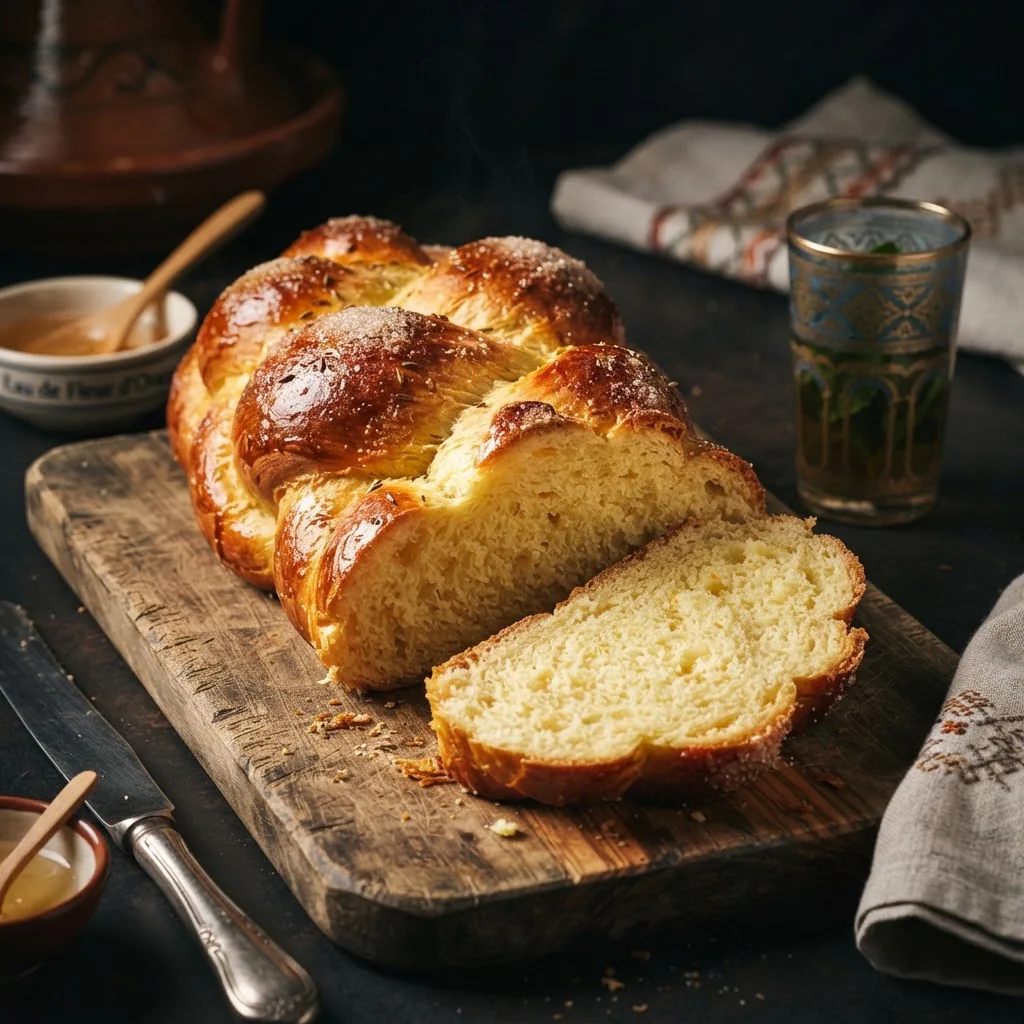
Quantities live in the recipe card.
Ingredients
Doneness & Quality Checkpoints
- Windowpane before the oil's arrival — the gluten's strength built at the lean stage
- The ferment doubled at the room's warmth, the poke's dent filling slowly
- The braid's snug weave, the second proof's edge — puffed, jiggly, never collapsed
- The internal 88–92 °C at the center, the mahogany crust, the hollow base's tap
- The 45-minute cool before the slice — the crumb's structure the patience's own reward
Mouna — The Orange Brioche of Oran
Prep: 40 min · Cook: 30 min · Total: 4 h 30 min (including rising) · Makes 2 loaves (12–16 slices)
Ingredients
Ingredients
- 500 g bread flour (about 4 cups), plus more for the bench
- 7 g instant yeast (about 2¼ tsp)
- 80 g sugar (about ½ cup scant)
- 1 tsp salt
- Zest of 2 oranges (about 2 tbsp) and 60 ml fresh orange juice (about ¼ cup)
- 2 tbsp orange blossom water (about 30 ml)
- 3 eggs (about 150 g), beaten, plus 1 for the glaze
- 60 ml mild olive oil or neutral oil (about ¼ cup)
- 1 tsp anise seeds, lightly crushed
- 180 ml lukewarm water (about ¾ cup)
- The finish: sesame seeds (about 30 g) and coarse sugar (about 25 g) for the crust
Instructions
- **The sponge and the initial knead (15 minutes).** The flour, yeast, sugar, and salt whisked dry. The orange juice and zest, the blossom water, the eggs, the anise, and 150 ml of the water worked in to a shaggy dough — the remaining 30 ml water only if the dough runs stiff — and the dough kneaded 8–10 minutes: from sticky and loose to smooth, elastic, and faintly tacky. Checkpoint — the windowpane's first proof: a walnut of dough stretched between the fingers — it thins to a translucent, stretching membrane without the immediate tear. This strength is the crumb's own insurance; the fat's arrival is next, and the fat is the gluten's smotherer.
- **The oil's incorporation (5–7 minutes).** The oil added a tablespoon at a time, each worked to the full absorption before the next — the dough initially slipping and separating, then re-binding smooth and supple. The bowl's ferment: covered, at the room's warmth (a steady 22–24 °C), until doubled — 90 minutes to 2 hours. Checkpoint — the ferment's law: the dough domed and jiggly-loose, a poked dent filling slowly — not the collapse's over-proof (the enriched dough's sugar makes the ferment's pace slower than the lean bread's; the patience is the crumb's own).
- **The braid (15 minutes, plus the second proof).** The dough divided in two (for two loaves) or in three strands per loaf; each strand rolled to a fat rope, about 30 cm, and rested 10 minutes (the relax's mercy — the elastic dough's retraction needs the rest before the braid's length holds). The three-strand braid laid on the tray, the ends tucked under. Checkpoint — the braid's tension: the strands woven snug but not strangled — the braid's pattern visible, the loaf plump rather than elongated — because the second proof's expansion is the pattern's own eraser if the weave runs loose.
- **The second proof (about 60 minutes).** The braids covered loosely and proofed until puffed to nearly one and a half times — jiggly at the tray's gentle shake, a light poke's dent filling slowly. Checkpoint — the proof's edge: the braid domed, the strands' pattern softening — this is the moment, the enriched dough's law being "proofed to the edge, baked before the collapse."
- **The glaze and bake (25–30 minutes at 180 °C).** The oven at 180 °C (350 °F). The remaining egg beaten with a splash of water and brushed gently over the whole braid — a single, generous coat, not the double-brush's streaks — and the sesame and coarse sugar scattered. Baked 25–30 minutes, the tray turned once at the 15-minute mark, until the crust runs deep mahogany-gold and the loaf's base sounds hollow at the tap. Checkpoint — the doneness's three proofs together: the crust's lacquered mahogany (the egg glaze's own shine), the hollow base's drum-tap, and the internal thermometer's 88–92 °C at the loaf's center (the enriched crumb's own law — the temperature, not the color alone, is the certainty).
- **The rest and the slice.** The loaf cooled at least 45 minutes on the rack — the enriched crumb's structure setting in the cool — before the slicing. Checkpoint — eating test: the crust's thin, egg-glazed crackle giving to the crumb's tender, feathery pull-apart — the orange blossom's perfume rising, the anise's whisper, the sweetness restrained — a slice that bends faintly before the tear. It should taste like Oran's own morning — the festival's warmth, the coast's perfume, the family table's center.
Finish & Plate
The loaf cooled on its rack to faint warmth (the full 45 minutes' patience), then sliced with a serrated knife's long, sawing stroke — never the press-and-cut, which compresses the feathery crumb into pillow-firmness. The festival table's own law: the whole braided loaf set at the center, torn by hand in the Oranais way or sliced generous, the orange blossom's perfume rising from the board, the mint tea or the coffee poured beside. The baker's wage is the first slice, eaten standing at the counter before the guests arrive.
Troubleshooting
| Symptom | Cause | Fix |
|---|---|---|
| Crumb close, dense | The oil's early arrival or the short knead | The windowpane's law first; the oil's patience |
| Braid's pattern vanished | The loose weave or the over-proof | The snug tension; the edge's law, baked before collapse |
| Crust dark before the center's done | The oven's heat | The 180 °C hold, the foil's mercy at the 20-minute mark |
| Soap's perfume | The blossom water's generosity | The 2-tbsp ceiling; the zest's honest orange |
Storage, Make-Ahead & Variations
- The mouna's own law: eaten the day of the bake, the festival's freshness — the slices keep 2 days wrapped (the brioche's staling the enriched crumb's own pace), and the day-three's remains make the finest toast the site offers. The freeze (2 months, the whole loaf or the slices) is the make-ahead's own mercy — thawed and warmed in the 150 °C oven's 10 minutes. - The variations: the single grand braid (the festival's centerpiece), the roll-sized miniatures (the beach picnic's own), the chocolate's or the almond's hidden stripe (the children's bribe).