Pastel de Carne — The Sephardic Meat Pie of the Double Crust
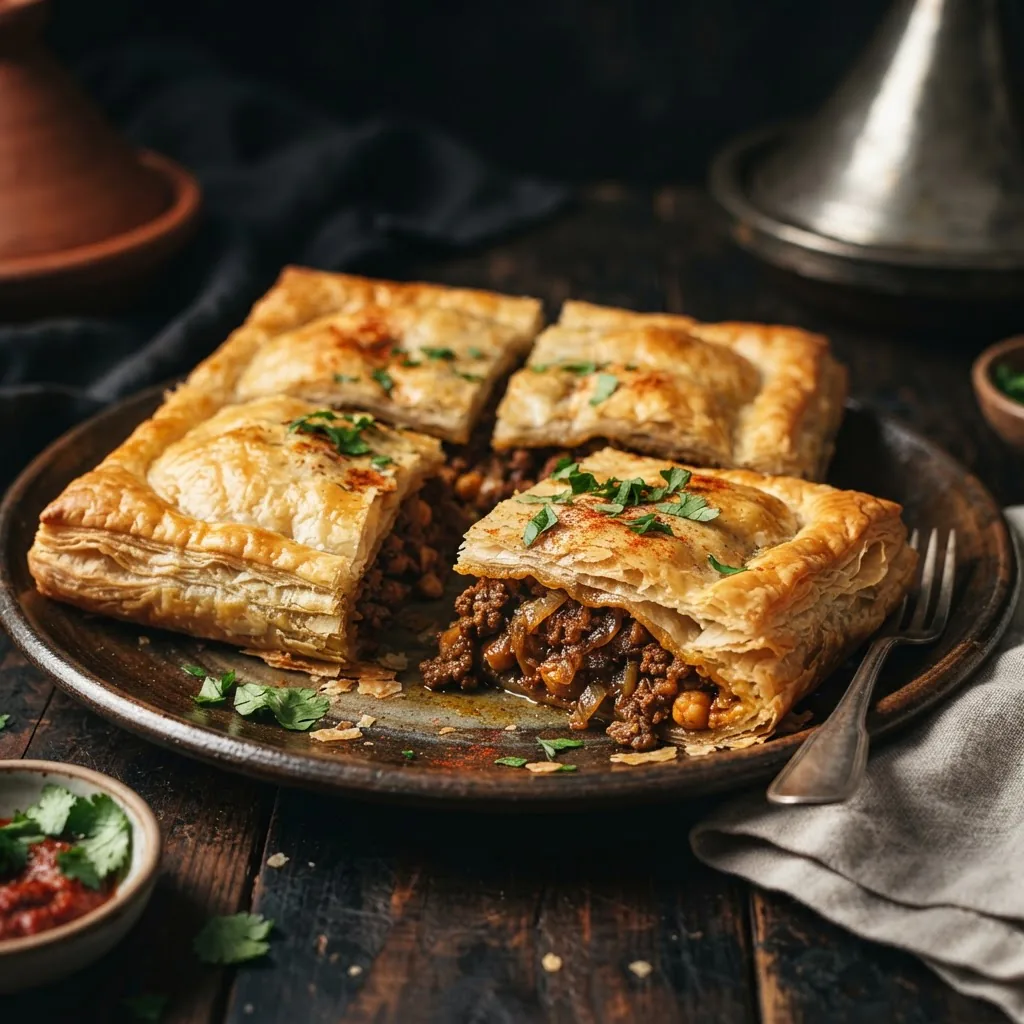
Quantities live in the recipe card.
Ingredients
Doneness & Quality Checkpoints
- The crust's rest, the soft dough's law before the roll
- The filling fried to the groove's line — the dryness the bottom crust's mercy
- The bind's pressed spoonful holding, never weeping
- The seal's crimp and the vents' breath — the pie's own law
- The 20-minute rest before the slice — the setting's patience
Pastel de Carne — The Sephardic Meat Pie of the Double Crust
Prep: 1 h (plus 30 min dough rest) · Cook: 45 min · Total: 2 h 15 min · 8
Ingredients
Ingredients
- For the crust: 400 g flour (about 3 cups), 120 ml mild olive oil (about ½ cup), 1 tsp salt, 1 egg (about 50 g), and 90–100 ml warm water
- For the filling:
- The assembly: 1 egg yolk beaten with a splash of water for the seal and the glaze
Instructions
- **The crust (10 minutes, plus the rest).** The flour and salt whisked; the oil worked in with the fingertips to a sandy, evenly-glistening meal (the oil coating every grain — the tenderness's own insurance). The egg and the warm water added, mixed to a soft, pliable dough, and kneaded barely 1 minute to the smooth ball. The dough rested, wrapped, 30 minutes — the gluten's relax before the roll. Checkpoint — the dough's law: soft and pliable, faintly glossy — not sticky, not stiff; a pressed dent recovering slowly. The rest's 30 minutes is the roll's own mercy — the un-rested oil dough's elasticity fights the pin.
- **The filling (25 minutes).** The oil in the wide pan over medium; the onion softened and faintly gold (about 7 minutes), the garlic and pepper for 3 more. The beef in and broken to the fine crumble, fried to its color's full development — no gray left, the browning's fond building (about 8 minutes) — the tomatoes, cumin, paprika, and cinnamon in, and the mixture simmered 8–10 minutes to the thick, spoonable, near-dry filling. Checkpoint — the filling's dryness's law: the pan's groove drawn through the mixture holds its line several seconds — the wet filling's steam is the bottom crust's own destroyer; the thick, jammy consistency is the pie's insurance.
- **The bind's off-heat entry.** The pan off the heat; the soaked, squeezed breadcrumbs, the beaten eggs, the parsley, the olives, and the chopped hard-boiled egg folded through — the filling's bind and the festive texture's mosaic. Checkpoint — the bind's test: the mixture holding a pressed spoonful's shape, moist but not weeping — the egg and bread's ratio the difference between the set slice and the runny collapse.
- **The assembly (20 minutes).** The oven at 190 °C (375 °F). The dough divided in two (the bottom's share slightly larger); the bottom rolled to the 30 cm round and laid in the oiled 23 cm springform or pie dish, the edge overhanging, the base pricked lightly. The filling spread in the even layer, the top crust rolled and laid, and the edges pressed together with the fork's crimping run. The yolk wash's coat, and two or three steam vents cut at the center. Checkpoint — the seal's law: the crimped edge pressed firmly, the vents' mercy open — the sealed pie's steam has only the crust's own blowout to answer for; the vents are the pie's breathing.
- **The bake (40–45 minutes).** The pie baked at 190 °C until the crust runs deep gold and the vents' steam runs fragrant — the pie's own perfumed announcement. Checkpoint — the doneness's proofs: the crust's even, deep gold (the yolk glaze's lacquer), the filling's bubbling audible at the vent's mouth, and the pie's center faintly springy at the press.
- **The rest and the slice.** The pie rested 20 minutes before the springform's release and the slicing — the filling's setting, the slice's own architecture. Checkpoint — eating test: the crust's tender, flaky-edged yield — the olive oil's own short crumb — giving to the filling's savory, spiced mosaic: the beef's richness, the olive's brine, the hard-boiled egg's richness, the cinnamon's aromatic lift. It should taste like the celebration's centerpiece — the home kitchen's majesty, the family table's own pastel.
Finish & Plate
The pastel rested its 20 minutes, the ring released, and the pie cut in wedges with the serrated knife's saw — the crimped edge's architecture shown at the slice's face, the filling's mosaic (the olive's dark, the hard-boiled egg's gold, the meat's brown) held clean by the bind's set. The table's argument: the pastel needs nothing beyond its own wedge and one sharp, cold thing beside it — the pickled turnip's fire or a lemon-dressed salad's cut through the richness. The first slice out whole is the pie's own report card.
Troubleshooting
| Symptom | Cause | Fix |
|---|---|---|
| Bottom crust soggy | The filling's wetness | The groove's law; the pricked base's 5-minute blind bake |
| Crust tough | The over-knead or the short rest | The 1-minute knead; the 30-minute rest |
| Filling runny at the slice | The bind's shortage or the short rest | The egg-bread ratio; the 20-minute rest |
| Blowout at the seam | The seal's weakness or the vent's absence | The fork's firm crimp; the vents' mercy |
Storage, Make-Ahead & Variations
- The pastel is the make-ahead's own festival food: assembled and refrigerated a day ahead (baked to order), and the baked pie keeps 3 days refrigerated, the slices re-crisped in the 170 °C oven's 12 minutes. The variations: the chicken's own register (the Sabbath remains' economy), the spinach-and-cheese dairy version for the milkhig table, the miniature rolls (the party's own mercy).