Hawawshi
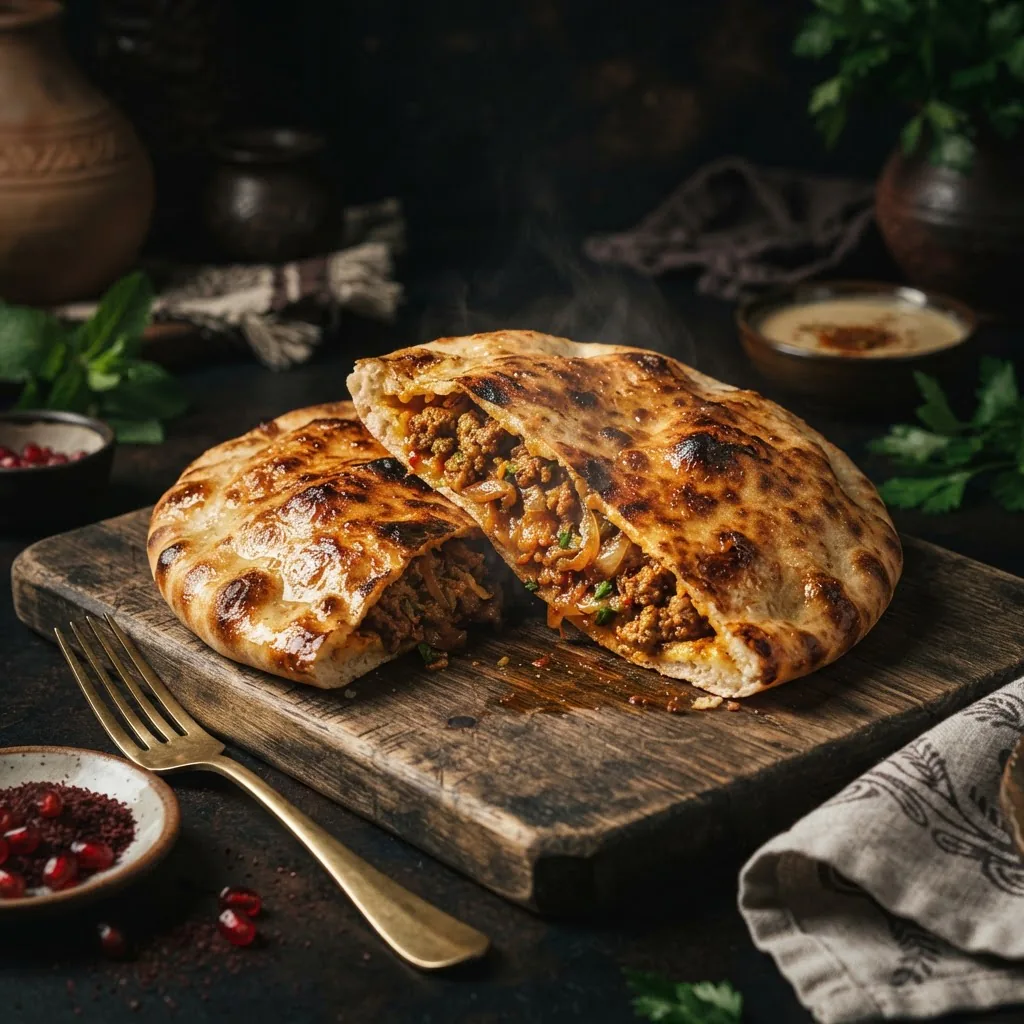
Hawawshi is Egypt's answer to the stuffed bread question: spiced raw kefta sealed inside a round of bread dough and baked until the bread crackles and the meat within steams in its own juices — the butcher's Cairo invention, named for the man who first thought to cook the meat inside its loaf rather than beside it. It arrives as a whole golden dome, cut into wedges at the table, the filling a moist, spice-darkened sheet layered through the crumb like a savory strata. Street versions use baladi bread split and resealed; the home baker's version — this one — makes its own dough and owns the whole architecture.
- **Knead the filling like a dough — it must bind.** The ground meat, grated onion, and spices worked 3–4 minutes with the hand turns from loose mince to a sticky, unified paste that will slice cleanly after baking. A filling merely stirred bakes to crumbles and floods the crumb with grease; the bind is the hawawshi's first craft.
- **The bridge:** baladi bread (the street's shell) bridges with pita for the quick version — split, stuffed thin, and pan-sealed — but the home dough is straightforward and owns the superior ratio of crust to filling. The spices are the souk's basic row; nothing here is hard to find.
Doneness & Quality Checkpoints
- The bind: the filling kneaded to a paste, rested firm.
- The seal: crimped, air pressed out, the juices locked.
- The bake: deep gold, hollow-tapped, rested before the wedge.
Hawawshi
Prep: 40 minutes, plus 1 hour dough rise and 30 minutes resting · Cook: 35 minutes · Total: About 2 hours 50 minutes · Makes 2 hawawshi (serves 4)
Ingredients
The dough
- 400 g flour; 1 tsp instant yeast (about 4 g); 1 tsp salt; 1 tsp sugar (about 4 g)
- 240 ml warm water (about 240 g); 2 tbsp olive oil
The filling
- 500 g ground beef (or lamb, or both — the fat should run 20 percent)
- 1 onion (about 150 g), grated or minced very fine; 4 cloves garlic (about 15 g), grated
- 1 green chili or 1 tsp chile flakes; a large handful parsley (about 20 g), minced
- 2 tsp cumin; 1 tsp coriander; ½ tsp cinnamon; ½ tsp allspice; ¼ tsp black pepper
- 1 tsp salt; 1 tbsp tomato paste (about 15 g); a spoon of #91 harissa or zhug if the house runs hot
- 1 tbsp olive oil
The finish
- 1 egg, beaten, for the crust; sesame or nigella seeds (about 10 g); more harissa and pickled things at the table
Instructions
- **Make and rest the dough (1 hour).** Knead the dough's elements 8 minutes to a smooth, soft ball; oil, cover, and let rise until doubled. Meanwhile, bind the filling as above and let it rest refrigerated 30 minutes — the rest firms it for spreading. Checkpoint — the dough should be soft and supple — softer than bread dough, closer to a loose pizza base — because it must stretch thin around the filling without tearing. The rested filling should hold a spoon's ridge.
- **Shape, fill, seal (15 minutes).** Divide the dough in two; roll one half to a 25 cm round. Spread half the filling to within 2 cm of the edge — an even, thin sheet, barely a centimeter — and fold the empty half over? No: the true hawawshi runs the filling to the edge of the round's half, folds, and crimps; or, simpler and better for the home oven, lay the whole round's worth in a single sheet and top with the second rolled round, pinching the edges into a sealed rim. Press out the air; rest the sealed loaves 15 minutes. Checkpoint — the sealed dome should be flat-topped and tight, the filling locked in — any gap is a vent for the juices, and the juices are the filling's sauce. The 15-minute rest relaxes the dough for the oven's spring.
- **Bake hot and finish (25–30 minutes at 220 °C).** Brush with beaten egg, scatter the sesame or nigella, and bake at 220 °C until deep gold and hollow-sounding at the tap — 25 to 30 minutes, the loaf inflating slightly as the filling steams within. Rest 10 minutes before cutting into wedges. Checkpoint — eating test: the crust's crackle, then the layer within — bread gone savory, stained and softened by the meat's spice and fat, then the kefta itself, juicy, cumin-warm, the chili and parsley arriving behind. It should cut like a cake and eat like a feast, and each wedge should hold together, the filling a sheet and not a scatter. The harissa and pickles at the table do what they always do.
Finish & Plate
Cut in wedges at the table, the cross-section's layering the presentation — no garnish beyond the pickles, the harissa, and the company it was made for.
Troubleshooting
| Symptom | Cause | Fix |
|---|---|---|
| Filling crumbled at the slice | Under-bound mince | The 3–4 minute knead; the 30-minute rest |
| Soggy bottom crust | Filling wet or seal vented | Grated (not chopped) onion; crimp fully |
| Bread raw at the center's depths | Too thick a filling sheet | A centimeter's sheet, no more |
Storage, Make-Ahead & Variations
- The bound filling keeps 1 day refrigerated; the dough keeps 1 day after its rise. Baked hawawshi keeps a day and re-crisps 8 minutes at 190 °C — a genuinely good lunch box. - Variations: the Alexandrian runs cheese into the filling; the street's pepper-heavy version. The #8's siblings on this site: the #25 mombar and the #62 mafroum, all the same binding doctrine.