Dafina with Kouclas — The Dumpling Seat of the Sabbath Pot
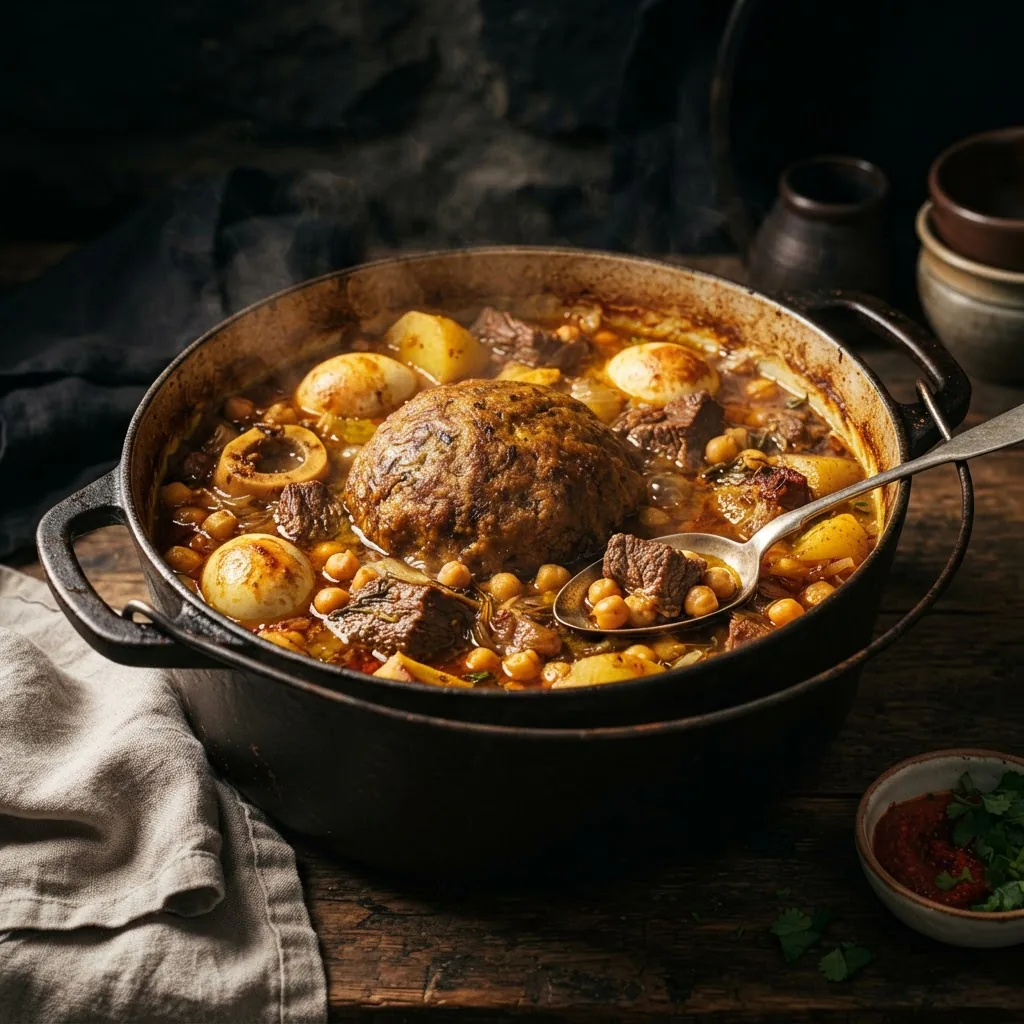
The kouclas are the Sabbath pot's own bread — dense dough balls of flour and oil, dropped into the dfina (#56) before the Friday sealing, overnight-cooked to a dumpling's sodden tenderness in the stew's own honeyed broth. This record is the dumpling's seat; the pot's whole law (the two-pot sweetness separation, the overnight gentleness, the eggs' amber) is the #56's own.
Quantities live in the recipe card.
Ingredients
- **The kouclas law: dense by design, because the overnight broth is the cooking.** These are not light dumplings — the flour-and-oil dough runs stiff and heavy, and the eight slow hours soften it into the slick, broth-soaked ball the table fights over. A tender, yeasted dough would dissolve into the pot's murk by morning; the kouclas holds because it begins nearly inert.
- **The bridge:** the #25 mombar's rice-stuffed doctrine runs the same patience in a casing; the kouclas runs it bare. And the #70's couscous service stands beside this record — the grain, the dumpling, and the egg are the Sabbath pot's three starches, each its own seat.
Dafina with Kouclas — The Dumpling Seat of the Sabbath Pot
Prep: 30 min · Cook: 8 h (overnight) · Total: 8 h 30 min · 8
Ingredients
Ingredients
- For the kouclas: 200 g flour (about 1½ cups), 3 tbsp vegetable oil (about 40 g), ½ tsp salt, and 90–100 ml water
- One batch of the #56 dfina, assembled through its meat-and-bean stage, the kouclas entering before the sealing
- The #73 haminados eggs, per the master's own law
Instructions
- **The dough (5 minutes).** The flour, oil, salt, and water worked to a stiff, heavy dough — stiffer than bread, closer to dry pasta's grip. Rested 10 minutes, then rolled to 8–10 balls (about 40 g each), each pressed dense and smooth with no cracks. Checkpoint — the density's proof: a ball pressed in the palm keeps its shape without springing — the yeasted dough's bounce is wrong here; the kouclas must feel like clay.
- **The entry, per the #56's timing.** The kouclas nestled into the pot's liquid among the meat and beans at the Friday assembly — never dropped into boiling broth, but laid into the cool pot before the sealing — the lid set, the oven's lowest warmth (the master's own 90 °C-and-falling hold) carrying all through the night. Checkpoint — the pot's own law: the kouclas fully submerged or half-steamed under the lid's condensation; the master's sealing law (the foil, the lid) is the dumpling's mercy — a cracked seal dries the kouclas to leather by morning.
- **The Saturday service.** The pot opened at the table's hour: the kouclas lifted with the slotted spoon — swollen, gilded by the broth, slick and yielding — served beside the meat, the beans, and the #73 amber eggs. Checkpoint — eating test: the kouclas' interior should be saturated through — no dry flour's heart at the center — the texture between a matzo ball's feather and a bread pudding's sodden base, tasting wholly of the dfina's honeyed depth. A dry or crumbly center means the seal leaked or the night ran cool; consult the master's troubleshooting row.
Troubleshooting
| Symptom | Cause | Fix |
|---|---|---|
| Kouclas dry, leathery | The seal's leak or the oven's heat | The #56's foil-and-lid law; the lowest warmth only |
| Center still floury | The ball too large or the night too short | The 40 g law; the full overnight's patience |
| Kouclas dissolved into the broth | The dough too soft or the pot at a simmer | The stiff dough's law; the dying warmth, never a bubble |
Storage, Make-Ahead & Variations
- The kouclas exists only within the pot's own keeping — the leftovers store as the dfina's own, the dumplings re-heating sodden and improved. The variations run through the #56's own: the Sephardic Aleppo rice-and-meat version (the kibbeh's Sabbath seat), the chickpea-flour dumpling of the Turkish table. This record's own honesty: it adds the dumpling, not the doctrine — the master (#56) carries the pot.