Debla — Fried Roses in Orange Syrup
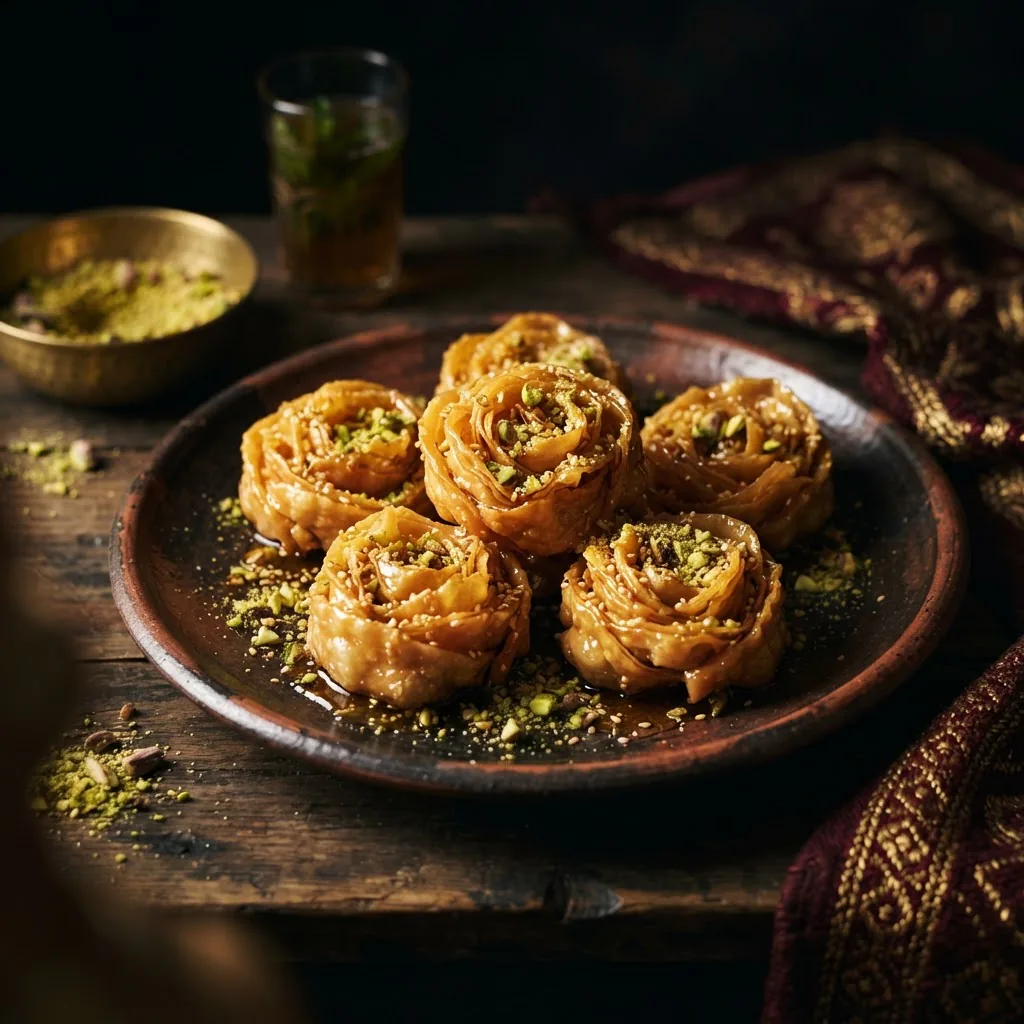
The debla are the fijuelas' (#71) festival sisters — the same stiff, egg-rich dough rolled to ribbons, but wound around themselves into roses before the fry, then soaked through the orange syrup until they glisten like the sweets stall's own glass. Where the fijuela runs the ribbon's freedom, the debla runs the rose's architecture: this record carries the winding craft; the dough and the syrup doctrines are the #71's own.
Quantities live in the recipe card.
Ingredients
- simmered 8 minutes to the light thread
- **The rose's law: the ribbon must be thin enough to wind and thick enough to hold its spiral.** The #71's ribbons fry at their own freedom, but the debla's winding demands the sheet rolled to near-translucence — the 1 mm order — because the rose's petals must fry through in their own folds without the thick dough's raw heart.
- **The bridge:** the #71 master carries the dough's knead law (the 10-minute full development, the 30-minute rest) and the syrup's thread stage; the #6 sfenj runs the street's yeasted counterpoint. The debla's own doctrine is only the wind and the soak — the two-hand craft that turns a ribbon into a rose.
Debla — Fried Roses in Orange Syrup
Prep: 40 min (plus 30 min dough rest) · Cook: 25 min · Total: 1 h 35 min · Makes about 20 roses
Ingredients
Ingredients
- One batch of the #71 fijuelas dough: 300 g flour (about 2¼ cups), 2 eggs (about 100 g), 1 tbsp olive oil (about 12 g), 1 tbsp orange blossom water (about 15 ml), a pinch of salt, and 2–3 tbsp water only if the dough demands
- For frying: 500 ml neutral oil (about 450 g)
- For the syrup, per the #71's own law: 250 g sugar, 180 ml water, 1 tbsp honey (about 20 g), 1 tbsp orange blossom water, and the juice of half a lemon — simmered 8 minutes to the light thread
Instructions
- **The dough and the roll, per the #71.** The dough kneaded to its full smoothness and rested its 30 minutes; then rolled — for the debla, thinner than the fijuela's own — to the 1 mm sheet, the rounds or squares cut to 8 cm. Checkpoint — the sheet's proof: the dough's faint shadow visible through it against the board — the thick patch winds into a raw-hearted rose, and no syrup forgives it.
- **The winding — the rose's craft.** One strip or round wound around two fingers to a loose spiral of 3–4 turns, the tail tucked under and pressed to hold — each debla set tail-down on the tray. The wind's law: loose, not tight — the tight rose's center fries raw while its outer petals burn; the loose spiral's folds hold air and fry through as petals. Checkpoint — the rose's proof: held to the light, the spiral's center shows its hollow — the fingers' own gap still visible — and the tail holds without the pinch's seam (the seam's ridge fries to a hard edge).
- **The fry, per the #71's oil law.** The oil at its 175–180 °C hold; the roses, 4–5 at a time, fried to the deep even gold — about 90 seconds per face, turned once with the spider's care — the petals blistering to fine bubbles at their edges. Checkpoint — the petals' proof: the surface's fine blister — the debla's own signature — and the deep gold, never the pale leather of the undercooked or the dark bitterness of the oil's patience exceeded.
- **The soak and the drain.** Each rose, still hot from the oil, dipped into the warm syrup (the syrup's own warmth against the rose's own heat — the two warmths' marriage soaks deeper than either alone) for 30–45 seconds, then lifted to the rack to set, glistening. Checkpoint — eating test: the syrup's first crunch of glaze giving to the petals' shatter — the rose's folds each their own fried layer, the orange blossom's perfume rising — never sodden (the over-soak's collapse) and never dry (the under-soak's stinginess). It should taste like the festival stall's own window — the Purim table's gold.
Troubleshooting
| Symptom | Cause | Fix |
|---|---|---|
| Rose's center raw | The wind too tight or the ribbon too thick | The fingers' gap; the 1 mm law |
| Rose unwound in the oil | The tail's press too shy | The tuck pressed firmly under the base |
| Roses sodden, heavy | The syrup's over-soak | The 30–45 second dip's law |
Storage, Make-Ahead & Variations
- The syruped roses keep a week in the sealed tin, the glaze softening gradually to the syrup's own humidity — the festival's make-ahead by design. The variations run the #71's own: the honey-only soak, the anise's whisper in the dough, the sesame's scatter after the dip. The master carries the family; this seat carries the rose.