Arroz a la Bomba — The Sephardic Rice Timbale of the Celebration Table
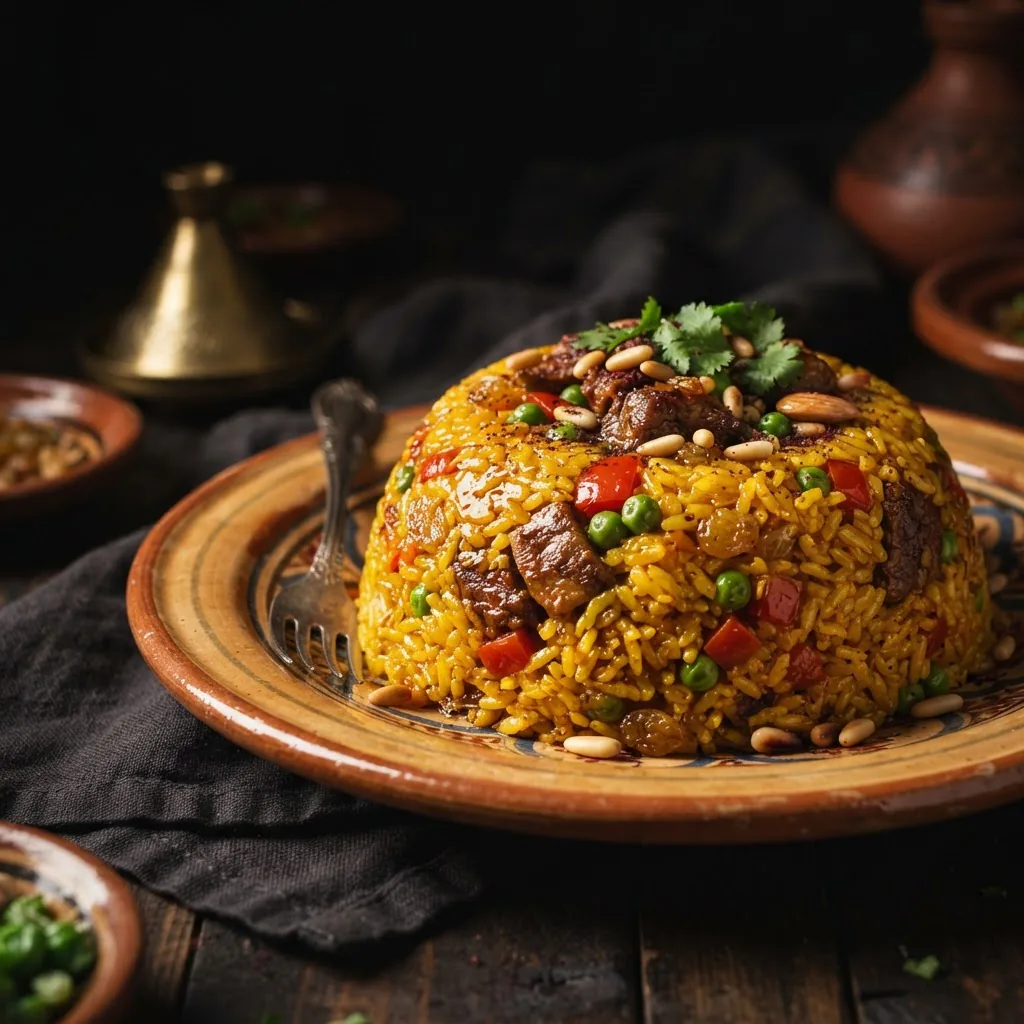
The bomba is the Sephardic celebration table's architecture — rice cooked to a savory richness with chicken, vegetables, and sausage, then pressed warm into a mold and unmolded at the table's center as one gilded crown. It is the #34 couscous's Spanish-Exile cousin: the same mound-and-crown logic of the festive platter, run in the Sephardic kitchen's own grain, the molded timbale that turns a pot of rice into an event.
Quantities live in the recipe card.
Ingredients
- **The timbale's law: the rice cooks moist and clings, because the mold's press demands the bind.** The bomba's rice finishes slightly wetter than a pilaf's separate grain — the final 5 minutes' rest absorbing the last of the stock into a mass that presses and holds its crown's shape at the unmolding. The dry, fully-separate rice of the banquet hall collapses at the bowl's turn.
- **The bridge:** the #34's couscous law (the celebration's grain, the mound, the crown) is the architecture's own ancestor; the #85's difference is the press and the unmolding — the theatrical single turn that the Sephardic tables of Tangier and Livorno ran as the course's own curtain-rise.
Arroz a la Bomba — The Sephardic Rice Timbale of the Celebration Table
Prep: 30 min · Cook: 45 min · Total: 1 h 15 min · 8
Ingredients
Ingredients
- 400 g long-grain rice (about 2 cups), rinsed and drained
- 600 g chicken thighs (about 6), in pieces, or a mix of chicken and 150 g beef, cubed
- 150 g spicy sausage (merguez or the Sephardic salami's register), sliced
- 1 onion (about 200 g), diced
- 3 garlic cloves, minced
- 1 red pepper (about 200 g), diced
- 200 g tomatoes, grated, or ½ can crushed
- 100 g frozen peas (about ⅔ cup)
- 2 carrots (about 200 g), in small dice, blanched 5 minutes
- 1 tsp ground turmeric or 3 threads saffron (about 0.3 g) bloomed in warm water
- 1 tsp sweet paprika
- 1 liter chicken stock or water, hot
- 3 tbsp olive oil (about 40 g), salt and pepper
- The mold: a 2-liter bowl or charlotte mold, oiled lightly; the crust's mercy: breadcrumbs or toasted almond slices
Instructions
- **The meats' brown (12 minutes).** The oil in the wide pot over medium-high; the chicken pieces browned well on both faces (about 8 minutes total — the skin's gold is the broth's own future), lifted out; the sausage's coins fried to their curl and the fat's render, lifted out with the chicken. Checkpoint — the pot's floor carries the browned fond — the amber glaze the next step's onions will lift; a pale floor means a pale broth, and the bomba's depth runs through this browning's honesty.
- **The base and the simmer (30 minutes).** The heat to medium; the onion, pepper, and garlic softened in the fond and fat (about 7 minutes), the tomatoes, paprika, and turmeric in and fried 2 minutes to the darkening, then the rice stirred through to its full coat of the sofrito — every grain gilded. The hot stock poured in with a teaspoon of salt, the meats returned, and the pot simmered covered, the heat at the gentle medium, 20 minutes. Checkpoint — the 15-minute peek: the liquid mostly absorbed, the rice's grains swollen but still faintly firm at the tooth's center — the peas and carrots scattered over now (the late entry keeps their color and shape), the lid set for the final 5.
- **The rest and the press (10 minutes).** The pot off the heat, covered, rested 10 minutes — the last steam finishing the grains to the moist, clinging mass. Then the mixture pressed firmly into the oiled mold — the spoon's back compacting each layer, the surface leveled — and the mold rested 5 minutes while the table gathers. Checkpoint — the press's proof: the rice packed dense enough that the inverted mold holds its contents against a light shake — the press's firmness is the crown's own insurance, and the fear of crushing is misplaced (the grain forgives the press; it does not forgive the loose heap).
- **The unmolding — the table's turn.** The serving plate laid over the mold's mouth, the single confident inversion (the #82 fritada's flip law carried whole — one motion, no hesitation), the mold lifted away to reveal the gilded crown. Checkpoint — eating test: the crown cut in wedges to the plate — the rice savory and moist, each grain carrying the sofrito's color, the chicken's richness and the sausage's fire distributed through the mass, the peas' bright bursts and the carrot's sweetness at the fork's mercy. It should taste like the celebration's own architecture — the everyday grain built into the table's centerpiece, the unmolding's applause earned.
Troubleshooting
| Symptom | Cause | Fix |
|---|---|---|
| Crown collapsed at the unmolding | The rice too dry or the press too shy | The moist finish; the spoon's firm compaction |
| Rice stuck to the mold's face | The mold ungreased | The oil's light coat; the breadcrumb's pavement |
| Rice's center undercooked | The stock's cool entry or the heat's rush | The hot stock's law; the gentle medium's patience |
Storage, Make-Ahead & Variations
- The bomba keeps 3 days refrigerated, the wedges re-warmed covered in the 150 °C oven with a stock-splash's mercy — the crown's second day runs denser and the table's argument holds that it improves. The make-ahead's own law: the pot made a day ahead and pressed cold into the mold, the reheated mold (warm in its 150 °C oven for 25 minutes) unmolding warm at the table's hour. The variations: the Pesach register (the matza farfel's substitution), the sweet finish (the cinnamon-honey crust of the holiday tables), the artichoke's spring seat.