Ojja with Merguez — Eggs Poached in the Sausage's own Fire
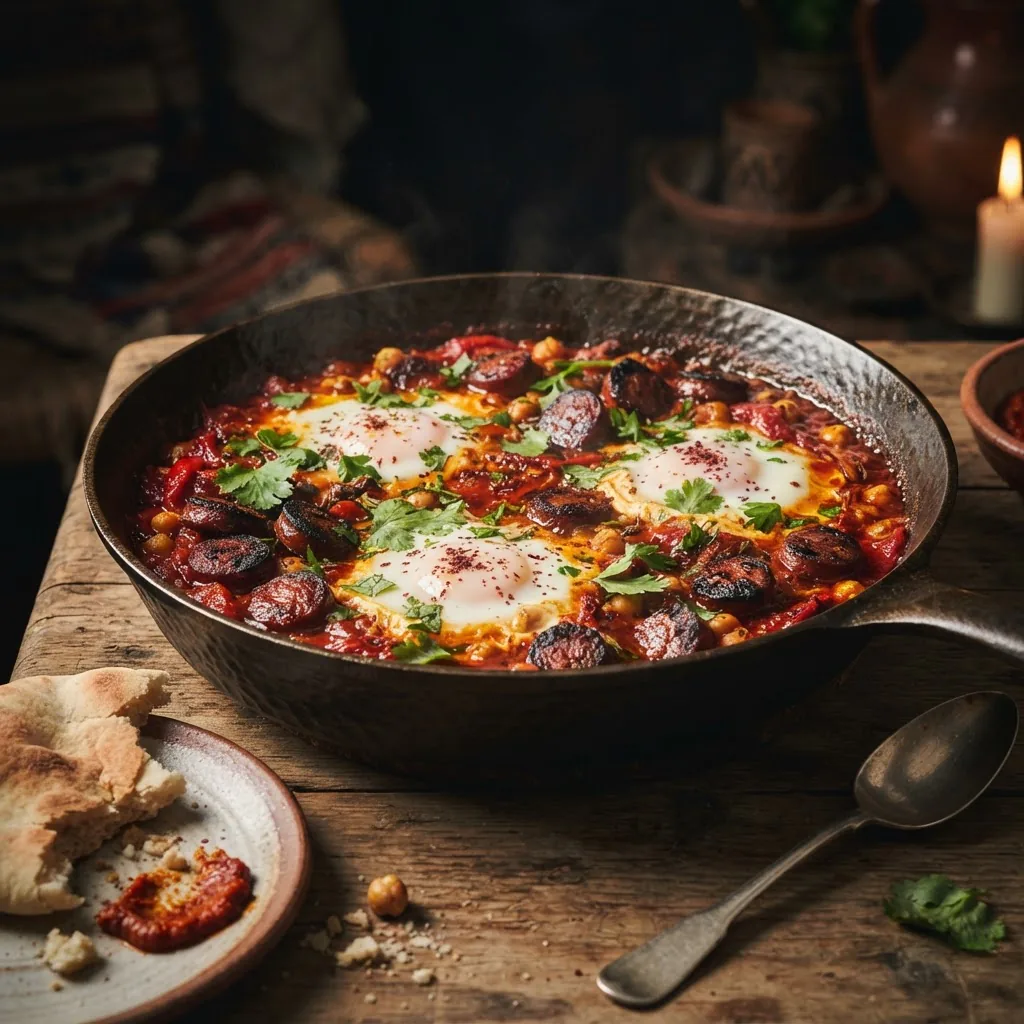
The ojja is the shakshuka family's (#61's) Tunisian-fire sibling: the same eggs poached at a sauce's surface, the pan's architecture unchanged, but the base built on the merguez sausage's own rendered fire — the pepper-tomato pan born from the sausage's fat rather than the oil alone. This record carries the ojja's own dial; the eggs-in-sauce doctrine, the family's history, and the base's reduction law are the #61 master's.
Quantities live in the recipe card.
Ingredients
- only if the merguez runs lean
- the ojja runs hotter than the shakshuka's base
- the Tunisian pan's own signature
- **The ojja's law: the sausage renders first, and the sauce is built in the sausage's own fat.** The merguez is not a topping stirred in late — its coins fried to their crisp edge first, the onions and the harissa bloomed in the red oil that runs from them, the base becoming the sausage's own concentrated fire. This is the single doctrine that separates the ojja from the shakshuka's milder family seat.
- **The bridge:** the #61 master carries the eggs' four-minute law, the base's spoon-trail reduction, the pan-to-table ceremony; the #33 kefta mkaouara runs the same eggs over the meatball's base. The ojja's own honesty: it is the family's hottest seat — the harissa's measure here doubles the master's, because the merguez's richness carries it.
Ojja with Merguez — Eggs Poached in the Sausage's own Fire
Prep: 10 min · Cook: 25 min · Total: 35 min · 4
Ingredients
Ingredients
- 400 g merguez sausage (about 4 links), sliced in 2 cm coins
- 1 tbsp olive oil (about 12 g) — only if the merguez runs lean
- 1 onion (about 200 g), sliced
- 3 garlic cloves, sliced
- 2 tsp harissa (#91) — the ojja runs hotter than the shakshuka's base
- 1 tsp tomato paste (about 15 g)
- 700 g tomatoes, grated, or 1 large can crushed
- 1 green pepper (about 150 g), in ribbons — the Tunisian pan's own signature
- 1 tsp ground cumin, ½ tsp caraway
- 1 tsp salt
- 4 eggs (about 200 g)
- The finish: parsley or cilantro (about 10 g), and the bread (about 300 g)
Instructions
- **The merguez's render (8 minutes).** The oil (only if needed) in the pan over medium; the merguez coins fried to the well-browned crisp edge, the fat running red — the coins lifted out to a bowl as they finish, the rendered fat left in the pan. Checkpoint — the render's proof: a slick of red-orange fat covering the pan's floor — the merguez's own spice and the fat's marriage; the coins browned at their faces but still giving (they return to braise, so the fully-crisp coin runs dry in the finished pan).
- **The base in the sausage's fat (12 minutes).** The onion softened in the rendered fat 5 minutes, the garlic and green pepper for 3 more, the harissa and tomato paste fried 1 minute to their bloom's darkening red — the spices waking in fat, never in the tomato's water — then the tomatoes, cumin, caraway, and salt in, and the pan simmered 8–10 minutes to the spoon's trail. Checkpoint — the #61's own law carried: the spoon's trail holds in the pan's center, the oil's red-gold breaking at the edges — and the taste: the harissa's fire deeper than the shakshuka's (the doubled measure) but rounded by the sausage's fat, which is the whole reason the ojja carries more heat than the master.
- **The return and the eggs (8–9 minutes).** The merguez coins stirred back through the base to their rewarm; the four wells made, the eggs cracked in, the lid set — the #61's four-to-five-minute window at the gentle surface's poach, the pan pulled at the whites' first full set. Checkpoint — the #61's eggs' law, verbatim in its application: the yolks must run at the table's break — the ojja's window is the same as the master's, and the fire below it changes nothing about the eggs' mercy of minutes.
- **The service — the pan's ceremony.** The herbs scattered, the pan to the table's center, the bread at every hand — the ojja runs the shakshuka's own theater entirely. Checkpoint — eating test: the egg's richness and the bread's chew against a base that runs the family's fullest register — the merguez's spice-bright fat, the harissa's slow burn, the caraway's North African signature — the heat honest but carried, never the raw pepper-paste's assault. It should taste like the shakshuka's cousin who stayed home in Tunis and kept the fire.
Troubleshooting
| Symptom | Cause | Fix |
|---|---|---|
| Base tastes of raw pepper paste | The harissa unbloomed | The 1-minute fry in fat before the tomatoes |
| Merguez coins dry, mealy | The coins fried to full crisp at step one | The lift at the browned-but-giving stage |
| Pan's heat uncarried, sharp | The fat's render skipped or poured off | The render's law — the base is built in it |
Storage, Make-Ahead & Variations
- The base keeps 3 days refrigerated and improves (the #61's station law carried) — the eggs always poached at the reheat, never stored in the sauce. The variations: the milder café dial (the harissa halved back toward the master's measure), the squid's coastal seat (the Tunisian market's own ojja), the greens' spring one folded through the base at the rewarm.