Kaak b'Yansoun — Anise Rings of the Sephardic Coffee Tray
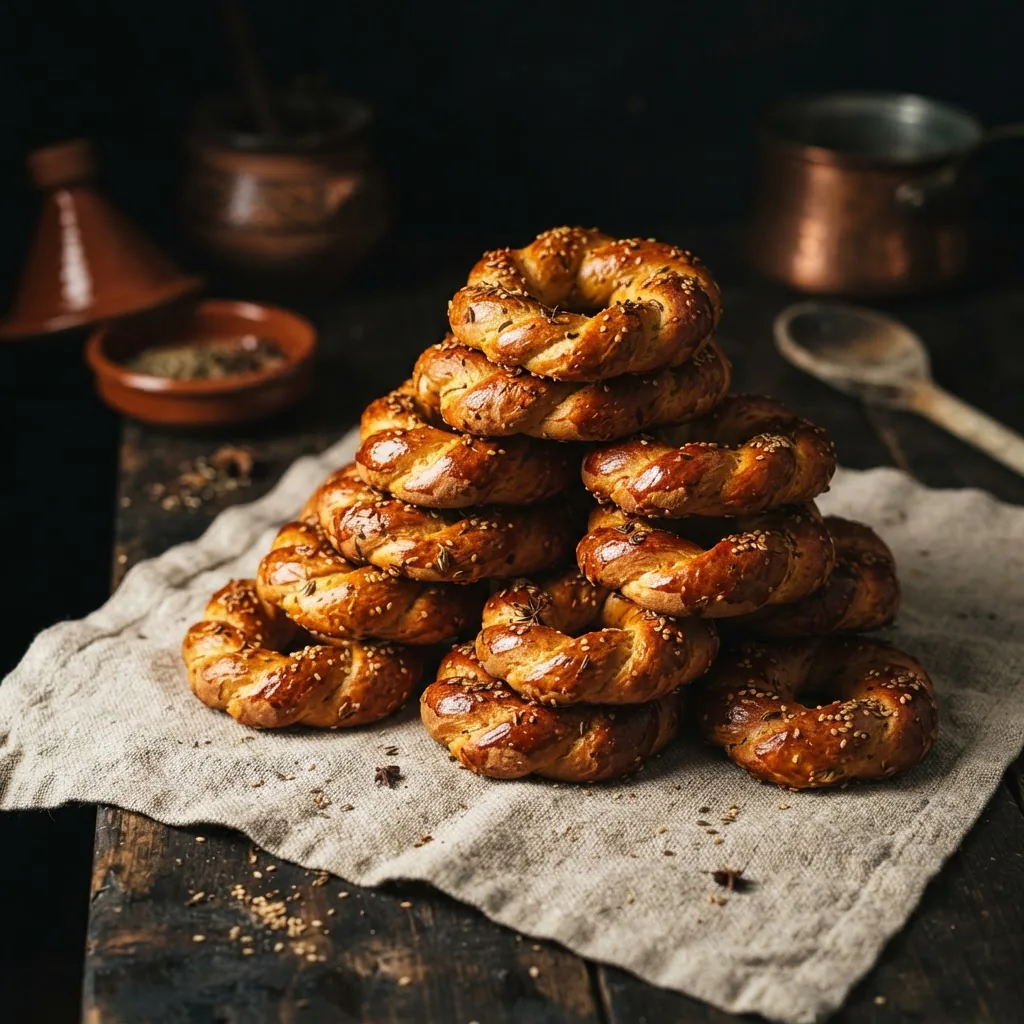
The Sephardic kaak is the street block's #26 warka ring run through the home oven's law — the same ring's architecture, but baked hard and dry rather than fried tender, perfumed with anise and rolled in sesame, the coffee tray's own biscuit that keeps for weeks and softens only in the dip. This record carries the baked ring's doctrine; the kaak's street-fried family is the #26 master's.
Quantities live in the recipe card.
Ingredients
- **The baked kaak's law: a dry dough, a full rise's absence, and a slow bake to the hard keep.** The #26's fried ring runs the enriched dough's tenderness; this record's runs the opposite economy — the dough stiffer, the yeast's work only a light lift (the biscuit's own breath, not the bread's), and the bake long enough at the moderate heat to dry the ring through, because the kaak's keeping quality is its whole point: the coffee tray's biscuit that waits for the guests.
- **The bridge:** the #26 master carries the ring-shaping craft (the rope's roll, the join's press, the even thickness); the #77 mouna runs the festival-bread's enriched counterpoint at the same Sephardic table — the soft brioche of the morning and the hard ring of the afternoon's coffee.
Kaak b'Yansoun — Anise Rings of the Sephardic Coffee Tray
Prep: 35 min (plus 1 h rest) · Cook: 30 min · Total: 2 h 05 min · Makes about 24 rings
Ingredients
Ingredients
- 500 g flour (about 4 cups)
- 7 g instant yeast (about 2¼ tsp)
- 80 g sugar (about ⅓ cup scant)
- 1 tbsp anise seeds (about 8 g), lightly crushed
- 1 tsp baking powder
- ½ tsp salt (about 3 g)
- 2 eggs (about 100 g), beaten, plus 1 for the wash
- 60 ml mild olive oil (about 55 g)
- 60 ml warm water, plus more as the dough demands
- 50 g sesame seeds (about ⅓ cup), for the coat
Instructions
- **The dough (10 minutes, plus 1 hour's rest).** The flour, yeast, sugar, anise, baking powder, and salt whisked dry; the eggs, oil, and water worked in to a stiff dough — stiffer than bread, demanding the heel's push to come together — kneaded 5 minutes to a smooth but dense mass. Covered and rested 1 hour: the yeast's light lift only, the dough rising to a relaxed puff, never doubled. Checkpoint — the dough's law at the hour's end: puffed faintly and relaxed (the stiff dough's own rise runs shallow by design) — the doubled domed loaf's dough belongs to the #77, not here; the kaak's rise is a breath, and the biscuit's snap begins in this restraint.
- **The shaping, per the #26's craft.** The dough divided in 24 pieces (about 40 g each); each rolled under the palms to a rope of 20 cm, joined to a ring with the ends' firm overlap and press — the seam's press doubled back on itself, because the ring's join opens in the oven if trusted to a single pinch. Checkpoint — the #26's own: the rope even along its length and the join pressed flat — the uneven rope bakes to the thin side's brittleness and the thick side's pallor.
- **The wash, the sesame, and the bake (25–30 minutes at 175 °C).** The oven at 175 °C (350 °F). The rings brushed with the egg wash and pressed into the sesame's scatter (or the sesame scattered over), laid on the lined trays with the rings' own breathing room, and baked 25–30 minutes to the deep even gold — the trays turned once at the 15-minute mark — then rested 5 minutes on the tray before the rack. Checkpoint — the bake's proof: the deep gold's evenness and the ring's own hard tap — the underside knocking firm at the fingernail's flick (the baked kaak's finish is dry to the tooth's anticipation, not pale's give) — the oven's moderate law drying the interior through while the color builds; the rushed 200 °C heat gilds the outside and leaves the within leathery.
- **The cooling — the biscuit's own finish.** The rings cooled fully on the rack, at least 1 hour, the hard set completing as they cool. Checkpoint — eating test: the first snap — dry, firm, the anise's perfume and the sesame's toast forward, the sweetness restrained to the coffee's companion register — the ring dipped briefly in the coffee or the tea running the table's whole argument: the kaak is engineered for the dip, the crumb's first softening the moment the biscuit was built for.
Troubleshooting
| Symptom | Cause | Fix |
|---|---|---|
| Rings opened at the join | The single-pinch seam | The doubled-back press |
| Interior leathery, pale | The oven's rush | The 175 °C moderation; the full 25–30 minutes |
| Rings soft in the tin by day three | The warm seal or the underbake | The full cool's law; the hard tap's proof |
Storage, Make-Ahead & Variations
- Keeps 3–4 weeks in the sealed tin at the room's cool — the record's own doctrine; the week-three ring runs hardest and the dip's mercy is the answer. The variations: the Pesach register (the matza meal's flour), the mahlab's sour-cherry whisper of the Aleppo tables, the braided crown for the festival tray — the #26's fried tenderness running the family's soft seat, this record the hard one.