Ta'ameya Falafel
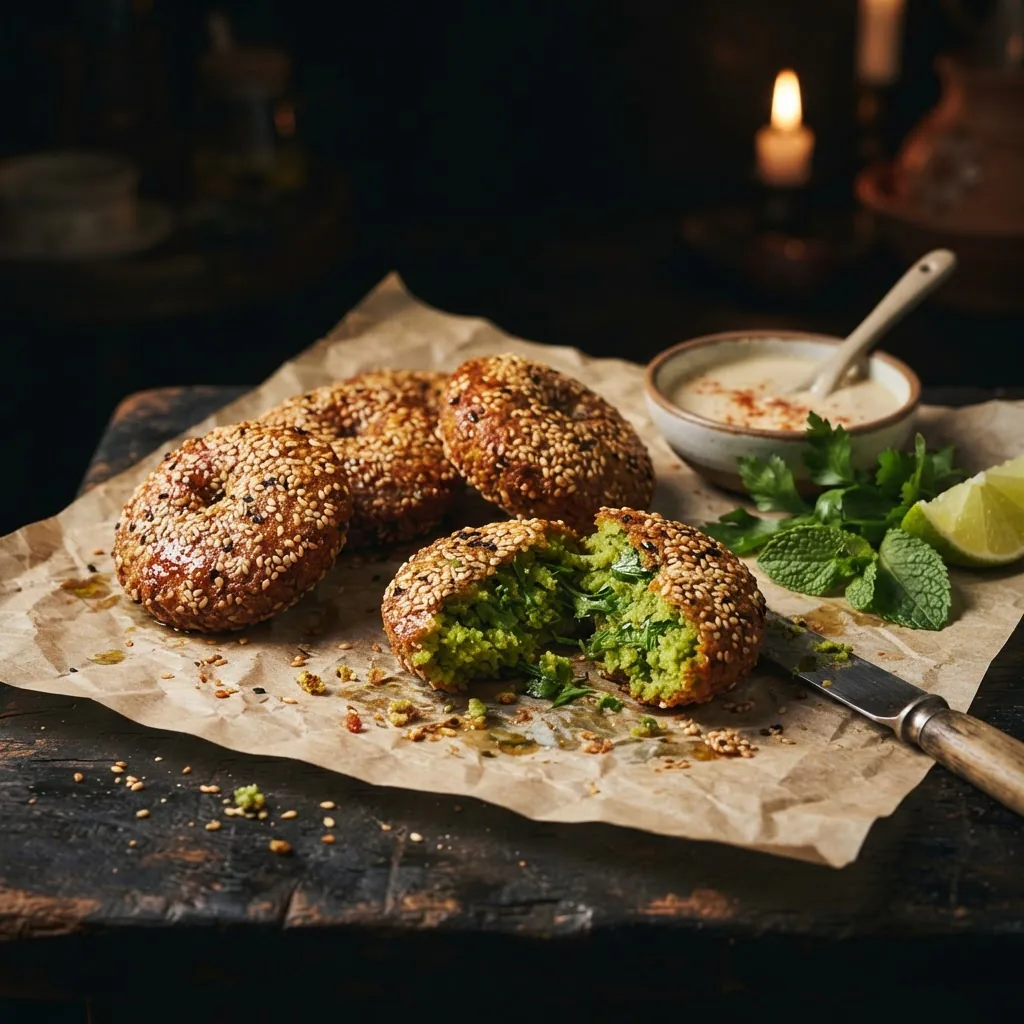
What the world calls falafel, Egypt calls ta'ameya — and Egypt is right about the beans: the original and, in the Egyptian kitchen's settled opinion, the superior falafel is made from dried favas, not chickpeas, and it is green to its heart, packed with parsley and cilantro and dill until the fried cake's interior is the color of the Nile valley. The chickpea version came later and traveled farther; the fava version stayed home and stayed greener. This is the fava original, fried dark, eaten in bread with tahini and the pickled vegetables of the Cairo cart.
- **Soak the favas 12 hours — no cooking, ever.** Ta'ameya fries from raw-soaked beans; cooked favas make a purée that explodes in the oil. The soaked splits should crush easily between fingers but remain raw — that raw starch plus the baking soda is the binder.
- **The herbs are half the recipe by volume.** This is the ta'ameya's green secret — where the chickpea version runs a modest handful, the fava original runs two full bunches, and the interior's green is the authenticity test. Bridge nothing here: both bunches, or it is only a fritter.
Doneness & Quality Checkpoints
- The paste: raw-soaked favas only, two full bunches of herbs, green to the heart.
- The shape: flat, sesame-faced, holding without cracks.
- The fry: deep chestnut gold, once turned, the interior creamed.
Ta'ameya Falafel
Prep: 30 minutes, plus 12 hours soaking · Cook: 20 minutes · Total: About 12 hours 50 minutes (mostly soaking) · Makes about 16 ta'ameya
Ingredients
Ingredients
- 400 g dried split fava beans (peeled), soaked 12 hours
- 1 large bunch parsley (about 50 g) and 1 bunch cilantro (about 50 g), leaves and tender stems
- 6 cloves garlic (about 25 g); 1 green chili or 1 tsp chile flakes
- 1 onion (about 150 g), roughly chopped
- 2 tsp coriander; 1½ tsp cumin; ½ tsp baking soda (the fryer's insurance); 1½ tsp salt
- Sesame seeds (about 30 g) for the crust's faces
- Neutral oil, 4 cm deep, at 180 °C
To serve (the full cart)
- Baladi bread, pita, or the #3's maakouda logic; tahini sauce (4 tbsp tahini, thinned with water and lemon, about 60 g)
- The #104-style pickled turnips or quick-pickled cucumber and onion; a fierce dash of #91 harissa
Instructions
- **Grind to a green paste (10 minutes).** Drain the favas and, in a food processor or the second-fine plate of a grinder, pulse the beans, herbs, garlic, chili, and onion to a fine, moist, very green paste — stopping to scrape and repeat until no whole bean remains, 3 to 4 minutes of processing. Checkpoint — a pinch of the paste should hold together when pressed in the palm, and taste faintly bitter-green, raw, and savory — the herbs forward, the cumin behind. It should be a paste, not a purée: some texture should remain, the beans' grit just perceptible. Blend in the spices, salt, and baking soda last; rest the mix 20 minutes for the soda's bubbles to begin.
- **Shape with the sesame crust.** With wet hands, form flat rounds 6 cm across and 1½ cm thick, pressing each face into a saucer of sesame seeds — the faces seeded, the edges clean. Checkpoint — the disks should be flat and dense-seeded: the sesame fries to a nutted crust that the soft green interior needs. The paste's wetness is right when the disk holds its shape without cracking at the rim.
- **Fry at 180 °C (3–4 minutes a batch).** Slide the disks into the oil, a batch of five or six, and fry undisturbed until the underside is a deep chestnut-gold — then turn once for the second face. Drain, salt lightly, and hold in a warm oven only if you must. Checkpoint — eating test, hot: the crust's dark crunch and the sesame's roast, then the interior — vividly green, soft, almost creamed, tasting of herb and garlic and cumin in a register the pale chickpea version never reaches. The tahini's cool and the pickles' sour complete the sandwich's argument. A cooled ta'ameya is a good fritter; a hot one is the original, and the difference is the whole argument for making them at home.
Finish & Plate
In bread with tahini, pickles, and harissa — the full cart's stack — or on a plate with the tahini as a pool and the pickles beside, the fritters' green interiors opened to the table's eye.
Troubleshooting
| Symptom | Cause | Fix |
|---|---|---|
| Disks fell apart in the oil | Cooked favas, under-processed, or soda skipped | Raw-soaked only; the fine paste; the soda |
| Interior dense, dry | Herbs short or soda over-measured | The two-bunch law; measure the soda |
| Green faded to khaki | Herbs under-loaded or over-fried | Load the herbs; pull at deep gold |
Storage, Make-Ahead & Variations
- The raw paste keeps 1 day refrigerated (the soda's work slows in the cold); the shaped disks freeze 2 weeks on a tray, then bagged — fried from frozen at 175 °C, a minute longer. Fried ta'ameya waits ten minutes. - Variations: the Alexandria school adds leek; the carts that tuck a fragment of soaked fava heart into each disk. The #2 koshari and the #18 lablabi are ta'ameya's Cairo cart-mates on this site.