Harissa — The Pepper Paste That Runs the Kitchen
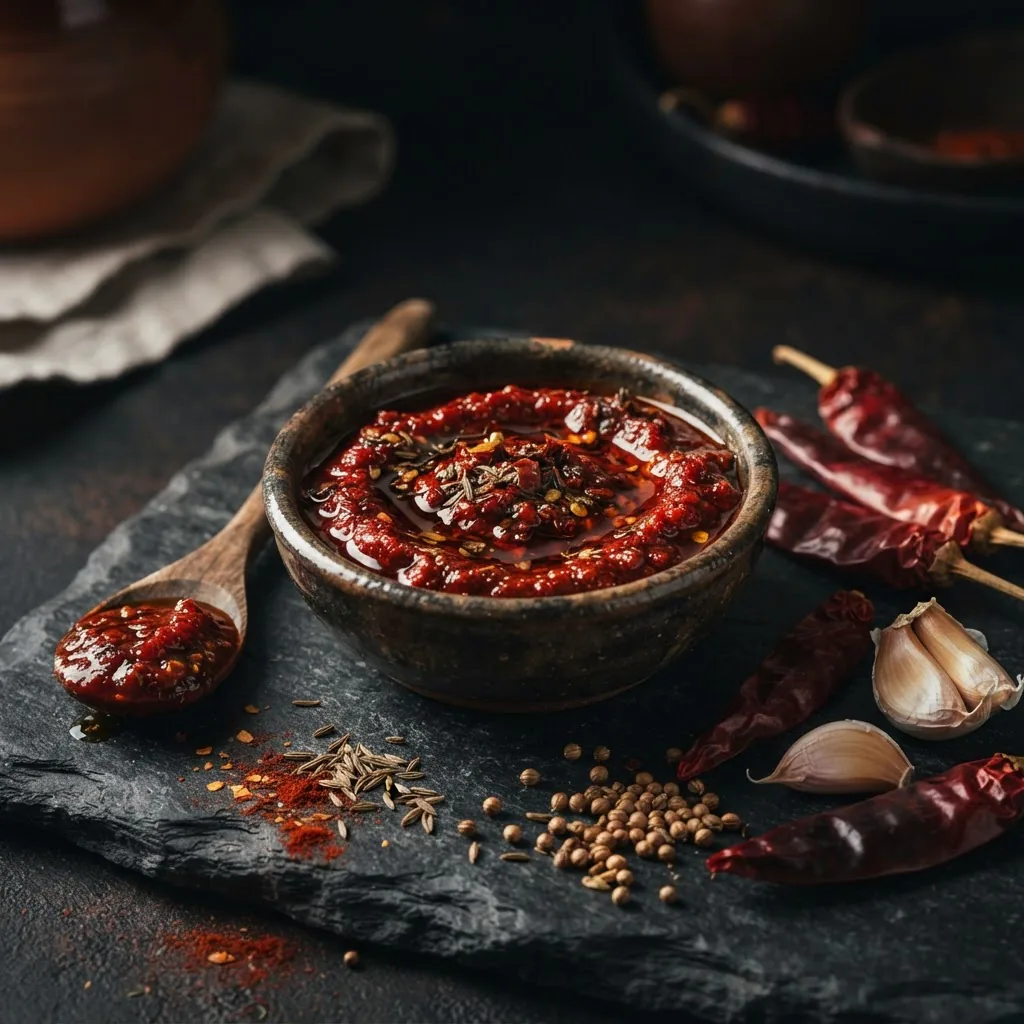
Quantities live in the recipe card.
Ingredients
- the paste's own preservation's law
- the Tunisian market's modern rounding
Doneness & Quality Checkpoints
- The peppers' plumpness — the fresh-pepper's fold at the 45-minute soak's proof
- The paste's spoon-ridge hold — the concentration's whole economy
- The caraway's presence in the foreground — the true harissa's own signature
- The jar's oil seal unbroken — the months' own preservation's law
Harissa — The Pepper Paste That Runs the Kitchen
Prep: 30 min (plus 45 min pepper soak) · Cook: 15 min · Total: 1 h 30 min · Makes about 350 g (one jar)
Ingredients
Ingredients
- 100 g dried red chiles — the honest mix: 60 g mild (New Mexico, guajillo, or ancho) for the body, 40 g hot (chile de árbol, or cayenne) for the fire
- 8 garlic cloves (about 30 g)
- 2 tsp caraway seeds (about 5 g), toasted
- 2 tsp coriander seeds (about 5 g), toasted
- 1 tsp cumin seeds (about 3 g), toasted
- 2 tsp salt (about 12 g) — the paste's own preservation's law
- 1 tbsp tomato paste (about 15 g), optional — the Tunisian market's modern rounding
- 120 ml extra-virgin olive oil (about 110 g), plus more for the seal
- 1 tsp red wine vinegar or the rehydration water's own 1 tbsp, the blender's mercy
Instructions
- **The pepper prep (10 minutes).** The dried chiles stemmed, halved lengthwise, and shaken of their seeds — the seeds' retention runs the paste bitter and gritty, and the honest harissa runs smooth. The halves inspected: the dried pepper's inner face should be clean and faintly glossy; any white mold's bloom or the off-smell's must rejects the pepper whole. Checkpoint — the seed's law: the majority shaken free but the straggler seeds' few survivors accepted — the fully-seeded pepper's patience (the tweezers' road) is the obsessive's waste; the paste's smoothness lives at the blend, not the shake.
- **The soak (45 minutes).** The pepper halves covered in just-boiled water (the water's own 100 °C pour, then the bowl's cooling pace), a small plate or lid holding them submerged, and the 45-minute soak to the full plumpness — the peppers drinking their own weight's near-double in water. Checkpoint — the plumpness's proof at the 45-minute mark: a pepper half folded between the fingers bends like a fresh roasted pepper — supple, thick-fleshed, without the leather's dry snap. The under-soaked pepper runs the paste's grit; there is no rescue later, only the return to the bowl.
- **The toast and the pound (10 minutes).** The caraway, coriander, and cumin toasted dry in the pan over medium — 2–3 minutes to the fragrance's first rising and the seeds' faint color's shift, never the smoke — and ground fine (the mortar's own 5 minutes or the spice mill's 10 seconds). The garlic, the salt, and the ground spices pounded to a paste in the mortar's tradition — or, honestly, the food processor's work: the drained peppers, the garlic, the spices, the salt, and the tomato paste pulsed to the thick, granular-smooth paste, the oil and the vinegar's splash worked in at the end. Checkpoint — the paste's proof: thick enough to hold the spoon's ridge — a harissa that pours is a sauce, and the jar's own concentration is the ingredient's whole economy — and the taste: the garlic's fire, the caraway's citrus-earth signature (the single spice that separates the true harissa from the generic pepper paste), and the heat's slow build rather than the raw pepper's assault.
- **The rest and the taste's settling (15 minutes, or the overnight's honesty).** The paste rested before the final verdict — the raw garlic and the fresh blend run sharper than the settled jar's married fire, and the overnight rest (refrigerated) runs the truest preview. Checkpoint — the settled taste: a spoon's edge on the bread — the heat present and carried, the caraway's perfume forward, the salt's preservation's edge — and behind it all the dried peppers' own fruit, the raisin-sweet depth the fresh pepper never gives. The harissa's whole architecture is this: the sun's concentration, rebuilt in the bowl.
- **The jar and the seal.** The paste packed to the sterilized jar (the jar's own 10-minute boil or the oven's dry sterilization at 120 °C), the surface leveled, and the olive oil poured to the 5 mm seal — the jar's own atmosphere, the paste's own preservation. Checkpoint — the seal's law: the oil's layer unbroken over the whole surface — every use's dip (the clean spoon's own law) re-leveled with the oil's top-up, and the jar's months run honest; the broken seal's paste darkens and molds at the rim's edge within weeks.
Finish & Plate
The harissa's service is the corpus's own running instruction: the spoonful thinned with the oil's own seal for the lablabi's surface (#18), the smear's edge inside the brik's fold (#1), the #86 ojja's doubled measure, the mokaouara's base (#33), the thinned bowl beside the grilled sardines (#14) and the terfess pot (#89). The jar's first opening's ritual: the clean spoon's law spoken aloud at the table — every dip's spoon clean, every use's seal re-leveled — the jar's own covenant, the kitchen's most-repeated small discipline.
Troubleshooting
| Symptom | Cause | Fix |
|---|---|---|
| Paste gritty | The under-soaked peppers | The plumpness's proof before the blend |
| Paste bitter | The scorched spices or the seeds' abundance | The toast's 2-minute law; the shake's majority |
| Jar molded at the rim | The broken oil seal or the double-dipped spoon | The seal's re-level; the clean spoon's covenant |
| Heat flat, one-dimensional | The single-variety peppers | The 60/40 body-to-fire law at the soak |
Storage, Make-Ahead & Variations
- The sealed jar keeps 6 months refrigerated, improving through the first month's marriage — the oil's seal's covenant the whole law. The variations: the rose harissa's boutique dial (the rose petals' and the cinnamon's addition at the blend), the Libyan filfel chuma's sibling (#101's own record), the smoked pepper's autumn register (the chipotle's substitution at the hot pepper's share). This jar is the pantry block's own first stone — the #92's lemons, the #94's ras el hanout, and the #97's tabil standing beside it in the same cupboard's ceremony.