Preserved Lemons — The Jar That Seasons the Tagine Block
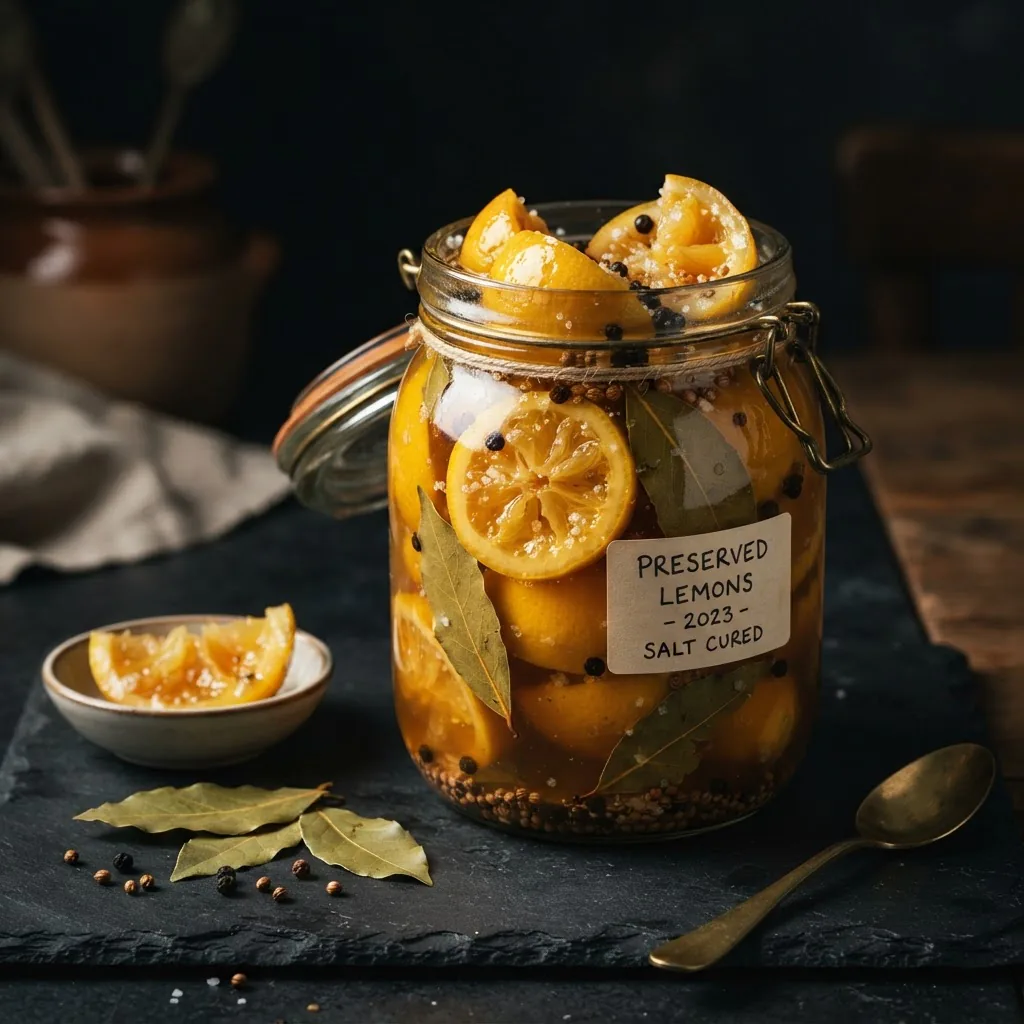
Quantities live in the recipe card.
Ingredients
- the Meyer's mercy where the winter offers it, the standard Eureka's honesty elsewhere
- the non-iodized law, the iodide's bitterness's own bar
- the optional spice's whisper, the Fez school's own
Doneness & Quality Checkpoints
- The hinged quarter-cut — the four petals' join at the base
- The salt's abundance, the 100 g's tally — the preservation's whole architecture
- The juice's submersion of the top lemon's crown — the mold's own bar
- The month's full cure: the translucent-gold pith, the thumb-yield peel, the bitterness gone
Preserved Lemons — The Jar That Seasons the Tagine Block
Prep: 25 min · Cook: No cook (a 3–4 week cure) · Total: 25 min plus the 3–4 week cure · Makes 1 liter jar (about 8 lemons)
Ingredients
Ingredients
- 8 small thin-skinned lemons (about 900 g) — the Meyer's mercy where the winter offers it, the standard Eureka's honesty elsewhere
- 100 g coarse kosher or sea salt (about ⅓ cup and a tablespoon more) — the non-iodized law, the iodide's bitterness's own bar
- The juicing reserve: 4–6 additional lemons (about 400 g juice's yield), or the lemons' own tally if the jar runs generous
- 1 bay leaf, 2 cloves, and 3–4 black peppercorns — the optional spice's whisper, the Fez school's own
- 1 tbsp olive oil (about 12 g), the jar's final seal
Instructions
- **The lemons' prep (10 minutes).** The lemons scrubbed under the running water and dried — the waxed lemon's honesty demands the hot water's scrub and the towel's rub, because the wax seals the cure's own penetration — and each lemon quartered nearly through: the two crossing cuts stopping at the base's 1 cm, the lemon opening like a flower's four petals still joined. Checkpoint — the cut's law: the four quarters held by the base's hinge, opening to the salt's packing and closing again to the jar's press — the fully-cut lemon's loose quarters run the jar's floating anarchy, and the hinged lemon runs the pack's own order.
- **The salt's packing (10 minutes).** Each lemon opened and packed generously with the salt — a tablespoon's abundance (about 15 g) in each flower's heart, the flesh's every face salted — and closed, pressed gently to the salt's first clinging. Checkpoint — the salt's measure's honesty: the abundance rather than the thrift — the lemon's own cure runs at the salt's generosity (the 100 g's tally for 8 lemons), and the salt-shy jar runs the ferment's wrong road (the soft, the slimy, the unsafe), because the salt is not the seasoning here but the preservation's whole architecture.
- **The jar's pack and press (5 minutes).** The salted lemons pressed firmly into the sterilized jar (the 10-minute boil's or the 120 °C oven's own mercy) — each lemon squeezed as it enters, the jar's own space compressing the lemons to their juice's first release — the spice's whisper (the bay, the cloves, the peppercorns) slipped between the layers, and the jar's final lemons pressed until the juice's level rises to the submersion. Checkpoint — the press's proof: the packed lemons submerged in their own released juice — the top lemon's crown pressing below the liquid's line, the extra juiced lemons' juice poured in to the cover's completion. The exposed lemon's crown is the mold's own invitation, and the juice's submersion is the jar's whole covenant.
- **The cure (3–4 weeks at the room's warmth).** The jar sealed and set at the kitchen's cool corner — the room's own 18–22 °C — and the cure's patience begun: the jar inverted gently every 2–3 days at the first week (the salt's redistribution, the juice's circulation), the rind's transformation running its slow course. Checkpoint — the cure's weekly proofs: the first week's foam's faint trace at the jar's edge (the ferment's own honest signature, skimmed and forgotten) — the second week's peel's softening's start — the third and fourth weeks' full transformation: the peel yielding to the thumb's press, the face's pith turning translucent-gold, the whole jar's aroma running the intense, fermented-citrus perfume that the fresh lemon never carries.
- **The verdict and the keeping.** At the month's mark: a lemon quartered and tasted — the peel's bitterness gone whole, the texture's silk, the salt's clean edge — the jar's readiness declared, and the olive oil's 5 mm seal poured (the fridge's keeping's own mercy) for the refrigerator's long months. Checkpoint — eating test: the rinsed peel's slice — soft, intensely lemon-perfumed, the bitterness transmuted to the fermented depth — and the pulp's mash's taste: the acid-salt intensity that seasons the #31's pot at the half-spoon's measure. The two faces run their opposite dials, and both are now the kitchen's own.
Finish & Plate
The jar's first service is the #31 chicken mqualli's own ceremony — the pulp's mash stirred to the pot's body, the rinsed peel's threads scattered over the finished surface — and the jar's months run the whole tagine block's seasoning from there. The pantry block's own trinity sits assembled: this jar, the #91 harissa, and the #94 ras el hanout, the three stones the cuisine's whole architecture stands on.
Troubleshooting
| Symptom | Cause | Fix |
|---|---|---|
| White mold at the jar's surface | The exposed crown or the double-dip | The juice's top-up; the clean fork's law; skim and seal if the catch runs early |
| Peel still bitter at week four | The cure's temperature ran cool | The patience's second fortnight at the warmer corner |
| Jar's liquid low through the cure | The press's shyness at the pack | The juiced lemons' top-up to the submersion's line |
| Peel soft, slimy rather than silk | The salt's thrift | The salt's abundance's law — the next jar's own lesson |
Storage, Make-Ahead & Variations
- The sealed jar keeps 6 months refrigerated (the oil's seal extending the honesty), the lemons improving through the second month's depth — and the used lemon's brine runs the jar's own second life: the marinade's base, the #93 chermoula's liquid, the olives' own curing bath. The variations: the Fez school's spice (the bay-and-clove's whisper, this record's own), the Sfax school's plain salt-only honesty, the blood orange's winter dial at the citrus's season.