Zhug — The Green Fire of the Yemenite Quarter
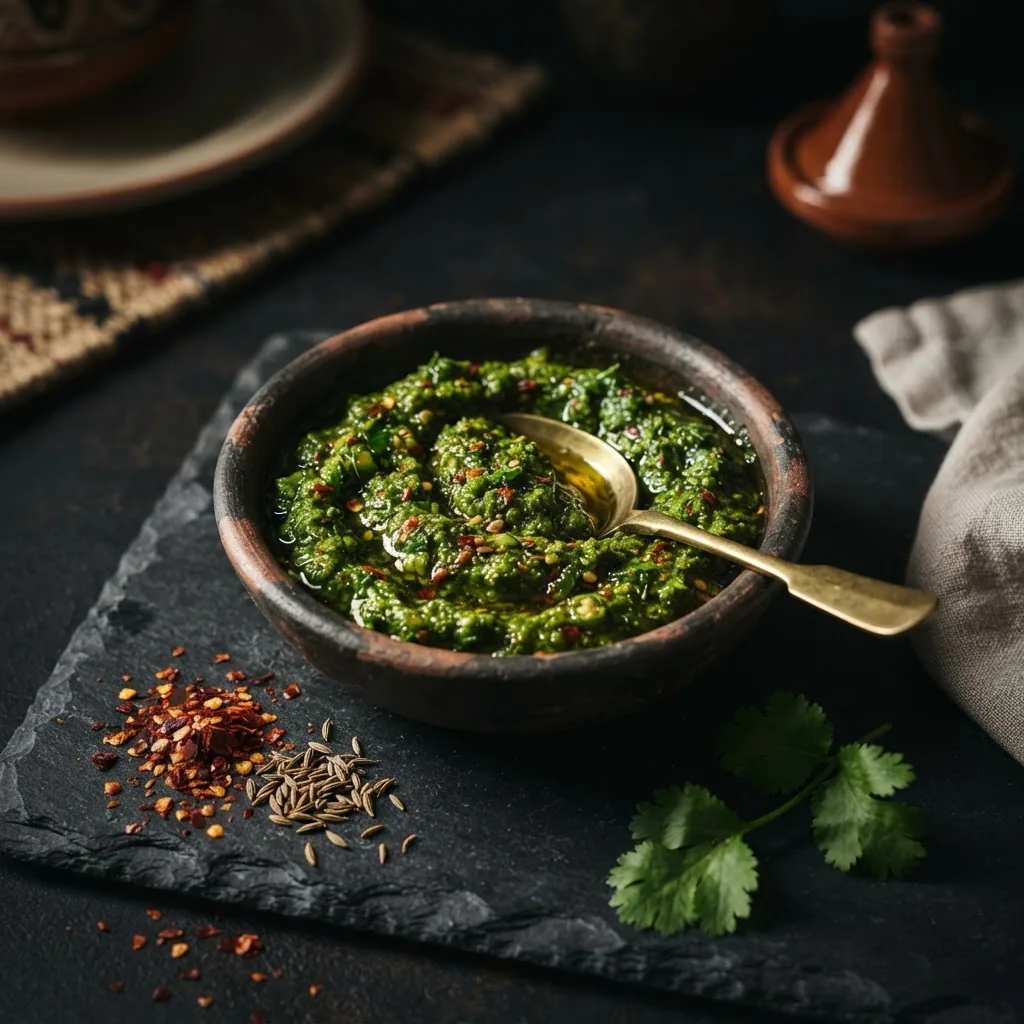
The zhug (sahawiq in the Yemen's own name) is the green pepper-herb paste that the Yemenite kitchens carried to every port they touched — the souk's hottest jar, the cilantro-and-chile emulsion that runs the #9 taameya's table, the #18 lablabi's fire, the #24 harira's own suspended spoon. Where the #91 harissa runs the dried-pepper's round depth, the zhug runs the fresh green's sharp lift: the two fires, two registers, the same cupboard.
Quantities live in the recipe card.
Ingredients
- the milder green's mercy
- the zhug's own signature, the Yemenite quartet's fourth
- **The zhug's law: the herbs' dryness and the paste's rough honesty.** The washed cilantro runs the spinner's or the towel's full dry — the wet herb's paste runs the watery jar and the week's fade — and the finished zhug runs the coarse, granular paste rather than the smooth purée: the pestle's honesty (or the processor's five honest pulses), the texture's crush carrying the fire's release at the bite's own pace.
- **The bridge:** the #91 harissa's record runs the two-fires doctrine's first half (the dried pepper's round depth, the fermentation's option); this jar runs the second — and the corpus's hottest pots (#86 ojja's doubled measure, the #9's table jar) cite both. The green sauce's family map: the zhug at the chile-forward register, the #93 chermoula at the marinade's, the Italian salsa verde at the herb's — three grammars, one cupboard's peace.
Zhug — The Green Fire of the Yemenite Quarter
Prep: 20 min · Cook: No cook · Total: 20 min · Makes about 300 g (one jar)
Ingredients
Ingredients
- 150 g fresh green chiles (jalapeño, serrano, or the green bird's-eye at the hotter register), stemmed
- 1 large bunch cilantro (about 50 g), the tender leaves and stems' top third
- ½ bunch flat-leaf parsley (about 20 g), optional — the milder green's mercy
- 8 garlic cloves (about 30 g)
- 1 tsp ground cumin (about 3 g)
- ½ teaspoon ground cardamom (about 1 g) — the zhug's own signature, the Yemenite quartet's fourth
- ¼ tsp ground cloves (about 0.5 g)
- 1 tsp salt (about 6 g)
- 2 tbsp lemon juice (about 30 ml)
- 60 ml mild olive or neutral oil (about 55 g)
Instructions
- **The prep (10 minutes).** The chiles stemmed (the seeds' retention the heat's own dial — the full seeds at the bird's-eye heat, the majority removed at the jalapeño's mercy); the cilantro and parsley washed and run to the full dry; the garlic peeled. Checkpoint — the herb's dryness's proof: the bunch's squeeze runs no more than the faintest moisture at the towel — the wet herb's jar runs the separation's fade within the week, and the dry herb's jar runs the month's honest green.
- **The pound (10 minutes).** The garlic and salt pounded to the paste's first body; the chiles, the herbs, the cumin, cardamom, and cloves worked through in the mortar's tradition (or the processor's five pulses, the scraper's law between each) to the coarse, granular emulsion — the lemon juice and the oil's stream folded at the end. Checkpoint — the paste's proof: the rough-green texture at the spoon's ridge — the visible herb's fleck and the chile's fragment, never the smooth purée's monoculture — and the smell: the green chile's sharp fire, the cilantro's soap-or-citrus own argument (the table's own division, honestly kept), the cardamom's perfume lifting the whole above the generic pepper-herb paste. The cardamom-and-clove quartet is the zhug's own signature — the Yemenite kitchen's fingerprint that the generic "green harissa" never carries.
- **The jar and the rest.** The paste packed to the clean jar, the oil's 3 mm seal poured over, and the jar rested 30 minutes (or the overnight's marriage at the refrigerator's cool) before the first service — the fire's first settling and the spices' bloom. Checkpoint — eating test: the quarter-spoon's edge on the bread — the green fire's sharp attack (faster and brighter than the #91's round depth — the fresh chile's capsaicin's own register at the front of the tongue rather than the dried's slow build), the cilantro's green run through it, the cardamom's lift at the finish, the lemon's brightness holding the whole jar's freshness. It should taste like the port's own arrival — the Yemenite quarter's fire, the youngest jar in the old cupboard.
Troubleshooting
| Symptom | Cause | Fix |
|---|---|---|
| Jar faded, gray-green by the week | The wet herbs or the light's storage | The full dry's law; the dark cool's jar |
| Fire flat, generic | The quartet's shortcut | The cardamom-and-clove signature — the zhug's own name |
| Paste separated, watery | The smooth purée's overwork | The five-pulse law — the coarse emulsion's body |
Storage, Make-Ahead & Variations
- The sealed jar keeps 2–3 weeks refrigerated (the oil seal's covenant carried from the #91's law), the fire's honesty running brightest through the first week — and the red zhug's sibling (the ripe red chiles' register, the #101 filfel chuma's Libyan cousin) running the same doctrine at the dried-fruit's depth. The variations: the green bird's-eye's heat register, the parsley's milder mercy, the mango's fresh addition at the coastal summer's jar.